

The term ‘sour mash’ confuses many whisky enthusiasts who assume it describes a tart or acidic taste. In reality, sour mash refers to a fermentation technique that recycles spent mash from previous batches to control pH and microbial populations. This method produces remarkably smooth, consistent whiskies prized by collectors worldwide. Understanding sour mash whiskey transforms how you select and appreciate premium bottles, particularly as Australian distillers increasingly adopt this time-tested approach to craft exceptional spirits.
Table of Contents
- Introduction To Sour Mash Whiskey
- The Sour Mash Production Process Explained
- Chemical And Microbial Mechanisms Behind Sour Mash
- Flavor Profile And Aging Characteristics Of Sour Mash Whiskey
- Common Misconceptions About Sour Mash Whiskey
- Comparison: Sour Mash Vs. Other Whiskey Production Methods
- Practical Identification And Relevance For Australian Whisky Enthusiasts
Key Takeaways
| Point | Details |
|---|---|
| Sour mash reuses spent mash | This recycling method controls pH and inhibits harmful bacteria during fermentation. |
| Reduces off-flavors by over 70% | Controlled fermentation environments eliminate unwanted compounds that compromise quality. |
| Flavor is smooth, not sour | The process creates balanced, consistent profiles with subtle sweetness and complexity. |
| Legal requirement for some whiskies | Tennessee whiskey must use sour mash by law, while bourbon may optionally employ it. |
| Growing in Australian craft distilleries | Local producers are adopting sour mash techniques to create distinctive whisky profiles. |
Introduction to Sour Mash Whiskey
Sour mash whiskey represents a fermentation innovation that revolutionized American whiskey production in the 19th century. The process involves adding a portion of spent mash, called backset or setback, from a previous fermentation batch into fresh mash. This technique maintains consistent fermentation conditions across batches, ensuring reliable quality and flavor profiles.
The method differs fundamentally from sweet mash production, where each batch starts entirely fresh without reused material. While sweet mash allows for more variation between batches, sour mash delivers the consistency that premium whiskey brands demand. This reliability makes sour mash the dominant method in bourbon and Tennessee whiskey production.
Historically, distillers discovered that reusing spent mash created more predictable fermentation outcomes. Dr. James C. Crow, a Scottish chemist working in Kentucky during the 1830s, refined the sour mash process into a systematic technique. His innovations established standards still used by major distilleries today.
For collectors and enthusiasts in Australia, understanding sour mash production enhances appreciation for these whiskies’ craftsmanship. When sourcing whisky in Australia, recognizing production methods helps you identify bottles that align with your flavor preferences. This knowledge proves especially valuable as Australian distillers experiment with traditional techniques to create unique local expressions.
- Sour mash ensures batch-to-batch consistency through controlled pH levels
- The process originated in American whiskey traditions but now influences global production
- Recognition of sour mash whiskies improves collecting and tasting decisions
The Sour Mash Production Process Explained
The sour mash process follows specific steps that distinguish it from other whiskey production methods. Understanding these stages reveals why this technique produces such consistent, high-quality spirits.
-
Spent mash collection and storage: After distillation completes, producers reserve approximately 25% of the spent mash, which contains residual yeast cells, nutrients, and the crucial acidic pH that gives the process its name.
-
Mash bill preparation: Fresh grains, typically corn, rye, and malted barley, are milled and mixed with hot water to convert starches into fermentable sugars through a process called mashing.
-
Backset integration: The reserved spent mash combines with the fresh mash, immediately lowering the pH to 4.5-5.5, which creates an inhospitable environment for spoilage bacteria while promoting healthy yeast growth.
-
Controlled fermentation: Fresh yeast strains are introduced to the acidified mash, where they convert sugars to alcohol over 3-5 days, producing the beer-like liquid called distiller’s beer or wash.
-
Distillation in column or pot stills: The fermented wash undergoes distillation, often in continuous column stills that preserve the smooth character developed during fermentation.
Pro Tip: When examining understanding whisky label details, look for pH specifications or fermentation notes that indicate sour mash usage, as these details signal the distillery’s commitment to traditional quality control.
The spent mash acts as a natural buffer, maintaining optimal conditions even when variables like water composition or grain quality fluctuate. This buffering capacity explains why major distilleries achieve remarkable consistency across millions of bottles annually. Each batch inherits the microbial and chemical legacy of previous batches, creating a continuous thread of quality through generations of production.
Chemical and Microbial Mechanisms Behind Sour Mash
The science underlying sour mash production centers on pH control and microbial population management. These factors work together to create ideal fermentation conditions while preventing contamination.
Acidic pH levels between 4.5 and 5.5 inhibit bacterial growth without harming yeast. Most spoilage bacteria prefer neutral or slightly alkaline environments, so the acidic conditions created by spent mash effectively eliminate these threats. This natural antimicrobial action reduces the need for chemical sanitizers that might affect flavor.
Healthy yeast populations thrive under these controlled conditions. The spent mash contains dormant yeast cells and nutrients that jumpstart fermentation when fresh yeast is added. This combination accelerates fermentation onset and maintains vigorous activity throughout the process, converting sugars efficiently to alcohol and flavor compounds.
- Lactic acid from previous fermentations maintains protective pH levels
- Nutrient-rich spent mash supports robust yeast metabolism
- Controlled microbial environments prevent formation of fusels and aldehydes
- Consistent pH reduces variation in enzyme activity during mashing
The sour mash process represents one of the most elegant examples of biological engineering in spirits production, where waste becomes the foundation for quality control.
This scientific precision translates directly to flavor outcomes. Fermentations that avoid bacterial contamination produce clean distillates free from off-notes like vinegar, sulfur, or excessive bitterness. The resulting whiskey carries forward only the intended flavor compounds from grains, yeast, and later barrel aging.
Microbial stability also means distillers can use the same yeast strains continuously, developing house character that distinguishes one distillery from another. These proprietary yeast cultures, maintained through sour mash continuity, become closely guarded secrets that contribute to a brand’s signature profile.
Flavor Profile and Aging Characteristics of Sour Mash Whiskey
Sour mash whiskey typically exhibits smooth, balanced flavors with prominent sweetness from corn and subtle spice notes from rye or barley. The controlled fermentation eliminates harsh compounds, allowing the whisky aging process to develop complexity without fighting against off-flavors.
The clean fermentation base interacts beautifully with oak barrels during maturation. New charred oak imparts vanilla, caramel, and toasted wood notes that complement rather than mask the whiskey’s inherent character. Sour mash whiskies often show enhanced fruit notes, including apple, cherry, and citrus, which emerge more clearly than in whiskies produced with less controlled fermentation.
Batch-to-batch consistency represents perhaps the most valuable characteristic for collectors. While single barrels may vary, sour mash ensures that core bottlings maintain recognizable profiles year after year. This reliability makes building a collection more predictable and enjoyable.
| Characteristic | Sour Mash Whiskey | Non-Sour Mash Whiskey |
|---|---|---|
| Flavor consistency | High across batches | Variable between batches |
| Sweetness level | Prominent corn sweetness | Depends on grain bill |
| Off-flavor risk | Minimal due to pH control | Higher without acid buffer |
| Barrel interaction | Clean base enhances oak | May compete with fermentation notes |
| Aging predictability | Consistent maturation | More variation in outcomes |
Pro Tip: When tasting sour mash whiskey, focus on the mid-palate where smoothness and balance become most apparent. The absence of sharp edges or bitter notes indicates successful fermentation control.
Aging characteristics differ subtly between sour mash and traditional methods. Sour mash whiskies tend to mature more gracefully, developing complexity without excessive tannin extraction. The stable pH throughout production creates compounds that integrate smoothly with barrel-derived flavors, producing harmonious rather than disjointed taste experiences.
Collectors particularly value well-aged sour mash expressions because the foundational quality ensures that extended maturation enhances rather than diminishes the whiskey. Poor fermentation creates compounds that become more aggressive with age, but sour mash eliminates these risks from the start.
Common Misconceptions About Sour Mash Whiskey
Several persistent myths surround sour mash whiskey, creating confusion among enthusiasts and collectors. Clarifying these misconceptions helps you make informed purchasing decisions.
-
Myth: Sour mash whiskey tastes sour or acidic: The ‘sour’ refers exclusively to the fermentation method, not the final flavor. Sour mash whiskies actually taste smooth and often sweet, with no tartness or acidity on the palate.
-
Myth: All American whiskey uses sour mash: While most bourbon and Tennessee whiskey employ this method, not all American whiskies require it. Some craft distillers deliberately use sweet mash for different flavor profiles.
-
Myth: Sour mash is a type of grain or ingredient: Sour mash describes the process of reusing spent mash, not a component of the mash bill. The grains themselves remain unchanged regardless of fermentation method.
-
Myth: Sour mash whiskey contains vinegar or sour ingredients: The acidity comes from lactic acid naturally produced during fermentation, not from added vinegar or acidic substances.
-
Myth: Only Tennessee whiskey uses sour mash: Tennessee whiskey legally requires sour mash, but bourbon, rye, and even some international whiskies may use the technique without being Tennessee whiskey.
Understanding these facts prevents buying based on incorrect assumptions. You might avoid excellent whiskies thinking they taste sour, or overpay for bottles believing sour mash indicates rarity when it actually represents standard practice for many premium brands.
The mash bill, which specifies the grain percentages, operates independently from the fermentation method. A bourbon might use 70% corn, 20% rye, and 10% malted barley regardless of whether it employs sour mash or sweet mash techniques. The process affects fermentation stability and flavor development, not the fundamental grain composition.
Comparison: Sour Mash vs. Other Whiskey Production Methods
Comparing sour mash to traditional sweet mash production reveals distinct advantages and trade-offs that influence whiskey character and collecting value.
| Aspect | Sour Mash Method | Sweet Mash Method |
|---|---|---|
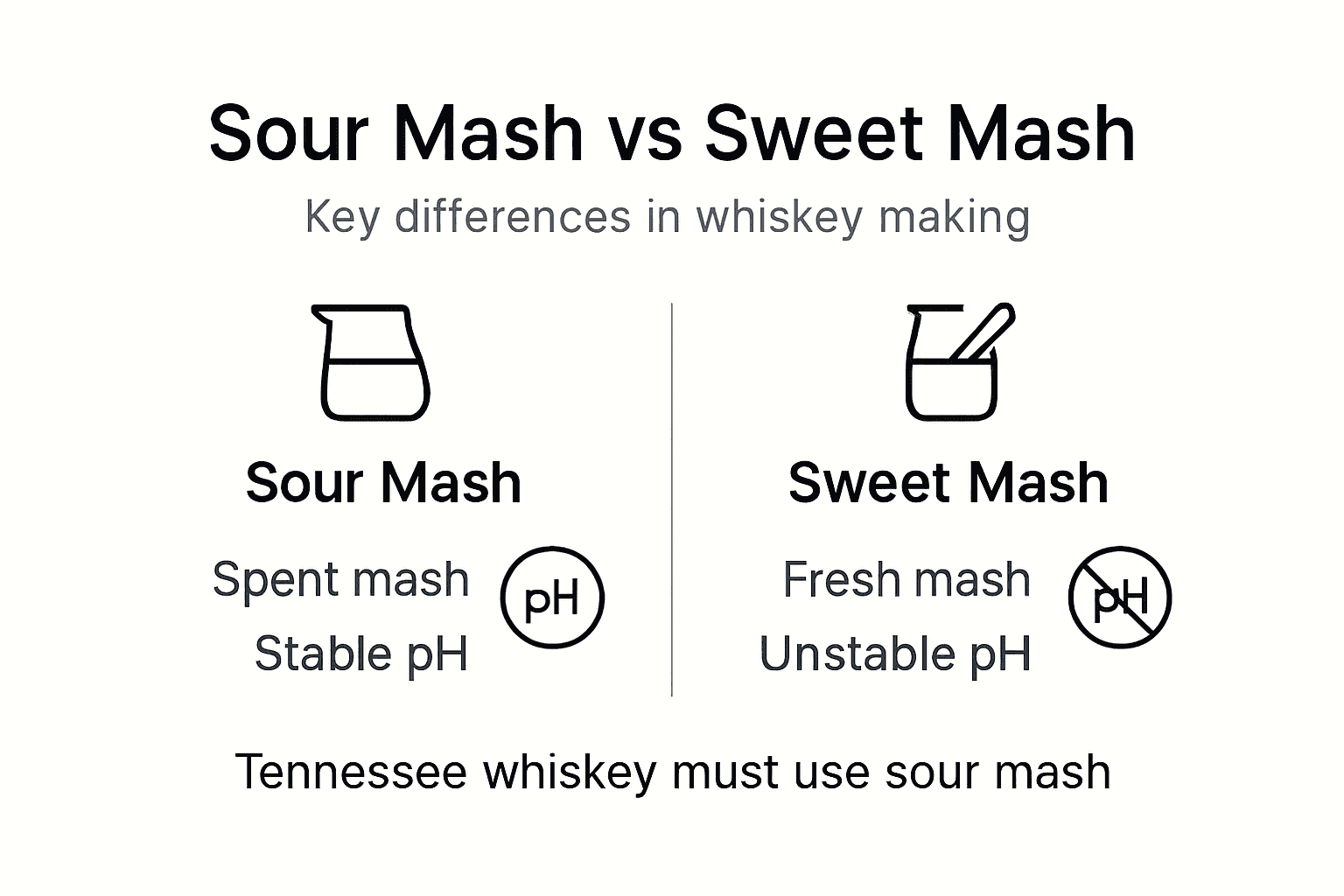
| Spent mash reuse | Yes, 25% from previous batch | No, fresh start each batch |
| pH control | Tightly regulated 4.5-5.5 | Variable, depends on water |
| Fermentation consistency | Very high | Moderate to variable |
| Off-flavor prevention | Superior bacterial inhibition | Requires vigilant sanitation |
| Flavor profile | Smooth, consistent, balanced | More variable, potentially unique |
| Production efficiency | Higher due to faster fermentation | Lower, more monitoring required |
Sweet mash production starts each batch completely fresh without reusing any material from previous fermentations. This approach allows greater flexibility and potentially more distinctive batch variation. Some craft distillers prefer sweet mash because it permits experimentation without carrying forward characteristics from previous runs.
However, sweet mash requires more careful monitoring and sanitation. Without the natural antimicrobial protection of acidic spent mash, bacterial contamination poses greater risks. Distillers must rely on chemical sanitizers and meticulous cleaning protocols to maintain quality.
- Sour mash advantages: Consistent quality, reduced spoilage risk, efficient fermentation, smooth flavor profiles
- Sour mash considerations: Less batch-to-batch variation, requires continuous production rhythm
- Sweet mash advantages: Greater experimental freedom, potential for unique batches, no dependency on previous runs
- Sweet mash considerations: Higher contamination risk, more variable outcomes, intensive monitoring needed
For collectors exploring Australian whisky types, both methods appear in local production. Established distilleries often adopt sour mash for flagship products requiring consistency, while craft producers might use sweet mash for limited experimental releases.
Regional practices also differ. American whiskey production overwhelmingly favors sour mash, with estimates suggesting over 80% of bourbon uses the technique. Scottish and Japanese distillers traditionally employed different methods, though some now experiment with sour mash principles to achieve specific flavor goals.
Legal definitions create additional distinctions. Tennessee whiskey must use sour mash by law, while bourbon has no such requirement despite widespread adoption. These regulatory frameworks influence production decisions and affect how whiskies are marketed and perceived.
Practical Identification and Relevance for Australian Whisky Enthusiasts
Identifying sour mash whiskies requires attention to label language, legal classifications, and regional production standards. Several clues help you recognize these bottles.
Tennessee whiskey automatically indicates sour mash usage because state law mandates this process. Any bottle labeled Tennessee whiskey, including famous brands like Jack Daniel’s and George Dickel, uses sour mash production regardless of whether the label explicitly mentions it.
Many bourbon brands voluntarily highlight sour mash on their labels as a quality indicator. Look for phrases like