

Every collector faces the moment where passion meets potential profit, especially as rare whisky becomes a favourite among Australian investors. With the global rare whisky market projected to expand by around 10.7% annually through 2033, more people are viewing premium bottles as a legitimate way to diversify their portfolios. This guide details how to set clear investment goals, evaluate risk, and understand what truly drives value in sought-after whiskies.
Table of Contents
- Step 1: Assess Your Whisky Investment Goals
- Step 2: Research Premium And Rare Whisky Markets
- Step 3: Select Bottles With Strong Investment Potential
- Step 4: Verify Authenticity And Track Market Value
- Step 5: Store And Manage Your Whisky Portfolio
Quick Summary
| Key Insights | Explanation |
|---|---|
| 1. Define Your Whisky Investment Goals | Understand if you seek financial return, collection pride, diversification, or a hybrid approach, as this shapes your purchasing strategy. |
| 2. Research the Whisky Market Dynamics | Track growth trends and key value drivers to make informed purchasing decisions in the expanding whisky market. |
| 3. Select Bottles with Genuine Investment Potential | Focus on distillery reputation, rarity, and age statements to identify whiskies likely to appreciate over time. |
| 4. Verify Authenticity and Market Value | Conduct thorough inspections and track market values to ensure your whisky collection remains valuable and genuine. |
| 5. Properly Store and Manage Your Portfolio | Maintain optimal storage conditions and regularly review your portfolio to protect your investments and strategise effectively. |
Step 1: Assess your whisky investment goals
Before you buy your first bottle, clarify exactly why you’re investing in whisky. Are you chasing financial returns, building a personal collection, or both? Your answer shapes every decision that follows.
Start by defining your primary objectives:
- Financial returns: You want your whisky to appreciate in value and eventually sell at profit
- Collection pride: You enjoy owning rare, prestigious bottles regardless of resale potential
- Portfolio diversification: You see whisky as an alternative asset class separate from stocks and bonds
- Hybrid approach: You want some bottles to appreciate while others bring personal enjoyment
Your investment goals determine your purchasing strategy, budget allocation, and holding timeline. Get this right first, and everything else becomes clearer.
Next, assess your risk tolerance. Whisky investing isn’t like buying blue-chip shares. Some bottles hold value beautifully; others plateau or decline. Research shows that vintage age and distillery reputation significantly influence price outcomes, so you need to understand which variables matter most to your goals.
Think about your timeline too. Are you holding for 3 years, 10 years, or longer? Short-term flippers face higher storage costs and market volatility. Long-term collectors can weather price fluctuations more comfortably.
Consider your budget honestly. How much capital can you allocate without affecting daily living costs? Whisky investment provides diversification benefits when integrated properly into your overall portfolio, but only if you invest responsibly.
Finally, determine your exit strategy. How will you sell when the time comes? Auction houses, private buyers, retailers? Understanding your exit route before buying prevents poor decisions later.
Here’s how whisky investment objectives impact buying decisions:
| Objective | Buying Approach | Holding Timeline | Typical Exit Route |
|---|---|---|---|
| Financial return | Focus on appreciating bottles | 3-10 years | Auction or private sale |
| Collection pride | Personal enjoyment & rarity | Indefinite | Seldom sell, keep in collection |
| Portfolio diversification | Blend with other assets | Flexible | Sell as needed for rebalancing |
| Hybrid approach | Balance return with enjoyment | Mixed (short & long) | Multiple, based on bottle purpose |
Pro tip: Write down your three main investment goals on paper, plus your risk tolerance and holding timeline. This becomes your decision filter when tempting bottles arrive on the market—use it to stay disciplined.
Step 2: Research premium and rare whisky markets
Understanding market dynamics separates smart investors from impulse buyers. You need to know what’s actually happening in the whisky investment space before committing your capital.
Start by tracking rare whisky market growth trends. The global rare whisky market is expanding at around 10.7% annually through 2033, driven by wealthy collectors seeking alternative investments. This growth creates opportunities, but also means prices are rising—knowing the trajectory helps you time your entries strategically.
Research the key market drivers affecting whisky values:
- Distillery heritage: Scotch from closed or iconic distilleries commands premiums
- Bottle rarity: Limited releases and discontinued expressions hold stronger value
- Age statements: Older whiskies generally appreciate faster than younger ones
- Condition: Original packaging, labels, and proof levels significantly impact price
- Auction results: Recent sales data reveals what collectors actually pay for comparable bottles
Whisky represents a distinct alternative asset class with unique price drivers separate from stocks and bonds. Study these drivers before making purchase decisions.
Investigate specific auction platforms and pricing indices. Rare whisky auction platforms and price indexes provide transparent market data showing historical prices and recent transactions. Whisky-focused sites track comparable sales, helping you assess whether a bottle is priced fairly or inflated.
Join whisky collector communities online. Forums, social media groups, and collector networks share real-time market insights you won’t find in official sources. Experienced investors discuss emerging trends, authentication concerns, and value trajectories before they become obvious.
Watch for geographic trends too. Australian whisky investment is gaining momentum, alongside established Scottish and Japanese markets. Understanding regional preferences helps you spot undervalued bottles before demand rises.
Finally, subscribe to auction house catalogues from major players. Preview upcoming sales to see what’s coming to market and at what estimate prices. This intelligence shapes your purchasing strategy.
Here’s a summary of key market drivers influencing whisky value:
| Market Driver | Impact on Value | Example Scenario |
|---|---|---|
| Distillery heritage | Premium for reputation | Closed Scottish distilleries |
| Bottle rarity | Higher prices for scarcity | Limited edition releases |
| Age statement | Older = faster appreciation | 25+ year expressions |
| Condition | Preserved state boosts price | Original packaging, intact labels |
| Auction results | Reveals actual collector demand | Recent record-breaking sales |
Pro tip: Create a spreadsheet tracking bottles you’re interested in, their recent auction prices, and price trajectories over 6 months. This data reveals which whiskies are genuinely appreciating versus those stuck in stagnant price ranges.
Step 3: Select bottles with strong investment potential
Not all bottles appreciate equally. Selecting whisky with genuine investment potential requires understanding which attributes drive long-term value and which ones fade over time.
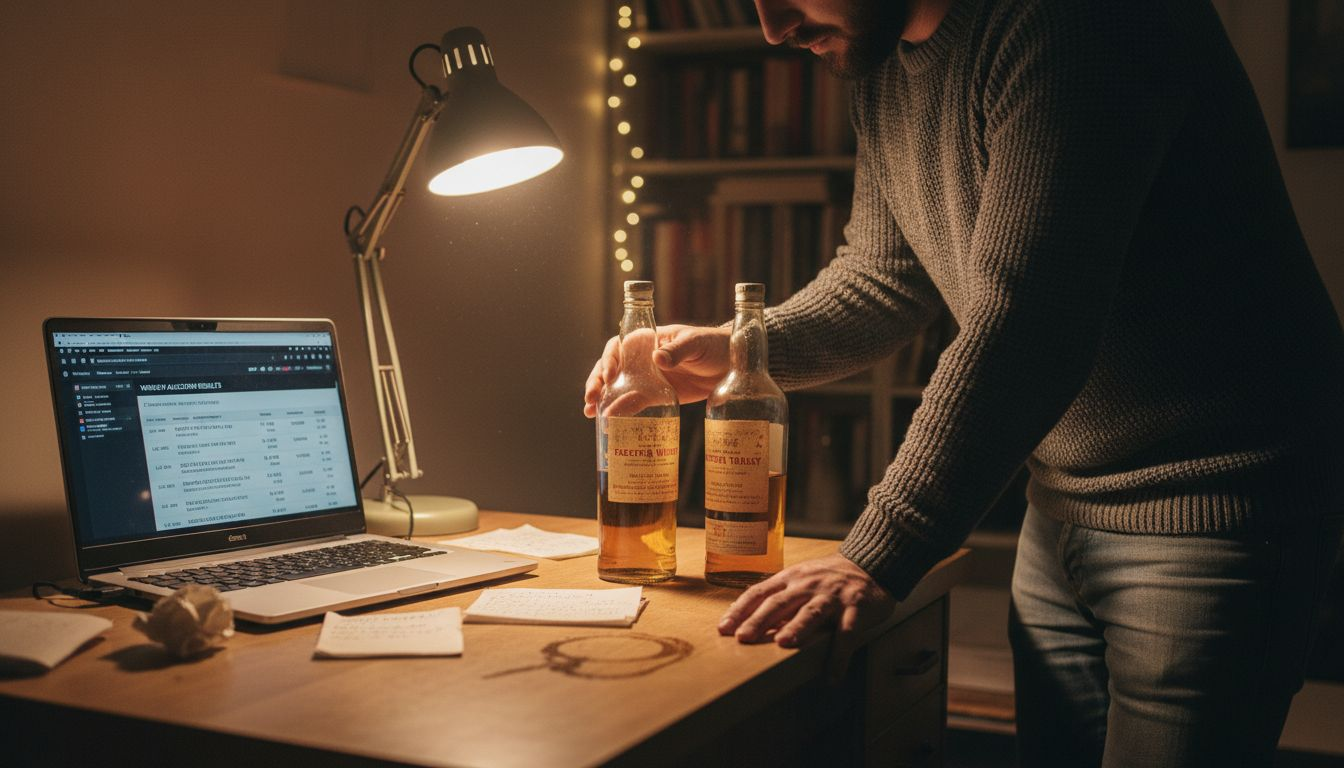
Focus on three core selection criteria. First, prioritise distillery reputation. Established Scottish distilleries like Macallan, Bowmore, and Dalmore command premium prices because collectors trust their quality and heritage. Japanese whisky from Yamazaki and Hibiki similarly holds strong value. Australian whiskies are emerging as promising investments too, as regional demand grows.
Second, seek rarity and discontinuation. Whiskies that are no longer produced appreciate faster than active production lines. Rare and discontinued whiskies from prestigious distilleries such as Macallan’s Anniversary series offer particularly strong investment potential. Limited editions, special releases, and closed distillery stocks attract serious collectors willing to pay premiums.
Third, assess age statements and proof levels. Older expressions generally hold value better than younger ones. Cask strength or natural proof variants often perform better than heavily diluted versions because collectors perceive them as more authentic.
Evaluate bottle condition carefully:
- Original packaging: Unopened bottles in pristine condition command 20-40% premiums
- Label integrity: Faded, damaged, or missing labels significantly reduce value
- Fill level: “Shoulder” fill or higher is critical for long-term holding
- Capsule condition: Original, undamaged capsules signal authenticity
- Proof consistency: Bottles matching declared alcohol content are more valuable
Market timing matters. Recent corrections create opportunities to acquire valuable bottles when prices dip, giving you stronger long-term upside potential.
Avoid common selection mistakes. Don’t chase trends blindly—just because a bottle is expensive doesn’t mean it will appreciate. Don’t overlook provenance either; bottles from reputable sellers with documented history outperform mystery purchases from unclear sources.
Research comparable sales before committing capital. Look at auction results for identical or very similar bottles sold in the past 12 months. If a bottle hasn’t sold recently at auction, it may be difficult to liquidate when you need to sell.
Pro tip: Build a diversified selection across different distilleries, ages, and regions rather than loading up on a single bottle or producer. This reduces risk if one category falls out of favour whilst others appreciate.
Step 4: Verify authenticity and track market value
Counterfeit whisky exists. High-value bottles attract forgers, so verifying authenticity before purchasing is non-negotiable for serious investors. You also need systems to track your bottles’ market value over time.
Start with visual inspection. Examine the bottle carefully for inconsistencies that suggest counterfeiting. Check label printing quality, font consistency, and colour accuracy against known authentic examples. Inspect the capsule for proper sealing and original manufacturer marks. Look for signs the bottle has been opened or refilled. Any irregularities warrant further investigation before committing capital.
Request provenance documentation. Reputable dealers provide purchase receipts, auction house catalogues, or chain-of-custody records proving the bottle’s history. This documentation protects your investment and makes future sales easier. Bottles with unclear provenance carry significantly higher risk regardless of condition.
For high-value acquisitions, consider scientific authentication methods using elemental profiling. Advanced techniques measure manganese, potassium, phosphorus, and sulphur levels that reveal aging authenticity and confirm provenance. Whilst testing costs money, it’s insurance for five or six-figure purchases.
Track market value systematically using these methods:
- Auction databases: Record what comparable bottles sold for at major houses
- Whisky pricing platforms: Subscribe to services tracking real-time market data
- Dealer quotations: Get annual valuations from reputable retailers
- Personal spreadsheets: Log purchase price, current estimates, and sale dates
- Insurance appraisals: Professional valuers provide documented assessments
Chromatographic and spectroscopic techniques combined with chemometric methods now provide reliable authentication, giving investors scientific assurance about quality and provenance.
Update your valuations quarterly. Market prices shift based on distillery news, collector trends, and supply changes. Tracking trends reveals which bottles are appreciating and which are stagnating, informing future purchasing decisions.
Build relationships with auction houses and specialist retailers. They provide market intelligence before prices shift publicly. They also alert you when comparable bottles arrive on the market, helping you benchmark your collection’s value against actual sales.
Stay alert to authentication red flags. If a seller pressures you, avoids questions about provenance, or offers suspiciously low prices, walk away. Authentic investment bottles sell confidently with complete documentation.
Pro tip: Photograph every bottle from multiple angles immediately after purchase, recording serial numbers and any unique characteristics. Store these images digitally and in printed form separately from the bottles themselves. This documentation proves authenticity if disputes arise.
Step 5: Store and manage your whisky portfolio
Proper storage protects your investment’s value. Poor storage conditions degrade bottles, destroy labels, and tank resale prices. Managing your portfolio systematically ensures you know what you own and can act strategically when opportunities arise.
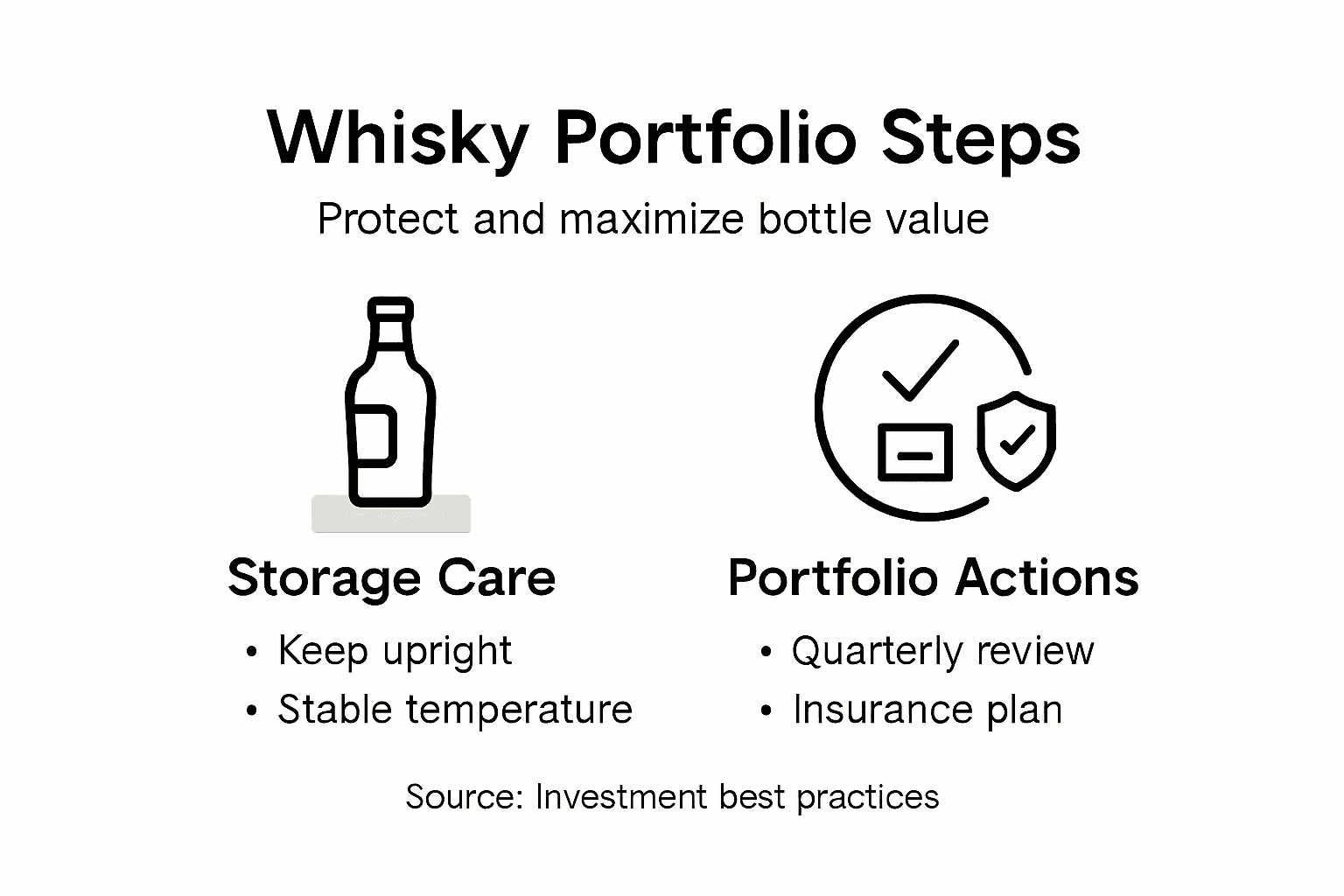
Create optimal storage conditions. Whisky bottles need consistent temperature, darkness, and humidity. Store bottles upright to minimise contact between the liquid and cork. Keep them away from direct sunlight, which fades labels and damages the spirit inside. Aim for temperatures between 15°C and 20°C with minimal fluctuation. Excessive heat accelerates evaporation; cold temperatures don’t harm the whisky but can affect label integrity.
Avoid common storage mistakes. Don’t store bottles in kitchens, near radiators, or above cookers where temperature swings are extreme. Don’t display bottles in sunny windows regardless of aesthetics. Don’t store horizontally like wine bottles. Whisky’s alcohol content and cork composition differ from wine, making upright storage essential.
Consider dedicated storage solutions. A climate-controlled cabinet or dark cupboard works for smaller collections. Serious investors with significant portfolios should explore specialist whisky storage facilities offering professional climate management, insurance, and security. These facilities charge annual fees but protect bottles worth thousands of dollars.
Develop a portfolio management system using these elements:
- Inventory spreadsheet: List each bottle with purchase date, price, distillery, and age statement
- Condition records: Document photographs and any label or bottle issues
- Value tracking: Update market estimates quarterly based on comparable sales
- Insurance documentation: Maintain receipts and professional appraisals for claims
- Selling timeline: Note which bottles you intend to hold long-term versus those flagged for potential sale
Understanding whisky collecting fundamentals helps you manage your portfolio strategically, ensuring bottles appreciate whilst remaining in pristine condition.
Review your portfolio quarterly. Check that stored bottles remain in good condition. Update valuations based on recent auction results. Reassess your overall strategy as market trends shift. This discipline prevents bottles from being forgotten and ensures you sell at optimal times.
Implement insurance protection. Standard home insurance typically doesn’t cover collectible whisky adequately. Specialist collections insurance provides coverage matching your bottles’ current market value. Maintain updated appraisals and documentation to support claims if damage occurs.
Pro tip: Create a separate document with your portfolio’s location, access details, and insurance policy information, stored securely outside your home. If something happens to you, your executor or beneficiaries can locate and manage your collection without confusion or delay.
Unlock the Full Potential of Your Whisky Investment with Uisuki
Investing in whisky for maximum returns demands careful selection, authentic sourcing, and expert market insight. The challenges of verifying provenance, tracking market value, and choosing rare bottles with strong appreciation potential can feel overwhelming — especially when every decision impacts your financial goals and collection pride. Whether you are aiming for long-term portfolio diversification or chasing those prized limited editions your collection deserves, having trusted access to premium whisky is essential.
Discover a curated range of rare and premium whiskies from renowned Scotch, Japanese, Australian, and American distilleries at Uisuki. Our expertly sourced selection supports your investment strategy with detailed descriptions, provenance assurance, and competitive pricing. Start building or expanding your whisky portfolio with confidence today — explore new arrivals and sought-after bottles, backed by comprehensive educational resources to sharpen your market knowledge. Visit Uisuki’s online store now and secure your next investment-grade bottle before prices rise further.
Frequently Asked Questions
What should I consider before investing in whisky?
Before investing in whisky, clarify your investment goals, such as financial returns or personal collection pride. Determine your risk tolerance, budget, and plan your holding timeline to ensure you make informed decisions about bottle purchases.
How can I assess which whisky bottles have the best investment potential?
Focus on distillery reputation, bottle rarity, and age statements to assess investment potential. Prioritise established distilleries and seek discontinued expressions or limited editions that have a higher chance of appreciation over time.
What are some key market trends I should track in whisky investing?
Monitor growth trends in the rare whisky market, particularly for premium offerings that have shown consistent price increases. Additionally, pay attention to distillery news, auction results, and upcoming regional whisky preferences to identify new investment opportunities.
How can I verify the authenticity of whisky before purchasing?
Conduct a visual inspection of the bottle, checking for inconsistencies in the label, seal, and overall condition. Request provenance documentation from the seller to ensure the bottle’s history is clear, which adds assurance to your investment.
What are the best practices for storing whisky bottles to maintain value?
Store whisky bottles in a cool, dark place, upright to avoid cork damage, and maintain humidity and temperature between 15°C and 20°C. Regularly check the stored bottles’ conditions and update your inventory to ensure you’re managing your portfolio effectively.