

TL;DR:
- Limited edition whisky hunting involves sourcing rare bottles through private clubs, reservations, auctions, and retailers, demanding preparation and quick action. Building multiple pipelines and tracking tools enhances success in acquiring highly sought-after releases. Patience, persistence, and understanding genuine scarcity versus marketing hype are essential for long-term collecting.
Limited edition whisky hunting is the practice of strategically sourcing rare and collectible bottles through exclusive channels including private member clubs, online reservation systems, auctions, and specialist retailers. The bottles worth hunting are not found on supermarket shelves. They exist in allocations of a few hundred, distributed through tightly controlled pipelines that reward preparation, relationships, and speed. This guide covers every major channel available to Australian collectors in 2026, from the Isle of Raasay’s Slàinte Club to Buffalo Trace’s reservation system and Sotheby’s auction rooms, along with the tools and tactics that separate successful hunters from those who miss out.
What are the main channels for limited edition whisky hunting?
The four primary sourcing channels are private member clubs, online reservation systems, auction houses, and retailer allocations. Each operates differently and rewards a different kind of preparation.
Private member clubs are the most exclusive pipeline. The Isle of Raasay Distillery’s Slàinte Club limited release is only available to club members who receive an ordering code by email. No code, no purchase. This model is spreading across the Scotch and craft whisky world because it rewards loyal customers and sidesteps the chaos of public drops.
Online reservation systems have become a major channel in 2026. Buffalo Trace introduced a free reservation system for limited releases, allowing registered buyers to secure a bottle and collect it from the distillery gift shop Tuesday through Sunday. The system is free to use but requires fast action when reservation windows open.
Auctions offer access to bottles that never appear in retail. Australian houses like Gibson’s charge a 22% buyer’s premium plus GST, with online bidding fees of 2 to 5% on top. That means a $500 hammer price can cost you $640 or more by the time you pay. Budget accordingly before you bid.
Retailer allocations are the least visible channel. Importers allocate cases to distributors and retailers based on account history and sales volume. Retailers with strong relationships receive more stock. As a collector, your relationship with a specialist retailer is a direct pipeline to allocated bottles.
Pro Tip: Register with at least one auction house, one distillery club, and two specialist retailers before any major release season. Having all four channels active simultaneously is the single biggest predictor of consistent success.
What tools and memberships do you need before you start?
Effective hunting requires infrastructure built before the releases drop. Walking into a hunt unprepared is the fastest way to miss every bottle you want.

| Preparation step | What it involves |
|---|---|
| Distillery club memberships | Join clubs like Isle of Raasay’s Slàinte Club to receive member-only ordering codes and early access. |
| Auction house registration | Pre-register with Gibson’s or other houses to avoid delays when bidding windows open. |
| Retailer waitlists | Contact specialist retailers directly and ask to be added to allocation lists for specific expressions. |
| Release calendar tracking | Follow distillery newsletters, Whisky Advocate, and community forums to anticipate drop dates. |
| Budget planning | Factor in buyer’s premiums, GST, shipping, and online surcharges when setting per-bottle limits. |
The storytelling behind a bottle drives collector psychology as much as the liquid itself. The Macallan 1926, with only 40 bottles remaining from the original cask after angels’ share losses, sold for £2.18 million in 2023. That price reflects provenance, narrative, and decades of auction visibility. Understanding what creates that kind of desirability helps you evaluate whether a new release is genuinely collectible or simply well marketed.
Tracking tools matter more than most collectors admit. Set up Google Alerts for distillery names and release keywords. Subscribe to newsletters from Uisuki, Whisky Auctioneer, and distillery mailing lists. Join communities on Reddit’s r/whisky and dedicated Facebook collector groups where members post real-time release alerts. Active engagement with release calendars is the difference between hearing about a drop the day it sells out and being first in the queue.
Pro Tip: Create a dedicated email address solely for whisky club and retailer newsletters. This keeps your hunting intelligence organised and prevents release notifications from being buried in a busy inbox.
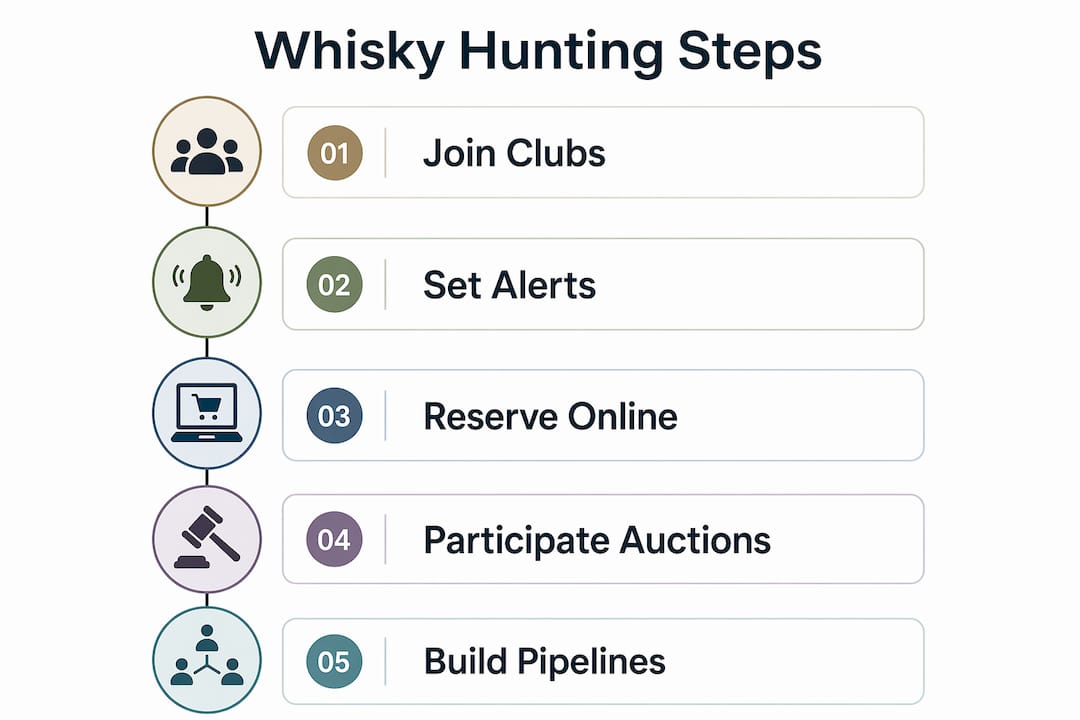
How do you execute the hunt step by step?
The process from preparation to possession follows a clear sequence. Skipping steps is where most collectors lose bottles they could have secured.
-
Join distillery and brand clubs. Confirm your eligibility for limited releases and read the terms carefully. Some clubs require a minimum purchase history or a waiting period before you qualify for allocation codes.
-
Register for reservation systems promptly. When Buffalo Trace or a similar distillery opens a reservation window, act within minutes. These windows close fast. Confirm your pickup availability before registering because most systems do not allow transfers or refunds.
-
Build retailer relationships. Visit specialist retailers in person where possible. Introduce yourself, discuss your collection, and ask explicitly about allocation waitlists. Retailer relationships are built over time and rewarded with priority access when limited stock arrives.
-
Prepare your auction accounts in advance. Register, verify your identity, and deposit any required bidding bond before the auction opens. Pre-registering with auction houses avoids the delays that cause collectors to miss live bidding windows. Set a hard ceiling for each lot that already includes the buyer’s premium and GST.
-
Monitor release announcements actively. Check your dedicated hunting email daily during peak release seasons, which in Australia typically run from March through May and September through November. Set phone notifications for distillery social media accounts.
-
Collect and verify your purchase. For reservation pickups, bring your confirmation and valid ID. For auction wins, arrange shipping or collection promptly. Inspect the bottle on receipt and photograph the condition, capsule, and label before storing it.
“The collector who runs parallel pipelines across clubs, reservations, retailers, and auctions will always outperform the one who relies on a single channel.” This is the core discipline of serious whisky hunting.
Combining club memberships, reservations, and auctions simultaneously is the most reliable strategy for building a rare whisky collection over time.
What mistakes do collectors make in limited edition whisky hunting?
The most expensive mistakes in whisky hunting are predictable and avoidable. Knowing them in advance saves money and frustration.
- Ignoring buyer’s premiums. A bottle that looks affordable at auction can become poor value once you add 22% premium, GST, and online surcharges. Always calculate the total landed cost before bidding.
- Missing registration deadlines. Clubs and reservation systems have hard cutoffs. Arriving late means no access, regardless of how much you want the bottle.
- Confusing scarcity with collectibility. Genuine collectibility requires scarcity plus reputation, collector psychology, and market visibility. A bottle with 200 units and no auction history is not automatically valuable.
- Trusting marketing over bottle count. Focus on disclosed production numbers, cask type, and distribution channels. Talisker Magma’s 622-bottle run is a verifiable fact. “Extremely limited” in a press release is not.
- Underestimating competition. Serious collectors in Australia and globally are running the same pipelines. Assuming you have time to decide is the fastest way to lose a bottle.
Understanding what makes a bottle truly collectible versus simply scarce is one of the most valuable skills a hunter can develop. Repeated auction appearances establish price history and signal genuine desirability. A bottle that has never appeared at auction has no proven secondary market value.
Pro Tip: Run at least three parallel hunting pipelines at all times. A club membership, an active auction account, and two retailer relationships give you enough coverage to secure bottles consistently across a full release calendar.
Key takeaways
Successful limited edition whisky hunting requires simultaneous activation of clubs, reservation systems, retailer relationships, and auction accounts before release season begins.
| Point | Details |
|---|---|
| Build pipelines before releases drop | Register with clubs, auction houses, and retailer waitlists well in advance of known release windows. |
| Budget for total landed cost | Always include buyer’s premiums, GST, and shipping fees when calculating what a bottle will actually cost you. |
| Distinguish scarcity from collectibility | Verified bottle counts, cask provenance, and auction history matter more than marketing language. |
| Run parallel channels simultaneously | Combining clubs, reservations, retailers, and auctions gives the highest probability of consistent acquisition. |
| Speed is non-negotiable | Reservation windows, club order codes, and auction lots close fast. Delayed decisions mean missed bottles. |
Why patience and persistence are the real edge in whisky hunting
I have watched collectors with bigger budgets than mine miss bottle after bottle because they treated hunting as a casual hobby. The market does not reward casual. What it does reward is showing up consistently, building genuine relationships with retailers over months and years, and being ready to act the moment a release window opens.
The whisky market in 2026 is more competitive than it has ever been. Bots hit reservation systems within seconds of opening. Club allocation codes are forwarded and traded before the average collector has opened their email. The collectors who succeed are the ones who have done the unglamorous work: pre-registered everywhere, set up dedicated tracking systems, and built the kind of rapport with specialist retailers that gets them a phone call before a bottle hits the website.
What I find most interesting about whisky collectibility is how much of it is psychological. The Macallan 1926 is extraordinary whisky, but its £2.18 million price tag is also a story about scarcity, provenance, and decades of cultural mythology. The best hunters I know buy bottles they genuinely want to drink or hold long term. They are not chasing hype. They are building collections with meaning.
My honest advice: start with one distillery club and one specialist retailer relationship. Do those two things properly before expanding. Depth beats breadth in the early stages of building a hunting practice.
— Brendan
Find your next rare bottle at Uisuki
Uisuki is Australia’s specialist source for limited edition whiskies from Scotland, Japan, the USA, and local Australian distilleries. The team actively sources allocated and hard-to-find bottles, and the site is updated regularly with new arrivals that do not appear in general retail. If you are building a rare whisky collection or hunting a specific expression, Uisuki’s collector guides and expert articles give you the context to make informed decisions. You can also submit a personalised sourcing request for bottles you cannot find elsewhere. Browse the current selection at Uisuki.com.au and get ahead of the next release season.
FAQ
What is limited edition whisky hunting?
Limited edition whisky hunting is the practice of sourcing rare and collectible bottles through private clubs, reservation systems, auctions, and specialist retailers rather than standard retail channels. It requires preparation, speed, and active management of multiple acquisition pipelines.
Where can I find rare whisky in Australia?
Specialist online retailers like Uisuki, Australian auction houses like Gibson’s, and direct distillery club memberships are the primary channels for finding rare whisky in Australia. Building retailer relationships and joining distillery mailing lists significantly improves access to allocated stock.
How do auction buyer’s premiums affect my budget?
Australian auction houses typically charge a buyer’s premium of around 22% plus GST, with additional online bidding surcharges of 2 to 5%. A bottle with a $500 hammer price can cost $640 or more in total, so always calculate the full landed cost before placing a bid.
What makes a limited edition whisky genuinely collectible?
Genuine collectibility requires verified scarcity, a strong distillery reputation, documented cask provenance, and a track record of auction appearances that establish price history. Marketing language alone does not create collectible value.
How do distillery club memberships work for limited releases?
Clubs like Isle of Raasay’s Slàinte Club send ordering codes exclusively to members by email, allowing them to purchase bottles before or instead of any public sale. Membership eligibility and terms vary by distillery, so read the conditions carefully when joining.