

A rare Scotch whisky, in the collector’s sense, is a bottle that cannot be replicated: spirit from a closed distillery, a single cask drawn in fewer than a few hundred bottles, a ballot-only release, or a malt aged beyond 30 years with documented provenance. For Australian collectors, the practical verdict is this: the most reliable entry points are specialist retailers with sourcing services, domestic and international auction participation, and a short list of distilleries whose scarcity is structural rather than manufactured.
Before you spend serious money, know what you are actually buying. The rarity signals that matter most are:
- Closed or silent distillery — pre-closure stock is finite and irreplaceable
- Single-cask bottling — limited to whatever volume one cask yields, often a few hundred bottles
- Extreme age statement — 30 years and above, with documented 80-year releases existing as museum-grade decanters
- Ballot or allocation release — demand structurally exceeds supply at retail
- Artist or hand-finished packaging — limited edition scotch where the physical object is part of the asset
- Verified provenance chain — receipts, auction lot numbers, original packaging intact
Pro Tip: The most common early mistake is conflating “limited edition” with “rare.” A distillery can print 50,000 bottles with a special label. True rarity means the liquid itself cannot be reproduced — check the cask number and total bottle count before you decide it is collectible.
Table of Contents
- What actually makes a Scotch rare and collectible?
- Distilleries and bottles that serious collectors watch
- How rarity translates to price at auction
- Where and how to buy rare Scotch in Australia
- How to verify provenance and spot fakes
- Storing, insuring and moving rare bottles
- How Uisuki sources and verifies rare Scotch for Australian collectors
- Key takeaways
- The part of rare Scotch collecting most guides get wrong
- Uisuki: sourcing rare Scotch for Australian collectors
- Useful sources for collectors
What actually makes a Scotch rare and collectible?
Rarity in Scotch whisky comes from a handful of concrete, verifiable traits. Understanding them lets you evaluate a bottle in minutes rather than relying on marketing copy.
The primary rarity drivers
- Single-cask, cask-strength release — independent single-cask bottlings are limited to what one cask yields, typically uncoloured and non-chill-filtered, with a unique flavour profile that cannot be duplicated.
- Artist or hand-finished editions — Glen Scotia’s Elements of Campbeltown series pairs a 50-year-old spirit with original artwork by Gina Parr, limited to a handful of releases per year. The physical object becomes part of the collectible asset.
What to check on the label
| Label element | Why it matters |
|---|---|
| Cask number | Confirms single-cask origin; no cask number often means a vatted run |
| Bottle number / total bottles | Establishes true scarcity with documented bottle counts |
| Distillation and bottling dates | Verifies the age statement independently |
| Independent bottler statement | Signals a non-distillery release, often cask-strength and uncoloured |
| Artist edition markers | Indicates a numbered art collaboration with physical collectible value |
| Batch code | Allows cross-referencing against distillery records |
Pro Tip: Ask the seller for the distillery’s official release documentation or the independent bottler’s lot sheet. Legitimate releases almost always have a paper trail. If the seller cannot produce it within 48 hours, treat that as a red flag.
Distilleries and bottles that serious collectors watch
Collector demand concentrates on a short list of names. Here is why each one matters.
- Springbank — Campbeltown’s most celebrated survivor, producing tiny annual volumes with no chill filtration and minimal colouring. The Springbank 18 Year Old is a benchmark aged expression; society bottlings like the Longrow 11 Year Old Springbank Society show how club releases amplify scarcity further.
- Rosebank — closed in 1993, reopened in 2023 but pre-closure stock is finite. Triple-distilled Lowland style with a floral, delicate profile that has no modern equivalent.
- Brora — silent from 1983 to 2021, its pre-closure releases carry a premium that reflects both historical status and the fact that original-era spirit cannot be reproduced.
- Macallan — the benchmark brand for trophy collecting. Sherry-oak maturation, consistent quality across decades, and a marketing narrative that has made it the most recognised name at auction globally. The Macallan 18 Year Old Sherry Oak Cask 2024 release sits at the accessible end of the collectible range; the 1926 vintage sits at the other.
- Glenfiddich — the world’s best-selling single malt, which sounds counterintuitive until you look at the Janet Sheed Roberts Reserve (50 years old, 11 bottles) and the Snow Phoenix. Limited releases from a high-volume distillery can be genuinely scarce.
- GlenDronach — prized for heavily sherried expressions and a long history of single-cask releases. The distillery’s archive bottlings, drawn from casks laid down in the 1960s and 1970s, attract serious collector attention.
Independent bottlings and single-cask releases
Independent bottlers — Gordon & MacPhail, Signatory Vintage, Berry Bros & Rudd and others — are a significant source of collectible bottles. They acquire casks directly from distilleries, often decades in advance, and bottle at cask strength without colouring. The result is a flavour profile unique to that single cask, in a quantity limited to whatever the barrel yielded. For collectors, this means no two bottles from the same distillery and vintage will taste identical across different independent releases, which adds both interest and complexity to building a collection.
How rarity translates to price at auction
The Macallan 1926 (Adami) sold at Sotheby’s London in 2023 for a record hammer price, cementing its status as the most valuable whisky ever sold at auction. That sale is the ceiling of the market, not the floor. Most collectors operate well below it.
Auction record anchor: The Macallan 1926 at Sotheby’s 2023 represents the trophy tier of the rare Scotch market, where auction house narrative, artist packaging (the Adami label) and provenance combine to push prices beyond the liquid’s intrinsic value alone.
Price bands across rarity tiers
| Tier | Examples | Approximate price range |
|---|---|---|
| Ballot / limited retail release | Annual Springbank releases, Laphroaig Càirdeas | — |
| Single-cask independent bottling | Signatory Vintage, Gordon & MacPhail standard range | A$200–A$5,000 depending on age and distillery |
| Historic closed-distillery bottle | Pre-closure Brora, Rosebank, Port Ellen | — |
| Ultra-rare / museum-grade decanter | Macallan 1926, G&M 85-year decanters | Trophy bottles have traded at record-setting auction prices, well above standard retail and typical collector budgets. |
These ranges are indicative. Condition, provenance and timing all shift the outcome significantly.
Auction dynamics Australian collectors should understand
Buyer premiums at major houses typically run around a quarter on top of the hammer price, before adding international shipping, insurance and Australian GST on imported goods. Auction demand has also shifted geographically: Asian buyers once dominated the trophy market, but that dominance has reduced, broadening the buyer pool and affecting where the best prices are achieved. For Australian collectors, this means Langton’s domestically and Sotheby’s or Bonhams internationally are both viable, but the premium structures differ.
The principal drivers of long-term appreciation:
- Documented provenance and unbroken chain of ownership
- Structural scarcity (closed distillery, single cask, confirmed bottle count)
- Brand narrative strength (Macallan, Springbank, Brora carry decades of storytelling)
- Packaging and artwork integrity — the Macallan 1926’s Adami label is inseparable from its value
- Tasting reputation and critical scores from respected independent reviewers
- Liquidity in the secondary market — some bottles are easy to sell; others sit for years
Where and how to buy rare Scotch in Australia
Australian collectors have more options than most realise. The channels each carry different risk and cost profiles.
Specialist retailers like Uisuki offer curated stock, sourcing requests and condition reports. You pay a retail margin but get authentication support and Australian consumer protections. For bottles in the A$200–A$5,000 range, this is often the lowest-friction route.
Domestic auctions (Langton’s is the most established Australian fine wine and spirits auction house) give you access to secondary-market bottles with some provenance documentation. Buyer premiums apply; inspect condition reports carefully before bidding.
International auction houses — Sotheby’s, Bonhams, MacDougall’s — are accessible from Australia via online bidding or proxy. Factor in buyer premium, international freight, insurance and Australian customs/GST before calculating your true landed cost.
Private sales carry the highest provenance risk and the lowest fees. Only proceed with a seller whose history you can verify independently, and always request full documentation.
Ballot and allocation channels require registration with the distillery or an authorised retailer. Springbank’s annual releases, for example, are allocated through a small number of specialist retailers; being on the right mailing list matters.
Buyer checklist before committing
- Request full provenance documentation: original receipt or auction lot number, photos of all six sides of the bottle, and storage history.
- Confirm the bottle count and cask number against the distillery’s or independent bottler’s official records.
- Check the fill level — any evaporation beyond the standard ullage for the bottle’s age is a concern.
- Inspect the seal and cork condition from photos; ask for a close-up of the capsule.
- Verify the seller’s history: auction house track record, retailer reviews, or private seller references.
- Calculate your total landed cost: purchase price + buyer premium + freight + insurance + GST.
- Confirm storage conditions during transit — temperature-controlled shipping for bottles above A$2,000 is worth the additional cost.
Pro Tip: For bottles above A$3,000, commission an independent condition report from a specialist before bidding. The cost is modest relative to the purchase price, and it gives you documented evidence of condition at the time of acquisition — useful for insurance and eventual resale.
How to verify provenance and spot fakes
Counterfeiting in the rare Scotch market is real, concentrated at the trophy end but not limited to it. A systematic approach protects you.
Pro Tip: The single most reliable provenance document is an original auction lot receipt from a major house. It establishes price paid, condition at sale and chain of ownership in one document. Always ask for it first.
Provenance checklist
- Original purchase receipt or auction lot confirmation
- Full bottle photography (label, back label, capsule, fill level, base)
- Cask and batch number cross-referenced against official records
- Original outer packaging (box, tube, decanter case) in matching condition
- Independent laboratory or archivist confirmation for bottles above A$10,000
- Storage history: where the bottle has been kept and for how long
Red flags to watch for
- Label printing inconsistencies — font weight, colour registration or paper stock that differs from known authentic examples
- Fill level significantly below the standard ullage for the stated age
- Tampered or re-glued capsule
- Cork that appears replaced or does not match the bottling era
- Price significantly below comparable auction results with no explanation
- Seller with no verifiable transaction history or unwilling to provide documentation
When to escalate to expert inspection
For any bottle above A$5,000, consider:
- Requesting a professional condition report from a specialist whisky broker or auction house specialist.
- Commissioning a laboratory analysis of the spirit (rare but available for very high-value bottles; turnaround is typically several weeks).
- Contacting the distillery’s archive team directly — Macallan, Springbank and several others maintain records that can confirm cask details.
- Using a specialist archivist for independent bottler releases, particularly for bottles from the 1960s–1980s.
Storing, insuring and moving rare bottles
A bottle worth A$5,000 at purchase can be worth considerably less if stored badly for five years. The physical asset needs active protection.
Storage best practice
- Maintain a stable temperature between 15°C and 18°C; fluctuation causes expansion and contraction that can compromise the seal over time
- Keep bottles away from direct light, particularly UV — dark storage is non-negotiable for long-term holds
- Store sealed bottles upright, not on their side; unlike wine, high-ABV spirit can degrade the cork if it remains in constant contact with the liquid
- Control humidity at 60–70% to prevent label deterioration and cork drying
- Isolate bottles from strong odours — spirit can absorb ambient smells through a compromised seal
- Never store near vibration sources (appliances, subwoofers) for extended periods
Insurance steps for Australian collectors
- Obtain a professional valuation from a specialist whisky valuer or auction house — not a retail price estimate.
- Seek an agreed-value policy rather than a market-value policy; agreed value pays the insured amount without depreciation arguments.
- Update valuations annually for bottles in active appreciation; the market moves faster than standard insurance review cycles.
- Document everything photographically at acquisition and at each valuation update.
- Check whether your home contents policy covers collectibles at full replacement value — most standard policies do not.
- For collections above A$20,000, consider a specialist fine art and collectibles insurer rather than a general contents add-on.
Shipping considerations
For Australian buyers receiving international consignments: use a freight forwarder experienced with high-value spirits, confirm temperature-controlled transit for premium bottles, and ensure customs documentation is complete before the shipment leaves the origin country. Bonded storage options exist in Sydney and Melbourne for collectors who want to defer GST liability on imported bottles held for resale.
How Uisuki sources and verifies rare Scotch for Australian collectors
The sourcing process for a genuinely rare bottle is not a single transaction — it is a sequence of verification steps that takes days or weeks, depending on the bottle’s age and provenance complexity.
The sourcing process
- Sourcing brief — a collector specifies the distillery, vintage range, bottler preference and condition requirements. Uisuki uses this to search its network of international suppliers, auction houses and private sellers.
- Provenance checks — before any offer is made, Uisuki requests full documentation: original receipts or auction lot numbers, cask and batch records, and a complete photographic record of the bottle.
- Physical inspection — for high-value bottles, a condition report is commissioned from a specialist before the bottle ships. Fill level, seal integrity, label condition and packaging completeness are all assessed.
- Documentation package — every bottle sold through Uisuki’s sourcing service is accompanied by the provenance documents gathered during the process, so the buyer has a complete paper trail from acquisition.
- Brokering or auction participation — Uisuki can bid on behalf of Australian collectors at international auctions, managing the proxy process, buyer premium calculation and freight logistics.
What Uisuki presents to buyers
- Full photographic record of the bottle at the time of sourcing
- Copies of all provenance documents (receipts, lot numbers, condition reports)
- Landed cost calculation including buyer premium, freight, insurance and GST
- Storage recommendations and, where required, bonded storage referrals
Collectors who want to replicate parts of this process independently should start with the distillery’s archive team for bottles from named houses, and with the independent bottler’s lot records for single-cask releases. The documentation exists; the skill is knowing who to ask and what to request.
Key takeaways
Rare Scotch whisky holds long-term collector value when structural scarcity, verified provenance and intact packaging combine — no single factor is sufficient on its own.
| Point | Details |
|---|---|
| Identify true rarity | Check cask number, total bottle count and distillery status before treating a bottle as collectible. |
| Focus on proven distilleries | Springbank, Brora, Rosebank, Macallan and GlenDronach consistently attract collector demand for documented reasons. |
| Verify before you buy | Request original receipts, full bottle photography and cask records; commission a condition report for bottles above A$5,000. |
| Protect the physical asset | Store upright at 15°C–18°C in dark, humidity-controlled conditions and hold an agreed-value insurance policy. |
| Use Uisuki for sourcing | Uisuki provides provenance documentation, condition reports and landed-cost calculations for Australian collectors buying rare Scotch. |
The part of rare Scotch collecting most guides get wrong
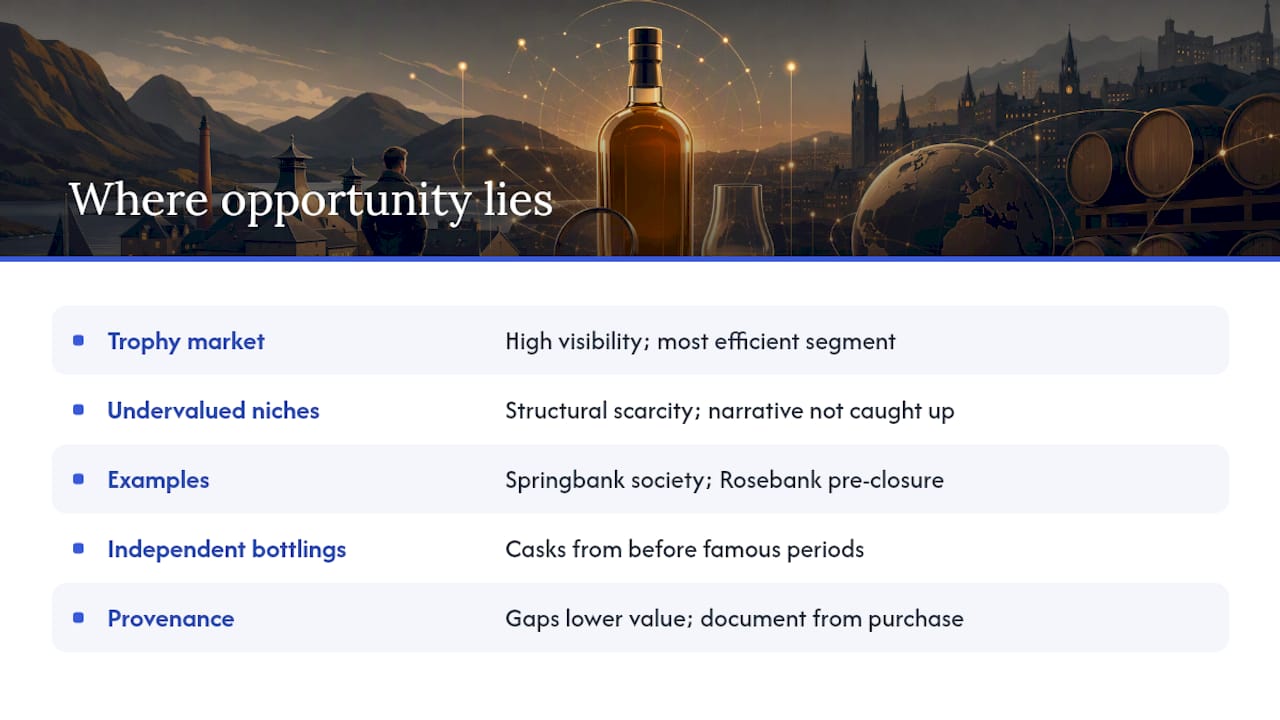
Most articles about collecting rare Scotch spend their energy on the trophy tier — the Macallan 1926, the museum decanters, the auction records that make headlines. That framing is understandable but it misleads most collectors about where the real opportunity sits.
The bottles that have delivered the most consistent appreciation for collectors I have spoken with are not the ones that sold for £2 million at Sotheby’s. They are the Springbank society bottlings that went for A$400 at release and traded at multiples of that within three years. They are the pre-closure Rosebank expressions that sat in specialist retailers’ back catalogues for a decade before the distillery’s reopening announcement changed the conversation overnight.
The trophy market is real, but it is also the most efficient part of the market. Everyone knows the Macallan 1926 is valuable. The less-efficient opportunities are in the bottles where structural scarcity exists but the narrative has not fully caught up yet — closed distilleries with remaining stock, independent bottlings from casks laid down before a distillery’s most famous period, ballot releases from smaller producers that did not attract mainstream attention at launch.
Provenance documentation is where most collectors underinvest their attention. A bottle with a gap in its ownership history is not just harder to sell — it is genuinely worth less, because the buyer at the other end of the transaction cannot verify what they are buying. Treating documentation as a priority from the first purchase, not as something to sort out later, is the single habit that separates collectors who build real value from those who accumulate bottles.
Uisuki: sourcing rare Scotch for Australian collectors
Finding a specific rare bottle in Australia without specialist help means months of monitoring auction catalogues, managing international freight logistics and navigating provenance gaps on your own. Uisuki removes that friction.
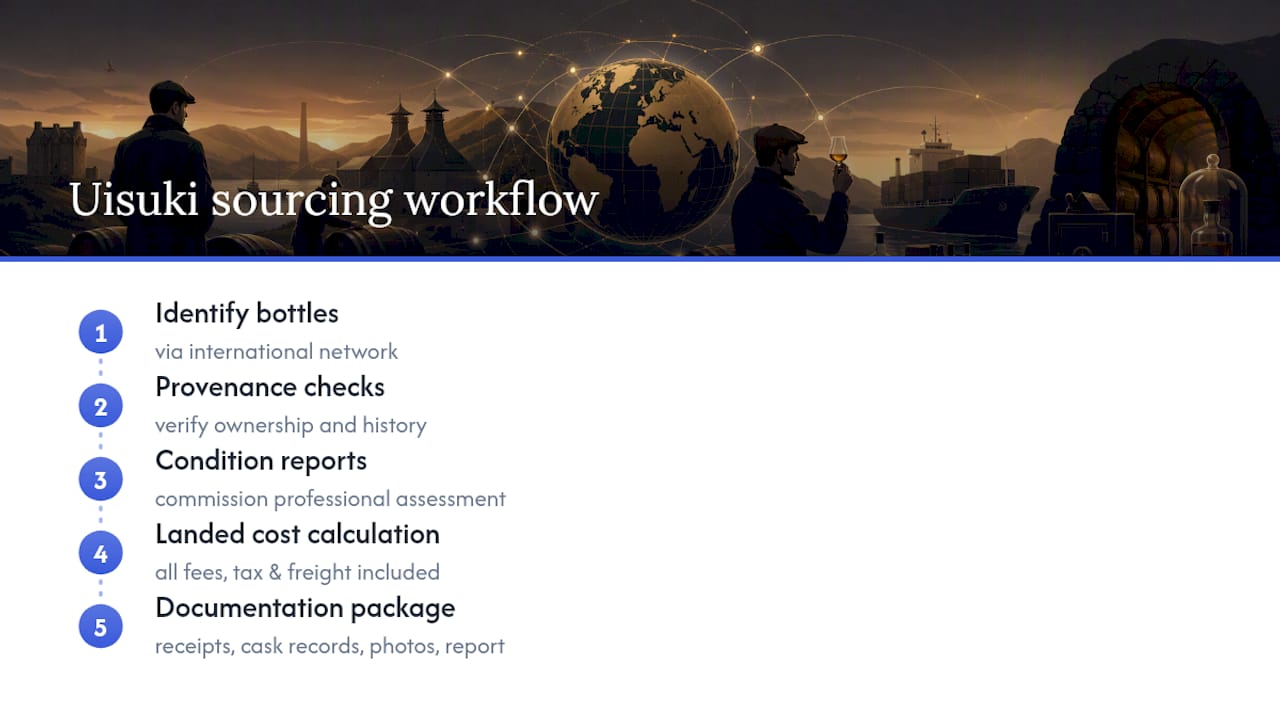
Uisuki’s sourcing service handles the full process: identifying bottles through its international network, running provenance checks, commissioning condition reports and calculating your true landed cost before you commit. Every purchase comes with the documentation package — receipts, cask records, condition report, photographic record — so your bottle arrives with a complete paper trail.
The platform’s curated retail range covers everything from accessible limited releases like Ichiro’s Malt and Grain Limited Edition through to hard-to-find single malts sourced on request. If you are looking for a specific distillery, vintage or bottler, submit a sourcing brief directly through Uisuki’s website and the team will respond with availability, provenance status and pricing.
Useful sources for collectors
The sources below are worth bookmarking for ongoing research, auction monitoring and provenance verification.
- Sotheby’s — The Macallan 1926 and the making of a market — the definitive account of how the trophy tier of the rare Scotch market formed, with auction narrative and pricing context.
- The Macallan — A legacy in the making — the distillery’s own account of the 1926’s history; useful for provenance research on Macallan releases.
- Gordon & MacPhail — Ultra Rare — documents limited bottle counts and cask provenance for ultra-rare releases; a model for what good provenance documentation looks like.
- Gordon & MacPhail — Artistry in Oak 85 Years Old — illustrates extreme-age releases and the decanter format used for museum-grade bottles.
- CaskTrade — A guide to collectable whisky — practical overview of independent bottlings and what makes single-cask releases collectible.
- Wine-Searcher — Gordon & MacPhail Generations Glenlivet 80 Year Old — useful for researching extreme-age release pricing and availability history.
- The Spirits Business — How luxury cognac is attracting whisky collectors — covers the geographic shift in auction demand and what it means for where trophy bottles sell best.
- The International Man — World’s best and most expensive whiskies — broad price context across tiers, useful for setting realistic expectations before entering the market.
Sources were selected for auction records, bottler archives and specialist market commentary — the three areas where collectors most need verified, primary-source information rather than secondary aggregation.