

TL;DR:
- Proper storage conditions with stable temperature and humidity are essential to preserve whisky quality and value.
- Sealed bottles should be stored upright, while open bottles should be resealed and used within 12 months.
- Documenting bottles and maintaining an ideal environment enhances protection for resale and insurance purposes.
A bottle of rare Scotch or Japanese single malt represents serious money, genuine passion, and years of anticipation. Yet many Australian collectors unknowingly sabotage their investment the moment it arrives home. Our climate is unforgiving, our summers brutal, and a poorly chosen storage spot can strip a whisky of its character within months. This guide walks you through every practical step to protect your collection, from getting the environment right to documenting bottles for insurance and resale. Follow this advice and your whisky will stay exactly as the distiller intended, whether you open it next month or in twenty years.
Table of Contents
- What you need for optimal whisky storage
- Step-by-step instructions to store sealed and open bottles
- Protecting your collection from light, heat and humidity
- Documentation and insurance for valuable collections
- Why serious collectors go beyond basic storage advice
- Discover premium bottles to expand your collection
- Frequently asked questions
Key Takeaways
| Point | Details |
|---|---|
| Upright storage essential | Always store whisky bottles upright to keep corks healthy and prevent leaks. |
| Control light and humidity | Keep bottles in a dark, stable environment with 50-70% humidity to avoid spoilage. |
| Document for insurance | Record your collection and maintain original packaging to protect value and simplify resale. |
| Open bottles need care | Tightly reseal and finish open bottles within a year for best quality. |
What you need for optimal whisky storage
Before your next bottle even lands on the shelf, you need to understand the conditions that either preserve or destroy whisky over time. Think of it less like storing a beverage and more like managing a long-term asset. The wrong environment does not just dull the flavour; it can crack corks, blister labels, and slash resale value overnight.
Temperature is your first priority. The ideal range sits between 15°C and 20°C. Go above that consistently and you accelerate evaporation through the cork, causing what distillers call “the angel’s share” to claim more than its fair share of your bottle. Australian summers, particularly in Sydney, Brisbane, and inland regions, can push uninsulated rooms well above 30°C for weeks at a time. That kind of heat fluctuation is the single biggest threat most local collectors face.
Humidity is equally important. Optimal humidity is 50 to 70% RH; dropping below 40% dries out corks and risks air sneaking into the bottle, while anything above 80% encourages mould growth and label deterioration. Both extremes cost you money.
Here is a quick reference for storage conditions:
| Condition | Ideal range | Risk if too low | Risk if too high |
|---|---|---|---|
| Temperature | 15°C to 20°C | Flavour dulled slightly | Evaporation, cork failure |
| Relative humidity | 50% to 70% | Cork dries and shrinks | Mould, label damage |
| Light exposure | Zero direct light | N/A | Colour fade, flavour shift |
| Vibration | Minimal | N/A | Sediment disruption |
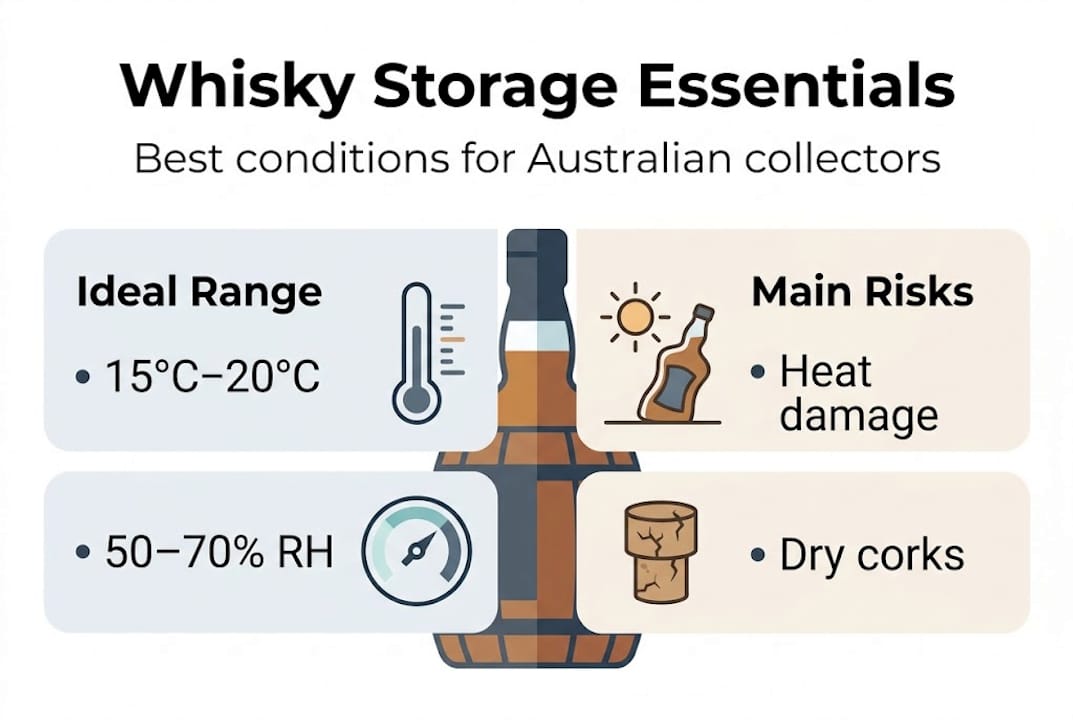
To monitor these conditions accurately, you need a basic hygrometer and thermometer. Combination units cost less than $30 and are available at most hardware stores. Place one wherever you store your bottles and check it weekly.
Location matters as much as equipment. The best spots in an Australian home are:
- A temperature-stable interior cupboard away from external walls
- A dedicated wine or whisky fridge set to the correct range
- A basement or cellar if you are lucky enough to have one
- A purpose-built cabinet with UV-resistant glass doors
Our storage guide for gift bottles covers specific room setups in more detail for those managing gifted or presented bottles alongside their main collection. For a broader overview of handling practices, the bottle care tips guide is worth bookmarking as a companion resource.
Original packaging, meaning the cardboard tube, tin, or presentation box the bottle arrived in, is not just decorative. It provides a physical barrier against light and temperature swings. Never throw it away.
Pro Tip: The bar trolley in your lounge room and the shelf above the fridge are two of the worst places to store whisky. Both suffer from sunlight, temperature swings, and kitchen humidity that changes daily.
Step-by-step instructions to store sealed and open bottles
Knowing the conditions is one thing. Knowing exactly what to do with each bottle in your collection is another. Sealed and open bottles have completely different storage needs, and confusing the two is a common and costly mistake.
Sealed bottles vs. open bottles at a glance:
| Factor | Sealed bottle | Open bottle |
|---|---|---|
| Position | Upright | Upright |
| Oxidation risk | Very low | High and growing |
| Primary concern | Cork drying | Air exposure |
| Recommended action | Occasional cork moisten | Use smaller bottle or finish within 12 months |
| Storage urgency | Low if conditions are right | High once below half full |
Now let’s get specific. Here is how to store each type correctly.
Storing sealed bottles:
- Stand the bottle fully upright on a stable shelf. Unlike wine, whisky’s high alcohol content (typically 40% ABV and above) will degrade natural cork if it sits in prolonged contact with the liquid.
- Check the cork every few months in dry climates. Occasionally tilt sealed bottles briefly to let the spirit moisten the cork without leaving it on its side.
- Keep the original capsule and foil intact. This protects the neck and cork from dust and humidity fluctuations.
- Store away from any vibration source, including speaker systems, washing machines, and high-traffic flooring. Vibration slowly disturbs sediment and can interfere with the maturation of certain aged expressions.
- Label each bottle’s shelf position if you rotate your collection, so bottles at the back do not sit untouched for years without a quick check.
Storing open bottles:
- Reseal the bottle immediately and firmly after every pour. Even a loose cap allows air in and begins the oxidation clock.
- If the bottle drops below half, consider transferring the remaining whisky into a smaller, food-safe glass bottle. Less headspace means less oxygen contact. This is especially important for expensive single malts where every millilitre matters.
- Store open bottles in the same stable environment as sealed ones. Avoid the instinct to keep them “handy” near the kitchen bench.
- Aim to finish open bottles within twelve months of opening for the best experience. Some robust expressions hold up well beyond that, but many lighter and more delicate whiskies begin losing their edge noticeably after six months.
Managing preserving flavour and value in an open bottle is largely about discipline. Taste it regularly, share it with fellow enthusiasts, and resist the urge to let rare bottles sit half-empty on a shelf for years. Check out our presentation tips if you are looking for ideas on sharing these experiences with others in a memorable way.
Pro Tip: Avoid decanting whisky into a decorative decanter for long-term storage. Glass decanters with stopper-style closures are rarely airtight and expose your whisky to far more oxygen than the original bottle.
Protecting your collection from light, heat and humidity
Even collectors who nail their temperature and humidity readings sometimes overlook the more immediate threats of light, heat spikes, and fluctuating moisture. In Australia, these risks compound each other in ways that collectors in cooler climates simply do not experience.

Light is a silent destroyer. Ultraviolet and visible light rays accelerate chemical reactions inside the bottle, causing colour changes, flavour shifts, and the fading of labels that matters enormously for resale. A bottle left on a sunlit shelf for a single summer can look noticeably different by the time autumn arrives. Dark amber glass offers some protection, but it is not total.
Practical ways to block light from reaching your collection:
- Store bottles inside closed cabinets rather than open display shelves
- Use UV-blocking film on any windows near your storage area
- Choose storage rooms with no skylights or sun-facing windows
- Keep original tubes and boxes on bottles whenever possible
“Optimal humidity is 50 to 70% RH; below 40% dries corks, above 80% risks mould and label damage.”
Heat spikes are the Australian collector’s most persistent challenge. A car boot in summer, a hot garage, a loft space above a tin roof — these environments can expose bottles to temperatures exceeding 40°C within minutes. Even a single extreme heat event can push whisky through the cork and create sticky residue around the neck, a sure sign of evaporative loss.
Climate-controlled wine cabinets are the most practical solution for serious collectors without a cellar. Entry-level models designed for 20 to 50 bottles are widely available and can maintain stable temperatures year-round regardless of what the Queensland or Western Australian summer throws at you.
Keeping bottles safe from light is covered in detail in the gift bottle guide, and the collecting tips for protection article covers broader strategies for building a resilient collection environment.
Preserve original packaging for light protection and collector value; this also simplifies documentation significantly when you need to provide proof of condition for insurance or resale purposes.
Humidity fluctuations, particularly those that swing dramatically between seasons, cause the cork to expand and contract repeatedly. Over time, this micro-movement degrades the seal and allows tiny amounts of air to enter. A simple way to stabilise humidity in a small storage area is to place a small, open container of water inside a sealed cabinet or to use a passive humidity control sachet designed for wine storage.
Documentation and insurance for valuable collections
Proper storage protects the liquid inside the bottle. Documentation protects the value of what you have built. These are equally important parts of responsible collecting, and far too many enthusiasts skip the paperwork entirely until something goes wrong.
Start documenting your collection from day one. Here is what to record for each bottle:
- A clear photograph of the front and back labels, including the capsule and bottle base
- A photograph of the original packaging, including any certificates of authenticity or batch numbers
- The purchase receipt or invoice, showing the price, date, and source
- The current estimated market value, updated annually if the bottle is a limited or collectible expression
- Storage location notes, including temperature and humidity readings at the time of storage
- Any tasting notes if the bottle has been opened, along with the date and amount consumed
Preserve original packaging for documentation purposes as it directly increases both the collector value and insurability of your bottles.
Insurance is a conversation that many collectors avoid because they assume their home and contents policy covers it. In most cases, standard policies either exclude or significantly undervalue collectibles, particularly consumables like whisky. A collection worth $5,000 to $50,000 or more deserves a dedicated rider or a specialist collectibles policy.
When approaching an insurer, bring:
- Your full photographic catalogue
- Purchase receipts and valuations
- A storage environment report showing your temperature and humidity conditions
- Any provenance documentation for rare or limited releases
Insurers reward collectors who demonstrate proper storage. A temperature-logged, humidity-controlled environment tells them the risk is lower, which often translates to better premiums. Review our article on insuring your collection for detailed advice on policy types and what to look for in coverage.
For broader collecting strategy, the collector’s tips guide outlines how documentation fits into the larger picture of building and protecting a valuable collection over years.
Pro Tip: Keep both a digital folder stored in the cloud and a printed hard copy of your collection catalogue. If your storage area is damaged by fire or flood, you will need evidence that is not also destroyed in the same event.
Why serious collectors go beyond basic storage advice
Here is an opinion that often surprises new collectors: basic storage advice will keep your whisky alive, but it will not keep your collection meaningful. The collectors who genuinely protect generational value treat their storage environment as a living system, not a set-and-forget shelf.
The story of Shackleton’s whisky is often cited in collector circles and for good reason. Sealed bottles remain stable for decades when conditions are right; Shackleton’s whisky survived intact for over a hundred years under Antarctic ice, and the recovered liquid was analysed and reproduced. That is not a myth about cold climates. It is evidence that meticulous, consistent conditions trump every other variable.
What separates a serious Australian collector is routine. Monthly checks of temperature and humidity logs, seasonal adjustments to storage solutions, and a genuine relationship with the provenance of each bottle. There is no single correct setup. A climate-controlled cabinet in a Perth apartment can be just as effective as a sandstone cellar in the Adelaide Hills, provided the collector is paying attention. Browse our premium collecting advice to go further with your strategy.
Think of your collection as a legacy asset, not a display feature. That shift in thinking changes every decision.
Discover premium bottles to expand your collection
You have done the work to create a proper storage environment. Now it makes sense to fill it with bottles that reward that effort.

At Uisuki, we curate bottles that are worth looking after. Whether you are drawn to the bold, locally crafted character of Hobart Whisky Bourbon Matured Rum Finished Single Malt, the acclaimed complexity of Ichiros Malt and Grain Limited Edition World Blended Whisky, or the peaty coastal elegance of Ardnamurchan Macleans Nose Blended Scotch, each of these is a bottle that belongs in a well-maintained collection. We ship across Australia with care, and our team is always available to help you source rare or hard-to-find expressions.
Frequently asked questions
Should whisky bottles be stored upright or on their side?
Whisky bottles should always be stored upright to prevent the high-alcohol spirit from degrading the natural cork over time. You can briefly tilt sealed bottles occasionally to moisten the cork, but never store them on their side long-term.
What is the ideal temperature and humidity for storing whisky?
Keep whisky at a stable 15°C to 20°C with 50 to 70% relative humidity to prevent both cork drying and mould growth on labels.
Can sunlight damage my whisky collection?
Yes, both ultraviolet and visible light accelerate chemical changes inside the bottle, fading labels and shifting flavour. Preserve original packaging to provide the first line of defence against light exposure.
Is original packaging important for resale or insurance?
Absolutely. Original packaging not only protects the bottle from light and heat but also increases collector value and makes it significantly easier to insure and resell with confidence.