

TL;DR:
- A diverse whisky collection enhances enjoyment, sharpens palate, and offers investment potential.
- Include key regions like Scotland, Japan, USA, Ireland, Australia, and emerging areas.
- Proper storage and regular rotation keep the collection interesting and in top condition.
Most whisky collectors don’t set out to build a boring shelf. Yet somehow, after a few years of buying what you know and love, you glance at your collection and realise it’s 80% Speyside Scotch or all Japanese single malts. It’s a common trap. The good news is that a deliberately diverse collection doesn’t just look impressive — it deepens your enjoyment, sharpens your palate, and can even hold serious investment value. This guide walks you through setting goals, sourcing standouts from around the world, and managing your bottles so your collection stays exciting, balanced, and genuinely world-class.
Table of Contents
- Set your collection goals and taste priorities
- Essential building blocks: Regions, styles and must-have bottles
- Sourcing rarities and local standouts: Strategies for Australian collectors
- Collection management: Display, storage and ongoing evolution
- A collector’s perspective: Why diversity makes every bottle count
- Discover, collect and connect with unique whiskies
- Frequently asked questions
Key Takeaways
| Point | Details |
|---|---|
| Diversity is key | A collection from multiple regions and styles offers more enjoyment and value. |
| Australian advantage | Local distilleries and clubs provide unique bottles not available elsewhere. |
| Taste evolves | Revisit and refresh your collection regularly as your preferences grow. |
| Expert frameworks | Use region/style frameworks but add wildcard bottles for discovery. |
Set your collection goals and taste priorities
Before you spend another dollar, it pays to get honest about what you actually want from your collection. Are you building a drinking library, chasing investment-grade bottles, or somewhere in between? The answer shapes every decision that follows, from which regions you prioritise to how many bottles you keep sealed.
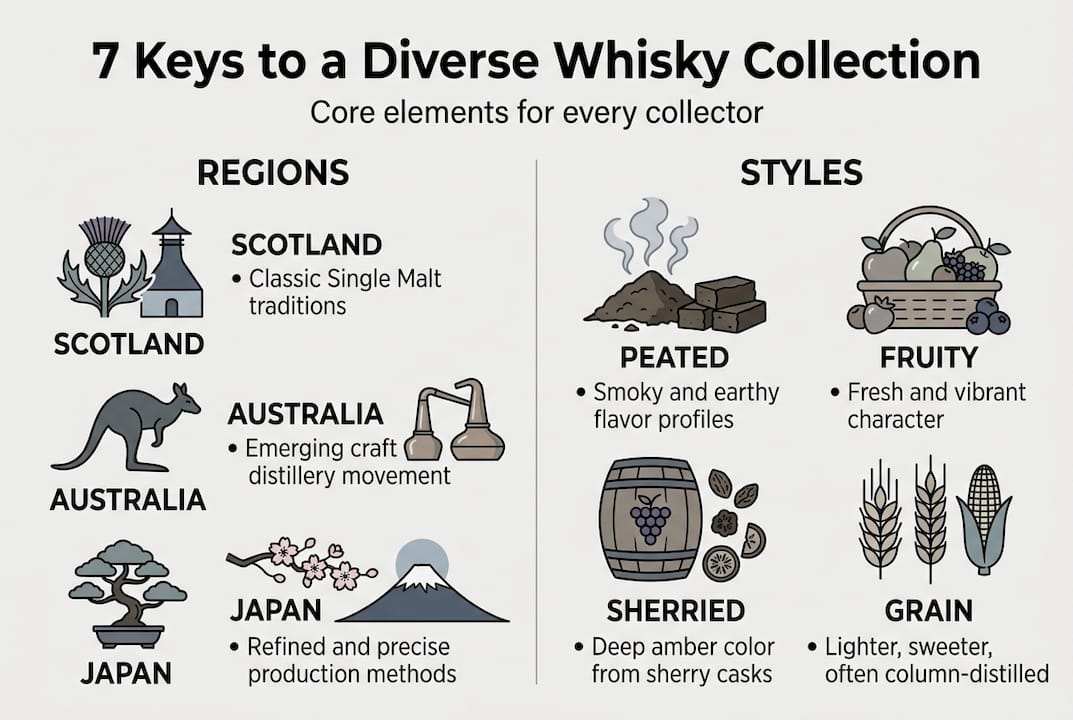
Start by mapping out the regions you want to represent. A well-rounded collection typically draws from at least four or five distinct whisky-producing areas. Consider these as your foundation:
- Scotland — the benchmark, with six distinct regions offering everything from delicate florals to full peat smoke
- Japan — precision-driven, often subtle, with a house style that rewards patience
- USA — bold bourbon and rye expressions with rich vanilla and spice
- Ireland — approachable triple-distilled styles that often surprise seasoned drinkers
- Australia — a rapidly maturing scene with genuinely world-class output, worth exploring through our Australian whisky comparison
- India — tropical climate maturation produces whiskies that age fast and drink beautifully
Next, think about flavour profiles. Do you lean towards smoky and peated expressions, or do you prefer fruity, sherried, or lightly floral drams? Knowing this helps you avoid accidentally duplicating the same flavour experience across multiple bottles. Aim to have at least one bottle that sits outside your comfort zone at all times.
That last point matters more than most collectors realise. Personal taste evolution is the real engine of a great collection — rotate wildcard bottles from emerging regions for both excitement and genuine development. Allocate one or two slots in your collection specifically for producers you’ve never tried, or regions you haven’t explored yet. Check out the top whisky regions worth adding to your radar.
Pro Tip: Revisit your collection goals once a year. Your palate changes, new distilleries emerge, and what excited you three years ago may no longer reflect who you are as a collector.
Essential building blocks: Regions, styles and must-have bottles
With your goals mapped out, it’s time to think about the actual bottles that form the backbone of a diverse collection. Global diversity is essential — include Japanese, American, Irish, and innovative Australian whiskies alongside your Scotch staples. Each region brings something genuinely different to the shelf.
Here’s a quick reference table to help you visualise regional diversity:
| Region | Key style | Unique feature |
|---|---|---|
| Scotland | Single malt, blended | Six sub-regions, huge stylistic range |
| Japan | Single malt, blended | Precision distillation, subtle complexity |
| USA | Bourbon, rye | New oak maturation, bold sweetness |
| Ireland | Triple-distilled pot still | Smooth, approachable, often underrated |
| Australia | Single malt, cask experiments | Rapid maturation, award-winning innovation |
| India | Single malt | Tropical ageing, rich and full-bodied |
For a balanced collection, aim to include these six types as your must-have foundation:
- A classic Scotch single malt from a region you love
- A Japanese expression — our Japanese whisky guide is a great starting point
- An American bourbon or high-rye expression
- An Irish pot still or single malt
- An Australian single malt — the best Australian single malts are genuinely competitive on the world stage
- A wildcard from an emerging region like India, Taiwan, or Scandinavia
Australian whisky has surged in international recognition, with local distilleries collecting major awards at global competitions including the San Francisco World Spirits Competition and the World Whiskies Awards in recent years.
Don’t overlook stylistic diversity within regions either. Scotland alone offers the delicate, grassy notes of the Lowlands, the rich fruit of Speyside, and the intense peat smoke of Islay. Explore Japanese whisky examples to see how much variety exists even within a single country’s output.
Sourcing rarities and local standouts: Strategies for Australian collectors
Knowing what you want is one thing. Finding it is another. Australian collectors are actually in an enviable position here. Local sourcing through clubs and direct releases gives Aussie collectors an edge, because rapid maturation and cask experimentation create high-value young whiskies that outperform their age statements.
Here’s how to approach sourcing strategically:
- Distillery clubs — many Australian producers offer membership programmes with first access to limited releases, barrel samples, and exclusive bottlings
- Specialty retailers — curated online stores stock hard-to-find imports that mainstream bottle shops simply don’t carry
- Auctions — both local and international auction platforms surface rare bottles, though provenance checks are essential
- Direct from distillery — visiting or ordering direct often yields cellar-door exclusives unavailable anywhere else
For Australian single malt picks, names like Starward, Lark, Sullivans Cove, and Hellyers Road are world-class choices that belong in any serious collection. Each distillery has its own character, and each offers releases that reward collectors who get in early.
Pro Tip: Sign up for distillery newsletters before you need a bottle. Limited releases often sell out within hours, and whisky club benefits frequently include pre-sale access that the general public never sees.
The open-versus-hold question is worth thinking through too. A good rule of thumb: buy two of anything you’re genuinely excited about. Open one to enjoy and learn from it. Hold the second to see how it develops in value or simply to revisit in a few years. Not every bottle needs to be an investment, but having the option is always satisfying.
| Sourcing channel | Best for | Typical advantage |
|---|---|---|
| Distillery clubs | Limited and exclusive releases | Early access, member pricing |
| Specialty retailers | Rare imports and curated picks | Expert guidance, rare stock |
| Auctions | Discontinued or aged expressions | Unique finds, collector bottles |
| Direct from distillery | Cellar-door exclusives | Unique bottlings, personal experience |
Collection management: Display, storage and ongoing evolution
Building a great collection is only half the work. Keeping it in excellent condition and refreshing it regularly is what separates a static shelf from a living, evolving collection.
Storage basics matter more than most people realise. Heat, light, and movement are the enemies of a well-kept bottle. Follow these principles:
- Store bottles upright to prevent the cork from prolonged spirit contact, which can cause deterioration
- Keep them away from direct sunlight — UV light degrades colour and flavour over time
- Maintain a steady ambient temperature, ideally between 15°C and 20°C
- Avoid storing near strong odours — corks are porous and can absorb surrounding smells
- Check partially opened bottles every few months and consider using inert gas sprays to slow oxidation
For display, think about telling a story with your shelf. Grouping by region creates a visual map of the whisky world. Mixing bottle shapes, label colours, and sizes makes the collection visually engaging for guests and sparks great conversation.

Rotation is where many collectors stall. It can feel wrong to remove a bottle you love, but a collection that never changes stops teaching you anything. Australian innovation challenges Scotch tradition in fascinating ways, and rapid maturation means many local whiskies drink beautifully young and fresh. This is a good reason to keep cycling in new Australian whiskies alongside your established favourites.
Set a simple annual review. Identify two or three bottles you’ve been holding onto without real reason, open them, enjoy them, and use the freed shelf space to bring in something new. A collection that breathes stays interesting.
A collector’s perspective: Why diversity makes every bottle count
Here’s something worth saying plainly: diversity in a whisky collection isn’t about ticking regional boxes or impressing guests with a globe-spanning shelf. It’s about what happens when you pour two very different drams side by side and suddenly understand something about both that you never would have grasped alone.
The myth that serious collectors should focus on a single iconic producer or region is, frankly, limiting. Regional stereotypes oversimplify the fun — not all Islay whisky is a peat bomb, and Australian innovation rivals tradition with unique casks outperforming in major awards. Staying inside one lane means missing the conversations, the surprises, and the genuine discoveries that make collecting worthwhile.
Real Aussie collectors thrive when they mix, rotate, and share new finds. The bottle that sparks the best conversation at a tasting is rarely the most expensive one on the shelf. It’s usually the unexpected one — the Tasmanian single malt next to a Speyside classic, or the Indian expression that nobody saw coming. Start exploring new whisky regions and you’ll quickly see what we mean.
Discover, collect and connect with unique whiskies
You’ve got the framework. Now it’s time to find the bottles.

At Uisuki.com.au, we’ve built a curated selection designed specifically for Australian collectors who want genuine variety — from rare Japanese expressions and award-winning local single malts to hard-to-find American and Scottish releases. We regularly update our stock with new arrivals and limited editions, so there’s always something worth discovering. Sign up for our newsletter to get early access to new stock, and keep reading our guides on whisky regions explored to keep building your knowledge alongside your collection.
Frequently asked questions
What is the most important factor when building a whisky collection?
Align your collection with your personal taste and include diverse styles and regions to maximise enjoyment. Constant discovery is key — frameworks help, but your palate should always be leading.
How do I find rare or exclusive Australian whiskies?
Join Australian distillery clubs and look for specialty retailers that offer members’ exclusive or limited releases. Local sourcing through clubs gives Aussie collectors direct access to high-value limited bottlings.
Is it worthwhile to buy whisky for investment or just for enjoyment?
Both approaches are valid — some bottles are worth opening straight away, while rare editions may appreciate in value if left sealed. Not all collectors need to invest, but having a mix of drinking and holding bottles keeps your options open.
How do I keep my whisky collection in top condition?
Store bottles upright, away from sunlight and heat, at a steady temperature between 15°C and 20°C for the best long-term preservation.