

Whisky tastes different because of three things stacked on top of each other: the base spirit itself (grain, yeast and distillation choices), the cask it ages in, and how you actually serve and taste it. The balance shifts by style. A peated Scotch leans hard on production, while a bourbon or sherry-finished single malt leans hard on the cask.
TL;DR:
- Over 200 flavour compounds in whisky are active at very low concentrations, making small production differences impactful on taste.
- Cask influence shapes whisky’s flavor more than distillation, with different oak types and treatment methods creating distinct taste profiles.
- The original spirit from the still, including its character and cut points, remains present and influences the final flavor even after years of aging.
- Factors like oxygen contact after opening, water addition, and storage conditions significantly alter the whisky’s aroma and taste over time.
- Tasting comparisons, such as single malts matured in different cask types, are key to understanding and recognizing cask-driven flavor differences.
Table of Contents
- Why does whisky taste different: ingredients and production shape the base spirit
- How do casks and ageing change whisky flavour?
- Does distillation still matter once whisky is in the cask?
- Why does the same bottle taste different over time?
- How should beginners taste whisky to notice these differences?
- What evidence backs these flavour differences?
- What I’ve learned watching people fall in love with whisky tasting
- Try bottles that show these differences for yourself
- Sources
- FAQ
Why does whisky taste different: ingredients and production shape the base spirit
Before a drop of whisky ever sees a barrel, its personality is already half formed. Grain choice sets the foundation. Barley gives a cereal, biscuity backbone and is the standard for single malt Scotch. Corn, dominant in bourbon, pushes sweetness and a rounder body. Rye brings spice and a peppery bite that cuts through sweetness, which is why rye whiskies taste sharper than bourbon even at similar proof. Wheat softens everything, giving a gentler, bread-like character often described as “wheated.”
Peat is where things get theatrical. When maltsters dry barley over peat smoke, phenolic compounds cling to the grain and survive fermentation, distillation and years in oak. Different peat bogs produce different smoke. Islay peat, cut close to the coast, tends toward medicinal, iodine-like notes, while Highland peat often reads as softer and more earthy. This regional variation is one of the clearest answers to why do whiskies differ so much even within the same country.
Fermentation is the quiet workhorse most drinkers never think about. Yeast strain and fermentation length determine how many esters form, and esters are what give whisky its fruity top notes: think green apple, pear, banana. A short, hot fermentation produces a heavier, oilier spirit. A long, slow one at cooler temperatures builds more esters and a fruitier, lighter profile. Distilleries guard their yeast choices and fermentation times closely because this stage does more to shape fruitiness than most people assume.
Then comes distillation, where the still itself becomes a flavour filter.
- Tall, narrow stills with long necks force more reflux, meaning heavier, oilier compounds condense and fall back for redistillation, producing a lighter, cleaner spirit.
- Short, squat stills with wide necks let more of those heavier compounds through, giving a richer, more robust new-make spirit.
- The “cut points,” where the distiller separates heads, hearts and tails, decide exactly which congeners make it into the final spirit and which get discarded or recycled.
- Double distillation (standard in Scotland) versus triple distillation (common in Ireland) changes how much congener complexity survives.
These production variables are why two whiskies made from the same grain, in the same region, can still taste nothing alike. The still shape and cut decisions are as much a signature as the recipe.
How do casks and ageing change whisky flavour?
Ask most veteran drinkers what drives flavour more than anything else, and they will point to the barrel. Wood is not a passive container. It is an active ingredient, and oak barrel ageing is widely regarded as the principal driver of whisky’s final flavour, often outweighing what happened during distillation.
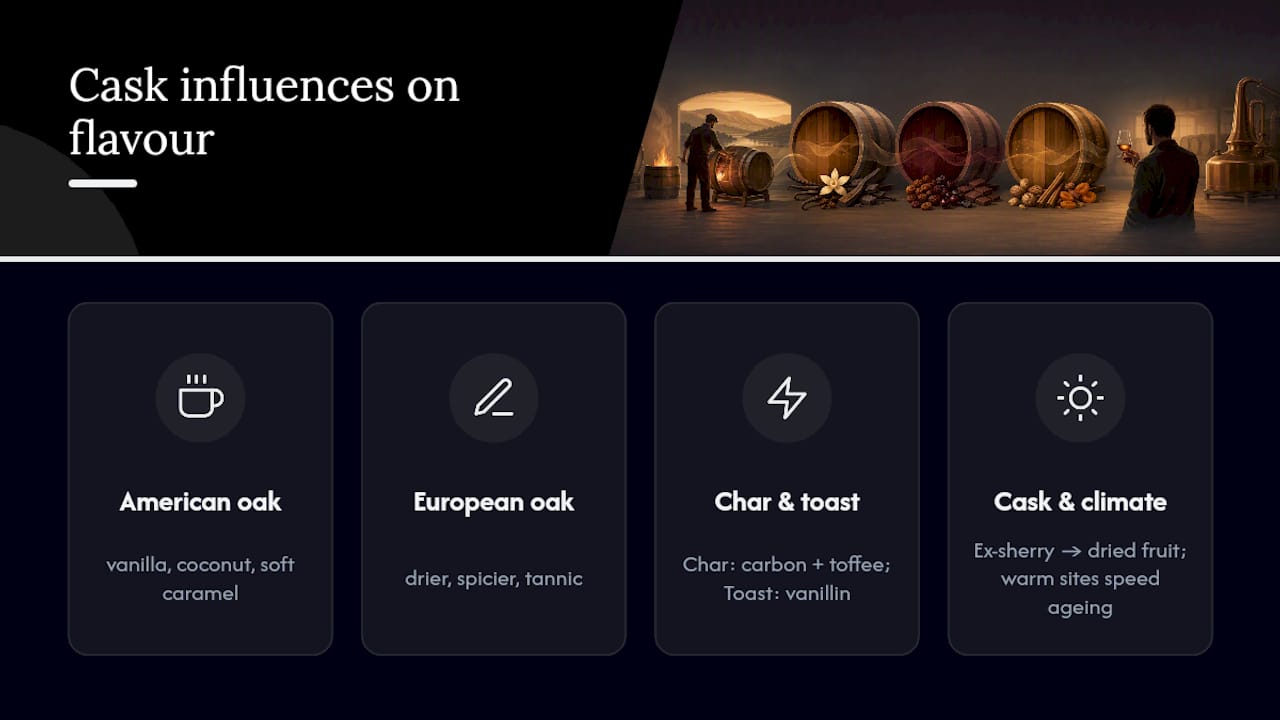
American oak and European oak behave differently inside the barrel. American oak, tight-grained and rich in oak lactones, tends to deliver classic vanilla, coconut and soft caramel notes. European oak, looser-grained and higher in tannins, pushes drier, spicier, more structured flavours, often with a firmer grip on the finish. This single choice explains a huge amount of the flavour variation between a bourbon-style malt and a heavily sherried one.
Char and toast level matter almost as much as the oak species. Charring a barrel burns the inner surface into a layer of active carbon, which filters out unwanted sulphur compounds and creates caramelised wood sugars that read as vanilla and toffee. Toasting, a gentler heat treatment used more in European cooperage, breaks down lignin into vanillin without the same carbon filtration. Both processes are chemical, not decorative, and they explain why a heavily charred bourbon barrel gives a different result to a lightly toasted sherry butt even using similar oak.
Then there is diffusion, one of the least understood parts of maturation for newcomers. When a barrel previously held sherry, bourbon or port, a genuine residue of that liquid remains soaked into the staves, and it slowly diffuses into the new spirit over years. This is why ex-sherry casks add dried fruit, raisin and a deeper, almost jammy sweetness that ex-bourbon casks simply cannot replicate. You can read more on how sherry cask maturation reshapes a whisky’s profile if you want the deeper mechanics.
Time and climate finish the job. Warmer, more variable climates (think Australia or Taiwan) push faster extraction and evaporation, meaning a five-year-old whisky can taste as mature as a twelve-year-old from a cooler Scottish warehouse. Seasonal temperature swings force the spirit in and out of the wood, accelerating flavour uptake, while evaporation, known as the angel’s share, concentrates the remaining liquid and intensifies both flavour and alcohol strength over time. For a closer look at how these ageing conditions play out in practice, our guide to ageing and premium flavour development covers the warehouse side of the story.
Pro Tip: If you want to taste cask influence in isolation, try two single malts of similar age, one matured in ex-bourbon oak and one finished in ex-sherry casks. The gap between them tells you almost everything about what wood alone contributes.
Does distillation still matter once whisky is in the cask?
Yes, and this is the part beginners tend to overlook. The cask reshapes flavour, but it does not erase what the still already built. New-make spirit, the clear, unaged liquid straight off the still, carries a distinct fingerprint that survives years of maturation. A distillery’s flavour profile is generally understood to be a combination of new-make character and cask extraction, not cask alone.
Still design decides whether that new-make spirit leans oily and robust or light and delicate. High reflux, from tall stills or slow distillation, strips out heavier congeners and produces a cleaner spirit that will taste lighter even after fifteen years in oak. Low reflux, from short stills or a fast run, keeps more of those heavier compounds, giving a fuller-bodied new-make that stays noticeably richer no matter what cask it meets.
The cut points a distiller chooses during distillation determine which congeners survive. Fruity esters, meaty sulphur compounds and waxy, soapy notes all sit at different points in the run, and where the “hearts” cut begins and ends decides the final mix. Some of these compounds are active at extraordinarily low concentrations. Phenolic compounds from peat have very low sensory thresholds, meaning tiny amounts can dominate a dram’s entire character even when they represent a fraction of the total liquid.
This is why two whiskies aged in identical casks for the same number of years can still taste completely different. If the new-make spirit going into those barrels was different, oilier from one still, lighter from another, the cask amplifies and reshapes that starting point rather than replacing it. Cask work is an editor, not a ghostwriter.
Why does the same bottle taste different over time?
Plenty of drinkers assume a bottle tastes identical from the first pour to the last. It rarely does, and the science behind it is straightforward once you understand what is happening in the glass and in the bottle itself.
Oxygen is the main culprit. Once a bottle is opened, the air pocket above the liquid grows every time you pour a dram, and oxidation from that changing fill level gradually shifts a whisky’s aroma and flavour over weeks and months. A bottle that is two-thirds empty has had far more oxygen contact than a freshly opened one, and the flavour, usually softer, sometimes flatter, reflects that.
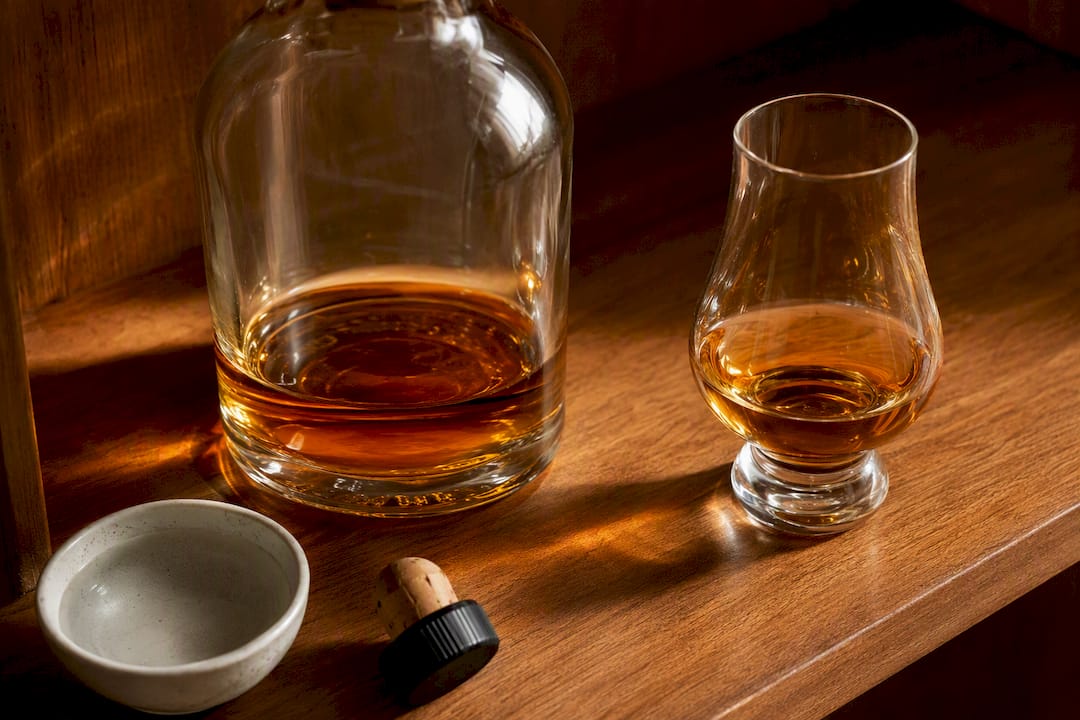
Water changes things instantly rather than gradually. Adding a few drops of water can release esters and aromatics that were previously masked, which is why a “closed” whisky can suddenly open up with the smallest splash. Ice does the opposite. Cold temperatures suppress volatile compounds, effectively muting the nose and flattening flavour, which is a big reason connoisseurs avoid ice on anything they actually want to taste properly.
A handful of everyday factors change what you perceive even when the liquid itself hasn’t changed at all:
- Glass shape concentrates or disperses aromas (a tulip-shaped glass traps more than a tumbler).
- Recent food or coffee dulls your palate for the next hour or more.
- Palate fatigue sets in after just two or three drams tasted back to back.
- Time of day and even mood shift how sensitive your nose is to subtle notes.
Storage plays a role too. Heat, light and an over-large air gap in a half-finished bottle all speed up unwanted change, which is one reason our guide on choosing the right water for whisky is worth a look if you’re serious about consistent tasting results.
How should beginners taste whisky to notice these differences?
You don’t need a trained palate to start picking up real differences. You need a routine, patience, and a willingness to taste the same whisky more than once.
- Pour a small measure and let it sit for a minute or two before nosing. Rushing straight in gives you alcohol burn, not flavour.
- Nose gently, mouth slightly open, from a few centimetres away rather than jamming your nose into the glass.
- Take a small sip and let it coat your whole mouth before swallowing, noting what hits first, middle and last.
- Rest for thirty seconds, then add two or three drops of water and taste again. Note what changes.
- Compare against a second whisky of a different style if you have one open, rather than relying on memory alone.
Three exercises build this skill fast. Try a side-by-side contrast between an ex-bourbon and an ex-sherry malt to isolate cask influence. Try the same whisky neat, then with water, to see how much aroma was hidden. And if you can get your hands on the same expression at two different ages, a bottle-age comparison shows maturation’s effect directly.
Most beginners make the same two mistakes: over-sniffing until the nose fatigues, and tasting too many drams in one sitting without a break. Space samples out, keep plain water or a dry cracker on hand as a palate cleanser, and stop after three or four serious tastings in a session.
What evidence backs these flavour differences?
Researchers have identified roughly 200 distinct flavour compounds in malt whisky, some active at parts-per-billion levels, which explains why such tiny production or cask differences produce noticeable changes in the glass. Industry sources generally treat new-make spirit and cask extraction as roughly co-equal contributors to final flavour, with oak ageing frequently cited as the larger single driver.
The tasting wheel used across the industry groups descriptors into categories like fruity, floral, peaty, feinty, sulphury and woody, separating what comes from production versus what comes from the cask. For deeper reading on how casks specifically reshape a whisky’s profile, our own breakdown of cask influence on flavour is worth bookmarking.
What I’ve learned watching people fall in love with whisky tasting
The biggest mistake I see beginners make isn’t picking the “wrong” whisky. It’s trying to taste everything at once, then feeling discouraged when nothing seems distinct. Flavour recognition is a skill, not a gift, and it builds with repetition and note-taking, not intensity.
Start light, move to something more robust, and save peated whiskies for last. Jumping straight to a heavily peated dram burns out your palate before you’ve learned to notice the subtler stuff underneath it.
— Brendan
Try bottles that show these differences for yourself
Reading about cask influence and new-make character only gets you so far. Tasting two whiskies side by side, one shaped heavily by bourbon oak, one reworked by a second cask, is what actually makes the theory click. We curate exactly these kinds of comparisons, sourcing bottles from Scotland, Japan, Australia and the US specifically because contrast teaches faster than any single bottle can.

If you want to feel cask finishing in action, the Hobart Whisky Bourbon Matured Rum Finished Single Malt shows how a secondary cask reshapes an already-mature spirit. For a study in how grain and malt character interact in a blend, the Ichiro’s Malt and Grain World Blended Whisky is a genuinely educational pour. And if smoke and peat are what you’re chasing, the Ardnamurchan Macleans Nose Blended Scotch demonstrates regional peat character without the heavier price tag of some single malts. Browse a curated range and pick a bottle that matches the flavour driver you’re most curious about.
Sources
- A flavour profile | Whisky Magazine
- Source of Whisky’s Flavor – Selfbuilt’s Whisky Analysis
- Whisky tasting wheel | The Whiskey Masters
- Is it the whiskey or is it you? Why your dram keeps changing | The Whiskey Wash
- How to taste whisky — Whisky Centurion
FAQ
Is it true that all whisky tastes the same?
No. Grain type, fermentation, still shape, cask choice and ageing conditions all produce measurably different results, which is why a peated Islay malt and a wheated bourbon share almost nothing on the palate.
Does anyone actually like the taste of whisky, or is it an acquired thing?
Plenty of people enjoy whisky from their first proper tasting, particularly lighter, less peated styles, but many drinkers genuinely need repeated exposure before they pick up subtler notes like dried fruit or vanilla. Starting with a lighter, sherry-influenced or bourbon-style single malt makes the transition easier than diving straight into a heavily peated dram.
Is Scotch better than other whisky styles?
Not objectively. Scotch follows strict regional rules around ingredients and maturation, but bourbon, Japanese and Australian whiskies use different grains, casks and climates to produce equally complex, simply different, results.
Why do some whiskies taste smoky and others don’t?
Smoky, medicinal notes come from phenolic compounds absorbed during peat kilning — a step some distilleries use heavily and others skip entirely. Regional peat also varies. Coastal Islay peat tends to read as more medicinal, while inland peat is often softer and earthier.
Is whisky the worst alcohol for you compared to other drinks?
There’s no solid evidence whisky is uniquely worse than other spirits at equivalent alcohol strength. Overall health impact depends far more on quantity and frequency of drinking than on which spirit you choose.