

You can enjoy whisky tonight by picking one simple serve, pouring a small measure, and running a short tasting routine: gentle nose, two small sips, then a splash of water to see how it opens up. There’s no single “correct” way to drink it. Personal taste and safe moderation matter more than any ritual.
TL;DR:
- Most beginners should start with neat whisky, then add a few drops of water to observe how it enhances aroma and flavor without overpowering.
- Using a narrow glass like a Glencairn concentrates aromas and improves the tasting experience, especially with small pours for detailed analysis.
- Tasting routines that include nosing, sipping, and water comparison teach more about whisky flavors than simply reading tasting notes.
- The main whisky flavor families are fruity, floral, malty, smoky, waxy, and woody, influenced by factors like peat level, still design, and cask type.
- Proper storage involves keeping bottles upright, away from sunlight and heat, and decanting to a smaller container when nearly empty to prevent oxidation.
Table of Contents
- What’s the easiest way to enjoy whisky as a beginner?
- How do you taste whisky step by step?
- Does the glass and pour size actually matter?
- What are the main whisky flavour families?
- How do you train your palate without getting overwhelmed?
- What mistakes should you avoid when tasting whisky?
- Why trust this whisky guide?
- What’s the difference between single malt, blended and bourbon?
- How do you pair whisky with food or cigars?
- How should you store an open bottle of whisky?
- How do you read a whisky label properly?
- Try this: a 30 to 45 minute beginner tasting plan tonight
- Sources
What’s the easiest way to enjoy whisky as a beginner?
Four serves cover almost everything you’ll encounter, and each teaches you something different about the liquid in your glass.
- Neat means whisky with nothing added, at room temperature. It shows you the whisky exactly as the distiller made it, which is why most guides recommend starting here even if the alcohol heat feels sharp at first.
- A splash of water (a few drops to a teaspoon) softens that heat and often unlocks aromas that stay hidden in a neat pour, according to Whisky Advocate.
- On the rocks chills the whisky and mutes both the burn and a fair chunk of the aroma, which suits hot afternoons more than serious tasting.
- Cocktails such as a whisky sour or an old fashioned use sugar, citrus, or bitters to balance the spirit, making them a forgiving entry point if straight whisky still feels intense.
If you’re brand new, try the same whisky neat, then with a few drops of water, side by side. You’ll notice the difference in under a minute, and that single comparison teaches you more than reading ten tasting notes ever will.
How do you taste whisky step by step?
Tasting isn’t about performance. It’s a short, repeatable routine you can run in about five minutes, and TasteScot notes that smell does most of the work, since somewhere around 70 to 80% of what you perceive as flavour actually comes from your nose rather than your tongue. That’s why the nosing step below matters more than people expect.
Here’s the routine, drawn from methods used by Whisky Advocate and Tomatin:
- Pour a small, standard tasting measure, enough to nose and sip through the full routine without waste.
- Let the glass rest for one to two minutes. This gives the alcohol vapour time to settle so it doesn’t just smell like ethanol.
- Nose it with short, gentle sniffs, mouth slightly open. Don’t inhale hard through the nose like you’re checking milk. That just burns your senses and tells you nothing.
- Take a small sip, hold it for two to three seconds, then swallow.
- Breathe out gently through your mouth. This retrohale step often reveals the longest and most interesting flavours, ones you’d never catch on the sip alone.
- Add two or three drops of still water, swirl, re-nose, and sip again. Compare what changed.
- Jot a one-word note on the dominant flavour before you move to anything else.
Pro Tip: Never taste with ice in the glass. Ice chills the whisky and mutes its aroma, so you’re tasting a quieter, flatter version of it, not the same drink at a different temperature.
Run this whole sequence in under five minutes and you’ll already taste more than most people manage in a full night of casual sipping.
Does the glass and pour size actually matter?
They do, more than most beginners expect. A narrow tulip glass or a Glencairn concentrates aroma at the rim, funnelling it toward your nose instead of letting it scatter the way a wide tumbler does. A standard wine glass works as an everyday stand in if you don’t own a Glencairn yet.
- Tasting pour: a small measure standard for tasting, enough to nose and sip through the full routine without waste.
- Casual pour: a larger measure suited to sipping over conversation rather than close analysis.
- Serving temperature: roughly 18 to 20°C, essentially room temperature. Whisky served too cold locks up its aromatics.
- If you like it colder: use one large ice cube rather than a handful of small ones, since a single cube dilutes and chills more slowly, keeping more flavour intact for longer.
Warming the glass gently in your hand for a minute before nosing can also help, especially with a whisky that’s just come out of a cool cupboard.
What are the main whisky flavour families?
Whisky flavour breaks down into a manageable set of families rather than an endless list of adjectives. The Whisky Magazine tasting wheel groups aromas into eight sectors: cereal, fruity, floral, peaty, feinty, sulphury, woody, and winey, split broadly between flavours created during fermentation and distillation, and those added later during cask maturation.
Scotch Authority’s flavour research narrows this to a similar set of core families you’ll actually taste in the glass:
- Fruity (apple, pear, tropical notes)
- Floral (heather, vanilla, light perfume)
- Malty or cereal (biscuit, toast, porridge)
- Smoky or peaty (bonfire, tar, medicinal)
- Waxy (candle wax, beeswax)
- Woody (oak, spice, vanilla, coconut)
The chemistry behind these families is fairly traceable: peat level, measured in phenol parts per million, drives smoky and medicinal notes, tall copper stills tend to push whisky toward lighter, floral character, and ex-bourbon oak brings the vanilla and coconut you’ll taste in countless single malts.
A simple two-axis flavour map, plotting smoky against delicate on one axis and light against rich on the other, gives you a practical shopping tool. If a whisky you love sits in the light, floral corner, look for bottles nearby on the map. If you want contrast rather than comfort, head for the opposite corner instead of guessing.
How do you train your palate without getting overwhelmed?
Palate development is a habit, not a talent. Short, frequent sessions beat one long, exhausting tasting marathon, largely because your nose tires quickly and stops sending you useful signals after too many sniffs in a row.
- Compare two drams side by side rather than tasting one whisky in isolation. Contrast teaches your brain far faster than a single sample ever will.
- Practise single-note focus. Pick one everyday smell, cut apple, toast, honey, and hunt for it specifically in a whisky before moving to the next descriptor.
- Cap sessions at two or three whiskies. Beyond that, olfactory fatigue sets in and every dram starts tasting the same.
- Keep a note template. Dominant flavour in one word, how it changed with water, and a simple enjoyment score out of five. That’s enough detail to build a real memory library over weeks, without turning a hobby into homework.
What mistakes should you avoid when tasting whisky?
Most tasting mistakes come from rushing, and they’re easy to fix once you notice them.
- Don’t take one big mouthful. Several small sips with pauses between them reveal more than a single gulp ever will.
- Don’t nose hard or immediately after pouring. Give the glass a minute or two to settle first, and use short sniffs rather than deep inhales.
- Don’t skip water. A few drops can open a cask-strength whisky that seems shut down and harsh when tasted neat.
- Pace yourself across a session, and be aware of ABV, since cask-strength releases can sit well above 55%, meaning a “small” pour still carries real alcohol content.
- If you’re hosting, water and food are as important as good glassware. Nobody enjoys tasting on an empty stomach after the third pour.
Why trust this whisky guide?
Com built its educational content around the same tasting methods used by leading distilleries and reference guides, translated into plain language for people who’ve never done a formal tasting before. Our team draws on hands-on retail experience curating bottles from Scotland, Japan, Australia, and the USA, alongside the palate-building techniques covered in Uisuki’s own tasting notes guide and scotch tasting primer. If you want a deeper regional breakdown once the basics click, the Scotch flavour guide is a natural next step.
What’s the difference between single malt, blended and bourbon?
The three terms describe how a whisky is made, not how good it is, and mixing them up is the most common beginner confusion.
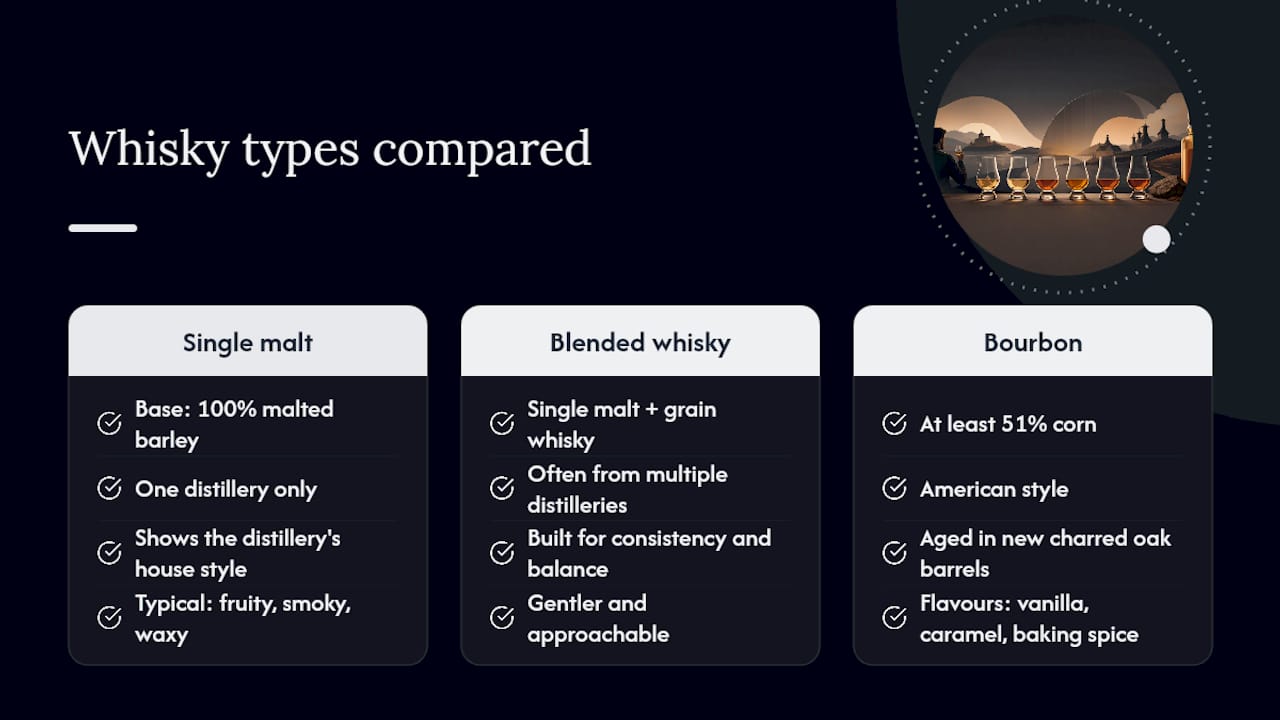
Single malt is made from 100% malted barley, distilled at one distillery. It tends to carry the clearest expression of that distillery’s house style, whether that’s fruity, smoky, or waxy.
Blended whisky combines single malt with grain whisky (often made from wheat or corn in a continuous still), usually from multiple distilleries. Blends are built for consistency and balance rather than showcasing one distinctive character, and they’re often gentler and more approachable for a first-timer.
Bourbon, an American style, must be made from at least 51% corn and aged in new charred oak barrels. That charred new oak is why bourbon leans so heavily into vanilla, caramel, and baking spice, quite different territory from a peaty Scotch single malt.
None of these is objectively “better.” A well-made blend can outshine a mediocre single malt, and a bourbon drinker exploring Scotch for the first time should expect a genuinely different flavour language, not a lesser version of what they already know. Try one of each side by side if you can. It’s the fastest way to feel the real difference rather than just reading about it.
How do you pair whisky with food or cigars?
Pairing works on a simple principle: match intensity, then look for either a complement or a contrast. A light, floral whisky gets lost next to a rich, fatty steak, while a peaty, smoky dram can stand up to strong cheese or dark chocolate without disappearing.
Some reliable starting points:
- Smoky, peaty whisky with smoked salmon, strong cheddar, or dark chocolate.
- Sherry-matured whisky (dried fruit, spice notes) with Christmas cake, fruit crumble, or blue cheese.
- Light, floral, or fruity whisky with fresh fruit, soft cheese, or light desserts, where a bold dram would overpower the food.
- Bourbon with barbecue, grilled meat, or anything with caramelised sugar, since the char and vanilla notes echo the smokiness of the grill.
Cigar pairing follows a similar contrast rule. A full-bodied cigar generally needs a richer, higher-proof whisky to stand alongside it. A mild cigar gets overwhelmed by a heavily peated dram, so lean toward something gentler, like a light Speyside style or a smooth blend.
The failure mode to avoid is pairing two overpowering things together. A super smoky whisky and a full-strength cigar don’t amplify each other, they just cancel each other out, and you end up tasting neither properly.
How should you store an open bottle of whisky?
Whisky stored correctly barely changes for years, but a few habits protect it properly. Keep bottles upright, not lying on their side, since prolonged contact between spirit and cork can degrade the seal over time in a way that doesn’t happen with wine’s different chemistry.
Store away from direct sunlight and heat. A kitchen shelf above the oven or a windowsill in full sun will slowly degrade flavour compounds, even though whisky is far more stable than wine once bottled. A cupboard or a dedicated shelf out of direct light is plenty.
Once a bottle is under roughly a third full, oxidation speeds up because there’s more air sitting on top of the liquid, and the whisky can flatten out over several months. If you’ve got a half-finished bottle you’re not going to get through quickly, decanting it into a smaller, airtight container reduces that airspace and slows the process.
Temperature swings matter more than a fixed number. A stable spot, whether that’s 15°C or 22°C, beats a location that lurches between hot and cold across the day. And once opened, most whiskies are genuinely fine to drink for a year or more, so there’s no need to rush a bottle out of anxiety about spoilage.
How do you read a whisky label properly?
A label tells you far more than the brand name if you know what to look for. The age statement (say, “12 Years Old”) states the youngest whisky in that bottle, not an average, so a 12 year old might contain some far older liquid blended in for character.
“Single malt” means one grain, malted barley, from one distillery. “Blended” means multiple whiskies, often malt and grain, combined. “Single grain” uses one distillery but grains other than malted barley, a category that trips up a lot of newcomers.
Cask type is often the most useful flavour clue on the whole label. “Ex-bourbon” or “American oak” points toward vanilla and coconut. “Sherry cask” or “oloroso finish” signals dried fruit and spice. “Finished in [cask type]” means the whisky spent most of its life in one cask, then a shorter period in a second cask for extra character.
Region and origin matter too, though less rigidly than older guides suggest. A Speyside label often leans lighter and fruitier, an Islay label often leans smoky and maritime, but plenty of distilleries in both regions now break that pattern deliberately.
Try this: a 30 to 45 minute beginner tasting plan tonight
Pour two contrasting drams, 25ml each. Nose both, sip both, note one word per whisky. Add water to each, retaste, and note what changed. Finish by ranking which you preferred and why.
There’s no wrong answer here. The whole point is figuring out what you actually like, not what a tasting note says you should like.
— Brendan
If tonight’s plan has you wanting a bottle to start with, Com’s Hobart Whisky Bourbon Matured Rum Finished Single Malt is an approachable, distinctive first pour that shows off cask influence clearly. If you’d rather explore a blended world whisky, Ichiro’s Malt and Grain is a genuinely interesting bottle for comparing blend character against single malt. And for a modern coastal style that hints at smoke without overwhelming a beginner palate, the Ardnamurchan Macleans Nose is worth adding to your side-by-side tasting list.
Sources
- Tasting wheel | Whisky Magazine
- Scotch flavour profiles | Scotch Authority
- How to taste whisky properly | TasteScot
- How to enjoy whisky | Whisky Advocate
- How to taste whisky – step by step | Tomatin