

Distilled or low-mineral filtered water is the safest bet for diluting whisky, because it carries no competing flavour of its own. Bring it to room temperature, add a few drops at a time, and taste between each addition. Everything else, brand picks, ratios, and the chemistry behind why this works, follows below.
TL;DR:
- Distilled or deionised water is the best choice for whisky dilution because it contains no minerals that could alter the whisky’s flavor or aroma.
- Adding a small amount of room-temperature water to cask-strength whiskies can enhance volatile flavor compounds, revealing more aroma and smoothness.
- Using regional low-mineral spring water can complement a whisky’s provenance, but high-mineral bottled water may dampen delicate aromatics and should be avoided.
- The best method involves adding one or two drops at a time, tasting between additions, and ensuring water is at room temperature for accurate flavor assessment.
- Water choice and dilution technique matter most for high-proof or cask-strength whiskies, where careful incremental addition can markedly improve tasting experience.
Table of Contents
- What’s the best water for whisky dilution?
- Why a splash of water changes a whisky
- How to add water: temperature, amount and method
- Recommended bottled waters and what each suits
- Expert tips from Brendan and Uisuki’s tasting approach
- A brief perspective: preference and experimentation matter
- Want bottles worth experimenting on? Browse Uisuki’s curated range
- Sources
What’s the best water for whisky dilution?
Distilled and deionised water win on neutrality alone. Neither contains dissolved minerals, so neither can clash with a whisky’s existing character. America’s Test Kitchen found that whisky cut with distilled water produced more robust aromas and smoother finishes than the same whisky cut with tap water, which is about as close to a controlled taste test as this topic gets.
Low-mineral spring water is the next best option, and sometimes the more interesting one. A spring sourced near the region a whisky was distilled can echo something of that whisky’s own water source, though Scotchwhisky, since those minerals thicken mouthfeel and can bury the subtler notes you’re trying to find.
Filtered tap water works in a pinch, but only if your tap water isn’t heavy with chlorine or metallic aftertaste. If you can smell your tap water before you even add it to a glass, don’t use it.
- Distilled or deionised water: zero minerals, zero flavour interference, the default choice for serious tasting.
- Low-mineral spring water: a regional match can complement a whisky’s provenance, but check the mineral content first.
- Filtered tap water: acceptable only if it’s odourless and free of chlorine or metallic notes.
- High-mineral bottled water: best avoided; it adds body but can flatten delicate aromatics.
Cask-strength whiskies (often 55% to 65% ABV) can handle more water and benefit from it, since there’s more raw alcohol burn to soften.
Why a splash of water changes a whisky
Ethanol binds to certain flavour compounds and, at higher concentrations, keeps them tucked away from your nose. Lower the ABV even slightly and those compounds become more volatile, meaning they evaporate more readily and reach your olfactory senses in greater concentration. Physicists writing for AIP Inside Science describe this as the core reason a splash of water can “open” a whisky, rather than simply weakening it.
Statistic Callout: Tasting comparisons cited by America’s Test Kitchen found distilled-water dilution produced noticeably more aroma and a smoother finish than tap-water dilution in side-by-side pours, a small but telling gap given the only variable was the water itself.
This doesn’t mean every whisky wants water. Some bottlings, particularly lower-proof ones already built around a delicate balance, can lose more than they gain from even a few drops. Treat dilution as a tool you test, not a rule you apply automatically.
How to add water: temperature, amount and method
Room-temperature water, roughly 15.5°C to 18.3°C, gives you the truest read on a whisky. Cold water suppresses aroma compounds and hot water exaggerates the alcohol burn, so either extreme skews what you’re actually tasting.
The method itself is simple:
- Taste the whisky neat first, and note what you smell and taste before touching the water.
- Add one or two drops using a pipette or teaspoon.
- Swirl gently, wait a few seconds, and taste again.
- Repeat in small increments until the whisky feels open rather than diluted.
If you’re drinking a non-chill-filtered whisky, don’t be alarmed if it clouds slightly when water hits it. That’s natural fatty acids and esters precipitating out, not a fault.
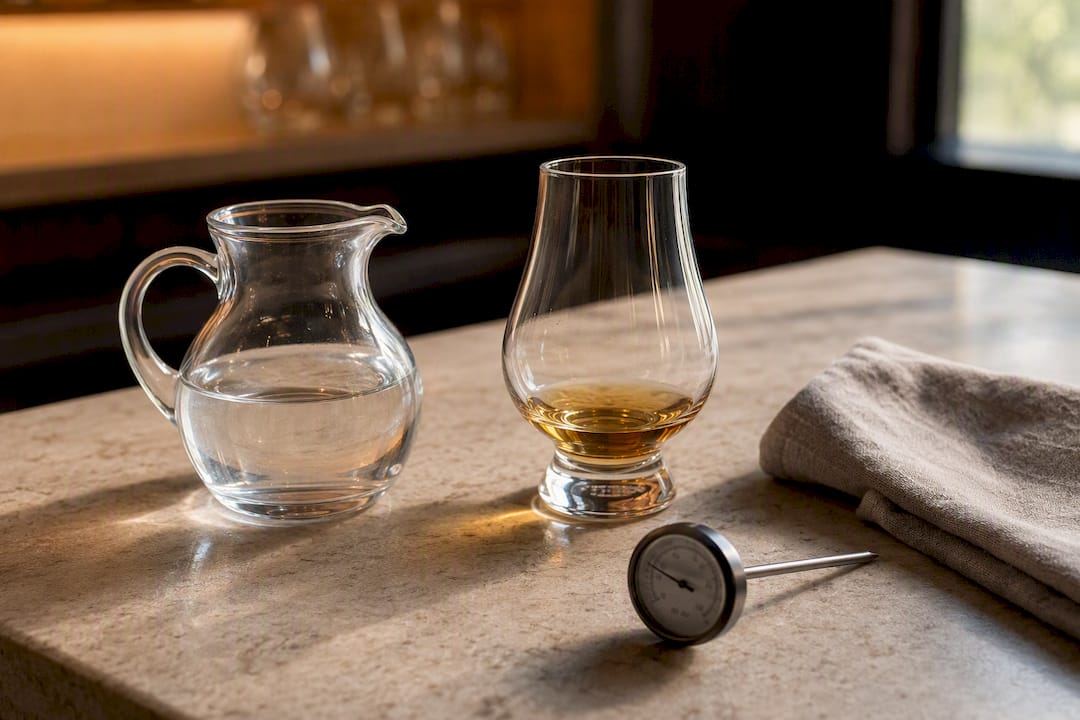
Pro Tip: Keep a small jug of your chosen water sitting at room temperature near your tasting glass, rather than grabbing it straight from the fridge or the tap. Consistency in temperature matters more than most people realise.
Recommended bottled waters and what each suits
Retailers and distilleries alike tend to circle back to the same shortlist of bottled waters, each suited to a slightly different job.
- Uisge Source offers regional variants matched to Islay, Speyside, and Highland styles, useful if you want a water that echoes the whisky’s own geography.
- Franklin & Sons (Scottish artesian) is often suggested for cask-strength drams, where a firmer mineral backbone can stand up to higher ABV without disappearing.
- Deeside mineral water is exceptionally soft, and that softness tends to tease out delicate, floral notes in lighter whiskies rather than compete with them.
- Highland Spring and Hildon are dependable, low-mineral options with consistent profiles bottle to bottle, a safe default when you don’t want variability.
- Old Limestone Mixing Water is limestone-filtered spring water from the United States, built specifically with bourbon-style whiskeys in mind. The Gentleman’s Journal notes that several of these branded waters are essentially low-mineral spring waters marketed with regional pairings, which is a fair point. Distilled water remains the more neutral baseline if you want to isolate the whisky’s character without any outside influence at all.
Expert tips from Brendan and Uisuki’s tasting approach
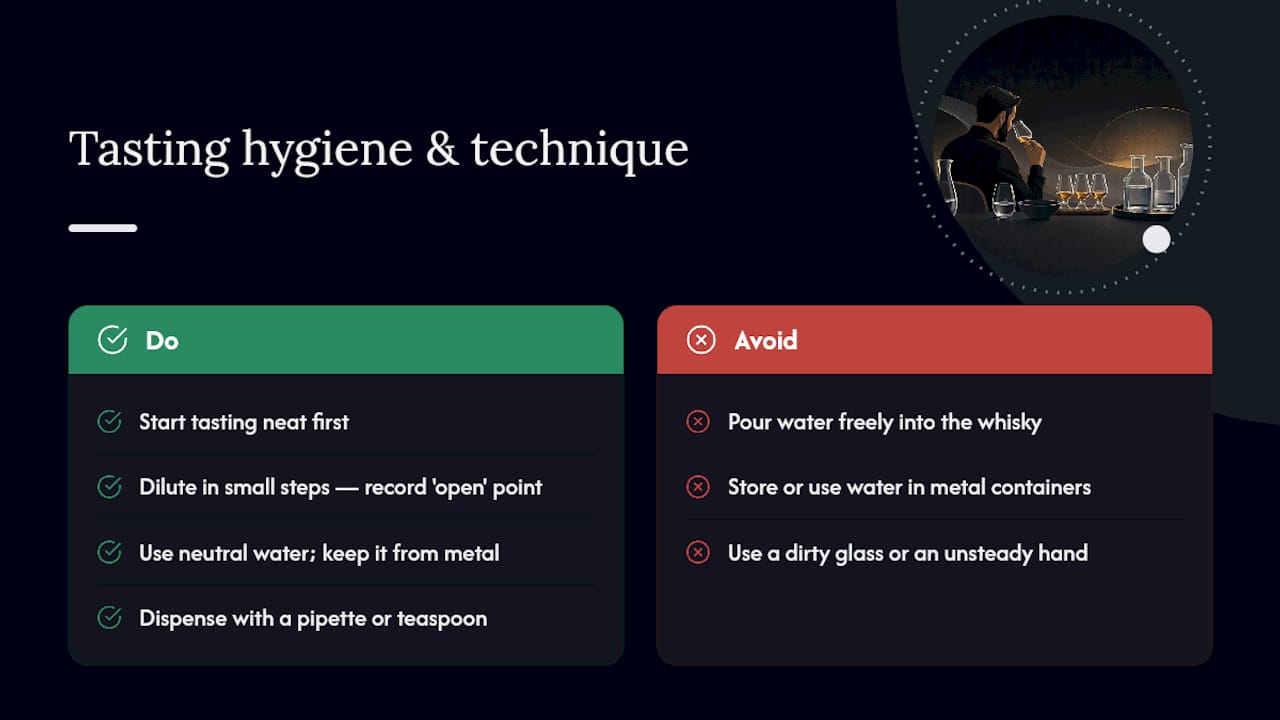
Our approach at Uisuki always starts neat. We taste before adding anything, then dilute in small steps, recording the exact point where a whisky “opens” so we can describe it accurately to customers. We use dedicated neutral water, kept away from metal containers, and dispense it with a pipette or teaspoon rather than pouring freely. A clean glass and a steady hand matter more than people expect.
A brief perspective: preference and experimentation matter
Distilled or low-mineral water, added at room temperature in small increments, is the recommendation that holds up best. But taste is personal. Try a splash, track what changes, and always taste neat before you touch the water.
— Brendan
Want bottles worth experimenting on? Browse Uisuki’s curated range
Water choice only matters once you’ve got a whisky worth diluting. Uisuki curates bottles across Scotland, Japan, Australia, and the USA, with product pages that flag ABV, cask strength, and tasting notes so you can match your water approach to the right dram before you even open it.

Cask-strength bottlings reward the incremental dilution method described above; standard-strength releases often need barely a drop. Either way, having a few different styles on hand, an Islay peater, a soft Speyside, a high-proof bourbon, gives you real material to test these water rules against rather than guessing from one bottle. Browse the current range at Uisuki and pick something worth the experiment.
Sources
- Want better-tasting whiskey? Just add (distilled) water — VinePair / America’s Test Kitchen summary
- Why your water temperature matters when mixing with whiskey — Tasting Table
- Not so neat: why you should add water to your whiskey — AIP Inside Science
- Why the water you add to your whisky matters — The Gentleman’s Journal