

TL;DR:
- Blended Scotch accounts for about 90% of global Scotch whisky sales, not single malt.
- Scotch whisky must be distilled and matured in Scotland under strict legal regulations.
- Understanding categories, regions, and production variables helps collectors make informed purchasing decisions.
Single malt gets all the glory, but here’s a fact that surprises many Australian whisky lovers: blended Scotch makes up about 90% of all Scotch whisky sold globally. Most enthusiasts spend years chasing single malts while an entire world of legally defined categories sits quietly in the background, shaping what’s in every bottle they buy. The Scotch Whisky Regulations 2009 legally define five categories of Scotch whisky, each with its own production rules, flavour tendencies, and collecting potential. Understanding these categories doesn’t just satisfy curiosity. It actively sharpens your purchasing decisions, helps you spot genuine value, and gives you the confidence to build a collection worth talking about.
Table of Contents
- What makes a whisky Scotch?
- The five official types of Scotch whisky explained
- How Scotch whisky regions influence flavour
- What collectors and enthusiasts should look for
- The truth behind prestige: Myths, exceptions and what matters most
- Explore, taste and collect with confidence
- Frequently asked questions
Key Takeaways
| Point | Details |
|---|---|
| Five legal types | Scotch whisky is officially classified into five distinct types, each with unique production rules. |
| Region shapes flavour | Whisky regions impact style, but specific distilling choices often matter more for taste. |
| Blends rule the market | Blended Scotch is the most widely consumed type and offers great consistency and value. |
| Collector focus points | Seek provenance, age statements, and legal authenticity for the best collecting and tasting experience. |
What makes a whisky Scotch?
Before you can appreciate the five categories, you need a solid grasp of what qualifies as Scotch whisky in the first place. This isn’t just academic. For Australian collectors importing bottles or buying from specialist retailers, these rules are the difference between an authentic product and a misleading label.
Scotch whisky is governed by strict UK law, and those standards apply to every bottle that enters Australia under the Scotch name. The core requirements are clear: Scotch must be distilled and matured in Scotland, aged in oak casks no larger than 700 litres for a minimum of three years, bottled at no less than 40% ABV, and produced using only water, yeast, and grains, with malted barley required for malt whisky expressions.
These aren’t just bureaucratic checkboxes. They exist to protect the integrity of one of Scotland’s most important exports and to give buyers like you a reliable framework for evaluating what you’re purchasing. When you’re buying premium whisky at the collector level, knowing these rules helps you verify authenticity before spending serious money.
Here’s a quick summary of the non-negotiable requirements under the Scotch whisky regulations:
- Origin: Distilled and matured entirely in Scotland
- Cask size: Oak casks of 700 litres or less
- Maturation period: Minimum three years
- Bottling strength: At least 40% ABV
- Permitted ingredients: Water, yeast, and cereal grains (malted barley mandatory for malt categories)
- No artificial additives: Only plain caramel colouring (E150a) is permitted for colour adjustment
“The regulations are not just about tradition. They are a legally enforceable guarantee of provenance, process, and quality that no other whisky category in the world matches in scope.”
For Australian collectors, this matters practically. If a bottle claims to be Scotch but was aged outside Scotland or blended with neutral spirits not permitted under the rules, it simply cannot be labelled as Scotch whisky. Always check the label carefully and buy from reputable sources who understand these distinctions.
The five official types of Scotch whisky explained
Now that you know what makes a whisky Scotch, let’s look at the categories themselves. The five legal categories are Single Malt, Single Grain, Blended Malt, Blended Grain, and Blended Scotch. Each has a distinct production profile that shapes its character, price point, and collectibility.
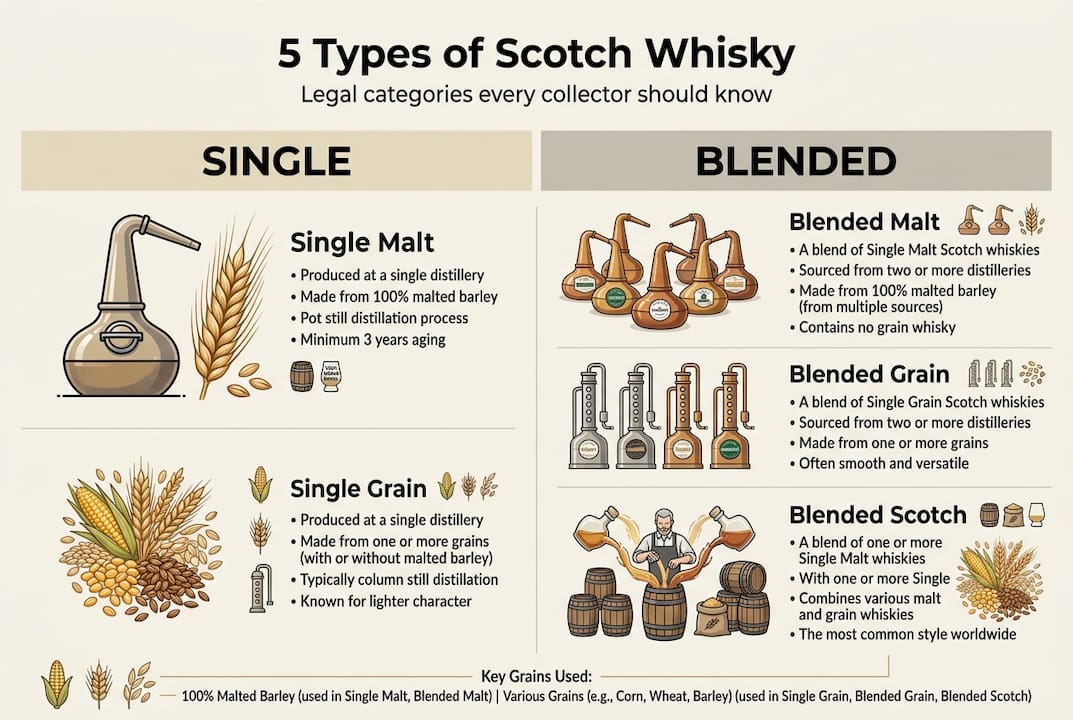
| Category | Key grains | Still type | Source |
|---|---|---|---|
| Single Malt | 100% malted barley | Pot stills | One distillery |
| Single Grain | Mixed grains allowed | Column stills | One distillery |
| Blended Malt | 100% malted barley | Pot stills | Two or more distilleries |
| Blended Grain | Mixed grains | Column stills | Two or more distilleries |
| Blended Scotch | Malt and grain combined | Both | Multiple distilleries |
Single Malt is the category most Australian enthusiasts know well. It must come from a single distillery, use 100% malted barley, and be distilled in pot stills. This combination creates the complexity and distillery-specific character that collectors prize. Think Glenfarclas, Laphroaig, or GlenDronach. Each bottle is a direct expression of one place and one process.
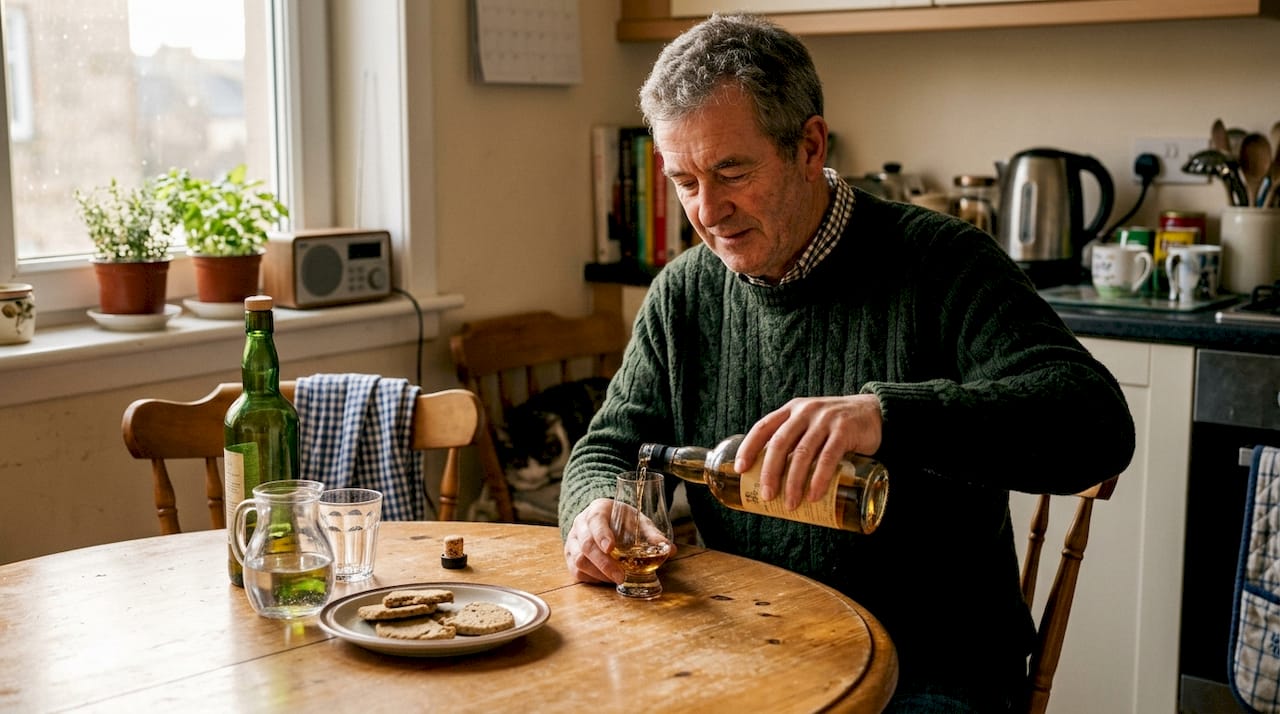
Single Grain is less understood but genuinely fascinating. It comes from one distillery but can use other grains like wheat or corn alongside malted barley, and it’s typically distilled in continuous column stills. The result is often lighter and more approachable, and differences between Scotch types show that single grains are increasingly valued for their unique texture and underrated complexity.
Blended Malt combines single malts from two or more distilleries with no grain whisky involved. This category, previously called “vatted malt,” allows master blenders to craft flavour profiles impossible from a single source. Blended Grain does the same but with grain whiskies only.
Blended Scotch, the category that dominates roughly 90% of sales, combines malt and grain whiskies from multiple distilleries. Johnnie Walker, Chivas Regal, and Dewar’s are the obvious examples. Consistency, accessibility, and value are the hallmarks here.
Pro Tip: Don’t overlook Blended Malt when building a collection. These expressions often offer the complexity of single malts at a more accessible price, and they’re still relatively underappreciated in the Australian market. Check out flavour profiles by type to identify which category suits your palate best, and explore whisky collecting tips for practical guidance on building a well-rounded collection.
How Scotch whisky regions influence flavour
Unpacking Scotch types naturally leads into the influence of where it’s made. Scotland has five protected regions: Speyside, Highlands, Lowlands, Islay, and Campbeltown. Each carries a reputation for a particular style, and understanding these regional identities helps you read labels and set expectations before you even open a bottle.
| Region | Typical character | Notable distilleries |
|---|---|---|
| Speyside | Fruity, floral, honeyed | Glenfiddich, Macallan, Aberlour |
| Highlands | Varied, often rich and full-bodied | Dalmore, Glenmorangie, Oban |
| Lowlands | Light, grassy, gentle | Auchentoshan, Glenkinchie |
| Islay | Peaty, smoky, maritime | Laphroaig, Ardbeg, Bruichladdich |
| Campbeltown | Briny, oily, complex | Springbank, Glen Scotia |
Islay is the region most whisky lovers encounter first when they want smoke. The island’s distilleries use heavily peated malt, and the maritime climate leaves a distinctive coastal character in the spirit. Speyside, by contrast, is the heartland of approachable, fruit-forward single malts, home to more distilleries than any other region.
However, production variables impact flavour more than geography alone. A Highlands distillery using heavily peated barley and ex-sherry casks will taste nothing like its unpeated neighbour. Cask type, distillation cut points, still shape, and maturation environment all contribute more to the final flavour than a postcode ever could.
This is a critical insight for collectors. Regional labelling is a useful starting point, not a guarantee. Here’s what to look for beyond the region:
- Cask type: Ex-bourbon, ex-sherry, port, and wine casks each leave distinct flavour signatures
- Peat level: Measured in phenol parts per million (PPM); high PPM means more smoke
- Still shape: Taller stills produce lighter, more floral spirits; shorter stills create heavier, oilier character
- Age: Longer maturation softens spirit and builds complexity, but older doesn’t always mean better
Explore the Scotch regions explained guide for a deeper look at how geography interacts with production, and use flavour notes by region to match regional styles to your taste preferences.
What collectors and enthusiasts should look for
Armed with category and region knowledge, how should collectors and enthusiasts in Australia apply this insight? The practical side of collecting Scotch whisky involves more than knowing your Speyside from your Islay. It means making smart decisions about authenticity, value, and long-term enjoyment.
Here’s a structured approach to buying and collecting Scotch in Australia:
- Verify authenticity first. Check that the bottle carries a Scotch Whisky Association (SWA) protected label. This confirms the whisky meets all legal requirements. Counterfeit and mislabelled bottles do circulate, particularly in secondary markets.
- Read the age statement carefully. Understanding whisky age statements is essential. The age on the label refers to the youngest whisky in the bottle, not an average. A 12-year-old blend may contain older whiskies, but legally it’s a 12-year-old.
- Look beyond single malt for value. For collectors, cask types and age statements matter, but blends offer consistency and surprising value. A well-sourced blended malt or single grain can outperform a mid-range single malt in both flavour and investment potential.
- Consider the distillery’s reputation and output. Limited releases from smaller or closed distilleries carry scarcity value. Campbeltown’s Springbank, for example, produces limited annual batches that are highly sought after globally.
- Store correctly. Keep bottles upright to prevent cork deterioration, away from direct light and temperature fluctuations. This matters for both enjoyment and resale value.
- Think about gifting strategically. A well-chosen bottle makes an extraordinary gift. Explore gifting whisky expertly for curated guidance on selecting bottles for different occasions and recipients.
Pro Tip: When importing Scotch or buying rare bottles in Australia, always request a provenance document or purchase receipt from the seller. This protects your investment and confirms the bottle’s journey from distillery to your shelf.
The Australian market has matured significantly. Local collectors are increasingly sophisticated, and demand for rare, age-stated, and distillery-specific releases is growing. This means competition for limited bottles is real, and knowing your categories gives you a genuine edge when making fast purchasing decisions.
The truth behind prestige: Myths, exceptions and what matters most
Here’s an opinion that might challenge your assumptions: single malt is not legally or objectively superior to any other Scotch category. The law makes no quality distinction between the five types. A masterfully crafted blended Scotch or a rare single grain can be more complex, more rewarding, and more collectible than a mediocre single malt from a well-known name.
The prestige of single malt is largely a marketing achievement, not a reflection of inherent quality. Blended Scotch dominates market volume for a reason. The best blenders in Scotland are extraordinarily skilled, and their work deserves far more respect than it typically receives in collector circles.
There are also fascinating edge cases. “Teaspooning” is a practice where a tiny amount of whisky from another distillery is added to a batch, technically preventing it from being labelled as a single malt. Some distilleries have used this deliberately to avoid legal restrictions. Single-distillery blends are also possible, where malt and grain from the same site are combined.
For Australian collectors seeking genuine rarity and investment edge, the real opportunity often lies in Scotch flavour differences across overlooked categories. Hunt provenance, not hype. A single grain from a now-closed distillery or a limited blended malt from an independent bottler can be far more interesting and valuable than another heavily marketed 18-year-old single malt.
Explore, taste and collect with confidence
With a clearer understanding of Scotch whisky’s categories, regions, and the nuances that separate a good bottle from a great one, you’re ready to make more informed and rewarding choices.
At Uisuki, we’ve curated a range of bottles that reflect the full breadth of what Scotch whisky offers. If you’re curious about single malts with genuine character, the unique single malt selection is a great place to start. For those ready to explore beyond the familiar, the explore blended Scotch range offers something genuinely different. Browse the full Scotch whisky range and let your new knowledge guide every pour.
Frequently asked questions
What are the five types of Scotch whisky?
Scotch whisky is divided into five legally defined categories: Single Malt, Single Grain, Blended Malt, Blended Grain, and Blended Scotch, each governed by strict UK production regulations.
Why do blends dominate Scotch whisky sales?
Blended Scotch makes up about 90% of global Scotch sales because it offers consistent flavour, broad accessibility, and strong value, making it the everyday choice for most consumers worldwide.
Does region always determine flavour in Scotch whisky?
No. While region provides a useful style guide, production variables impact flavour more than geography alone. Cask selection, peat level, and distillation technique often have a greater influence on what ends up in your glass.
How can collectors in Australia ensure they’re buying authentic Scotch?
Look for SWA-protected labels on every bottle, verify age statements, and purchase from specialist retailers with transparent sourcing. Provenance documentation adds an extra layer of confidence for high-value acquisitions.