

The Speyside brands every buyer should know are Glenfiddich, The Glenlivet, The Macallan, Aberlour, Glenfarclas, Mortlach, BenRiach, Benromach, Tomintoul, and Glen Grant. For most Australian buyers starting out, The Glenlivet Founders Reserve is the single best first bottle: it’s approachable, widely available, and it just won Best Scotch Speyside Single Malt at the World Whiskies Awards 2026.
Here are the brands you’ll encounter most often:
- Glenfiddich
- The Glenlivet
- The Macallan
- Aberlour
- Glenfarclas
- Mortlach
- BenRiach
- Benromach
- Tomintoul
- Glen Grant
Key takeaways
Speyside produces more than 50 single malts ranging from light and floral to richly sherried, with The Glenlivet Founders Reserve standing as the best-credentialed entry point for Australian buyers in 2026.
| Point | Details |
|---|---|
| Best starter bottle | The Glenlivet Founders Reserve — 2026 World Whiskies Award winner, widely available under $80. |
| Flavour pick by cask | Choose sherry cask for richness (Aberlour, Glenfarclas, The Macallan); bourbon cask for lighter fruit (Glenfiddich, Glen Grant). |
| Price-band tip | The $80–$150 mid-range delivers the best complexity-to-cost ratio in Speyside. |
| Where to buy in Australia | Specialist online retailers and national bottle shops for core expressions; auction houses for collector-tier and limited releases. |
| Uisuki for sourcing | Uisuki stocks curated Speyside and Scottish single malts and can source rare or hard-to-find expressions for Australian buyers. |
Table of Contents
- What is Speyside and why does the label matter?
- The essential Speyside Scotch brands, profiled
- How Speyside whiskies typically taste
- Affordable Speyside bottles and sensible entry points
- How to pick a Speyside brand or bottle in Australia
- Award-winning and rising Speyside expressions worth watching
- Where to buy Speyside whisky in Australia
- Single malt vs blended Speyside whiskies: what’s the difference?
- Tasting notes for notable Speyside brands
- Why Speyside still earns its reputation
- Speyside whiskies available through Uisuki
- Sources
What is Speyside and why does the label matter?
Speyside is one of Scotland’s five protected Scotch whisky regions, centred on the River Spey in Moray. It’s the most densely packed whisky-producing area in Scotland, home to more than 50 working distilleries clustered around hubs including Dufftown, Aberlour, and Elgin. For quick orientation, Wikipedia’s Speyside single malt page lists the full catalogue of distilleries.
The labelling point matters for buyers: a distillery physically located within the Speyside region can choose to label its whisky as “Speyside” or, because the region sits inside the broader Highlands area, as “Highland.” Both are legally correct. When you see “Speyside single malt” on a label, you know the spirit was distilled and matured in that specific river valley, not just somewhere in the Scottish north.
| Regional fact | Detail |
|---|---|
| Geographic centre | River Spey, Moray, northeast Scotland |
| Working distilleries | More than 50 |
| Key hubs | Dufftown, Aberlour, Elgin |
| Labelling option | “Speyside” or “Highland” — both permitted |
Visitor experiences at the major estates often require advance booking, and premium tastings at places like The Macallan can sell out well ahead of time. That booking pressure also explains why certain limited releases feel scarce to overseas buyers before they even reach Australian shelves.
The essential Speyside Scotch brands, profiled
Whisky writers consistently describe Speyside as producing elegant, sweet, and fruity profiles — a style that suits newcomers and experienced collectors alike. The ten brands below cover the full range, from light and floral to rich and sherried to the occasional peated outlier.
Sherry-led and richly fruited
The Macallan is the region’s prestige name. Its core range leans heavily on sherry-seasoned oak, delivering dried fruit, spice, and chocolate. The 12 Year Old Sherry Matured at 40% ABV is the textbook entry point; the 12 Year Old Double Cask blends American and European oak for a slightly lighter take. Best for: collectors and anyone who wants a sherry-forward benchmark. Founded 1824.
Aberlour sits just below The Macallan in price but punches above its weight on flavour. The A’bunadh (cask strength, no age statement) is one of the most talked-about value expressions in the region — rich toffee, Christmas cake, and a warming finish. The 12 Year Old Double Cask is the more accessible daily sipper. Best for: sherry lovers who want more bottle for their dollar.
Glenfarclas is family-owned and has been since 1865. Flavour profile: dried fruit, oak spice, and a long, warming finish. Best for: buyers who want genuine heritage and don’t need a marketing budget behind the label.
Lighter, fruit-driven classics
Glenfiddich, founded in 1887, is the world’s best-selling single malt and the brand most Australians encounter first. The 12 Year Old delivers pear, apple, and a touch of oak — clean, easy, and forgiving. The 18 Year Old steps up to richer dried fruit and spice. Best for: beginners and gifting.
The Glenlivet, established in 1824, shaped the template for what Speyside tastes like: floral, honeyed, and gently fruity. The Founders Reserve (no age statement) is the award-winning entry point; the 12 Year Old is the classic. Best for: newcomers and anyone who wants a reliable, crowd-pleasing bottle.
Glen Grant is lighter still — almost delicate by Speyside standards. The 10 Year Old shows fresh orchard fruit and a dry, clean finish. It’s a good choice for drinkers who find sherry-led whiskies too heavy. Best for: aperitif-style sipping and warm-weather drinking.
Tomintoul markets itself as “the gentle dram” and earns the description. The 10 Year Old is mild, honeyed, and easy to drink. It rarely gets the attention it deserves, which keeps prices reasonable. Best for: entry-level buyers and those new to single malts.
Meatier and more complex
Mortlach is Dufftown’s oldest distillery (1823) and produces one of Speyside’s most distinctive drams through a unique 2.81-times distillation process. The result is meaty, waxy, and rich — nothing like the region’s lighter norm. The 12 Year Old Wee Witchie is the entry point. Best for: experienced drinkers who want something genuinely different.
BenRiach has earned a strong reputation for experimental cask finishes — peated expressions, rum casks, Marsala finishes. The Heart of Speyside (no age statement) is the accessible starting point; the 10 Year Old is a step up. Best for: curious drinkers who want to explore beyond the standard sherry/bourbon divide.
The peated outlier
Benromach is a family-owned Speyside distillery that deliberately reintroduces a touch of smoke into its spirit, recreating an older regional character that most modern Speyside producers have moved away from. The 10 Year Old is the core expression: light peat, vanilla, and spice. Best for: drinkers who want a bridge between classic Speyside and the smokier Islay style.
Pro Tip: If you’re buying a Speyside bottle as a gift for someone who usually drinks blended Scotch, start with Glenfiddich 12 or The Glenlivet 12. Both share the approachable sweetness of a good blend but add enough complexity to feel like a genuine step up.
How Speyside whiskies typically taste
The short answer: expect fruit, sweetness, and elegance. Speyside single malts tend toward a light-to-medium body with notes of apple, pear, honey, vanilla, and dried fruit. Sherry cask influence adds layers of Christmas cake, spice, and chocolate. It’s a style that rarely challenges newcomers but rewards patience from experienced drinkers.
Cask type is the single biggest variable in what ends up in your glass.
| Cask type | Typical flavour contribution | What to expect |
|---|---|---|
| Sherry (European oak) | Dried fruit, chocolate, spice, nuttiness | Rich, warming, complex |
| Bourbon (American oak) | Vanilla, honey, light oak, citrus | Lighter, sweeter, approachable |
| Peated malt | Smoke, earth, medicinal notes | Unusual for Speyside; a deliberate stylistic choice |
| Rum / wine finish | Tropical fruit, sweetness, additional layers | Experimental; varies widely by producer |
Pro Tip: When reading a bottle label, look for the cask type in the description before the age statement. “Sherry matured” or “double cask” tells you more about what’s in the glass than the number of years does.
Affordable Speyside bottles and sensible entry points
Most Australian buyers will find the best value Speyside expressions in the $60–$100 range. Here’s how the price bands break down in practice:
- Entry-level (under $80): The Glenlivet Founders Reserve, Glenfiddich 12 Year Old, Glen Grant 10 Year Old, Tomintoul 10 Year Old. These are widely stocked at Dan Murphy’s, BWS, and specialist online retailers. The Glenlivet Founders Reserve is the standout here — its 2026 World Whiskies Awards win makes it the most credentialed bottle at this price point.
- Mid-range ($80–$150): Aberlour 12 Year Old Double Cask, BenRiach 10 Year Old, Benromach 10 Year Old, Glenfiddich 15 Year Old. This is where Speyside starts showing genuine complexity without requiring a serious budget commitment.
- Premium ($150–$300): Glenfarclas 15 Year Old, The Macallan 12 Year Old Sherry Matured, Mortlach 12 Year Old Wee Witchie, Glenfiddich 18 Year Old. These are the bottles worth sitting with.
- Collector tier (above $300): Glenfarclas 105 cask strength, The Macallan 18 Year Old and above, aged Aberlour A’bunadh batches. Prices vary significantly at auction and through specialist retailers.
For buyers who want to explore the collector end without committing to a full bottle, the best single malt whiskies for Australian collectors 2026 guide is a useful companion read.
How to pick a Speyside brand or bottle in Australia
Start with flavour intent: sherry-led richness, lighter fruit, or a touch of smoke. That single decision narrows the field immediately.
From there, weigh these criteria in order:
Cask type and age statement. A 12-year-old sherry-matured expression will taste fundamentally different from a 12-year-old bourbon-matured one. Age matters, but cask type matters more at the entry level. NAS (no age statement) bottles are fine when the producer is transparent about maturation — watch for vague language like “carefully selected casks” with no further detail, which often signals a younger or thinner spirit dressed up in marketing copy.
Occasion. Mixing a Speyside in a highball? Use the lighter, fruit-driven styles (Glenfiddich, Glen Grant, The Glenlivet). Sipping neat after dinner? Go sherry-led (Aberlour, Glenfarclas, The Macallan). Buying for a collector? Look for limited releases, older age statements, or award-backed expressions.
Red flags. Be cautious of heavily marketed limited editions with no distillery provenance, no age statement, and a price that suggests rarity without any supporting evidence. Awards from credible bodies like the World Whiskies Awards are a useful filter. For a broader flavour-first framework, the types of Scotch brands guide covers the full regional picture.
Award-winning and rising Speyside expressions worth watching
The World Whiskies Awards 2025 winners list includes several Speyside distilleries across categories, with GlenAllachie, Craigellachie, and Aultmore among the recognised names alongside “Secret Speyside” bottlings — rare, independently bottled releases from distilleries not usually available under their own label.
A few expressions worth tracking:
- The Glenlivet Founders Reserve — 2026 World Whiskies Awards winner, Best Scotch Speyside Single Malt. The most credentialed affordable bottle in the region right now.
- GlenAllachie 10 Year Old — consistently recognised by critics for its sherry-forward depth at a price that still makes sense. Available through specialist Australian retailers; the GlenAllachie 10yo Batch 3 at 58.2% ABV is a strong example of what independent cask selection can achieve.
- Secret Speyside bottlings — independently bottled releases from distilleries that don’t typically produce their own label. These are a distinct collector niche and often command premium secondary prices. When they appear at auction or through specialist retailers, they move quickly.
Award results and independent tasting panels are genuinely useful for spotting rising expressions, but availability in Australia often lags behind the awards cycle. Expect limited allocations for recent winners and act when you see them.
Collector note: Independent producers have elevated smaller Speyside houses through meticulous cask selection, meaning lesser-known labels can outperform larger names in awards and specialist reviews. The rare Scotch whisky guide covers how to spot, buy, and protect these finds.
Where to buy Speyside whisky in Australia
The primary channels are specialist online retailers, national bottle shops (Dan Murphy’s, BWS, Liquorland), auction houses, and collector communities. Each has its place depending on what you’re after.
For everyday expressions, national bottle shops stock the major labels reliably. For mid-range and premium bottles, specialist online retailers carry a wider range and often have better pricing on aged expressions. For collector-tier and limited releases, auction houses and specialist platforms are the realistic options.
Practical tips for buying online:
- Check the retailer’s ABV and age statement listings carefully — a bottle listed without these details is a red flag.
- Verify seller reviews and return policies before purchasing anything above $150.
- Factor in shipping costs to your state; some retailers offer free shipping above a threshold, which changes the effective price per bottle.
- For rare or limited expressions, sign up to retailer newsletters — allocations often sell out before they appear on the main site.
Pro Tip: Buying a single 200ml miniature of an unfamiliar expression before committing to a full bottle saves money and disappointment. Several specialist Australian retailers stock miniatures of core Speyside expressions.
For a full walkthrough of safe online purchasing, the how to buy whisky online in Australia safely guide covers every step.
Single malt vs blended Speyside whiskies: what’s the difference?
The distillery name on the label is the producer.
A blended Scotch whisky can include grain whisky alongside malt whisky, and the component whiskies may come from multiple distilleries across different regions. Many of the world’s most popular blended Scotches — Famous Grouse, Johnnie Walker, Chivas Regal — draw heavily on Speyside malts as their flavour backbone, even when the blend itself isn’t labelled as Speyside.
The practical difference for buyers: single malts give you a direct line to a specific distillery’s character and cask choices. A blended Scotch is more consistent year to year and typically more affordable, but the individual distillery’s voice is diluted. If you want to understand what Speyside actually tastes like, single malts are the only honest way to find out.
There’s also a middle category worth knowing: blended malts (sometimes called vatted malts) combine single malts from multiple distilleries without any grain whisky. These can be excellent value and are increasingly common in the premium segment.
Tasting notes for notable Speyside brands
Tasting notes are more useful when they’re specific rather than poetic. Here’s what to actually expect from the core expressions:
The cleanest entry point in the region.
Gentle and consistent.
The sherry influence is forward and unmistakable.
Add a few drops of water to open it up.
One of the most complete expressions at this price point.
Not for everyone, but memorable.
Accessible and well-balanced.
The peat is present but restrained.
Soft and easy, with no rough edges.
The lightest profile in this list.
Why Speyside still earns its reputation
The conventional wisdom about Speyside is that it’s the “safe” choice — approachable, consistent, unlikely to surprise. That framing undersells what the region actually produces.
The sherry-led expressions from Glenfarclas, Aberlour, and The Macallan sit alongside some of the most complex whiskies made anywhere in Scotland. Mortlach’s distillation process produces something genuinely unlike anything else in the region. Benromach’s deliberate return to a smokier house style is a quiet act of revisionism in a region that largely abandoned peat decades ago. And the independent bottlers working with Secret Speyside releases are producing collector-grade expressions that regularly outperform their more famous neighbours at awards.
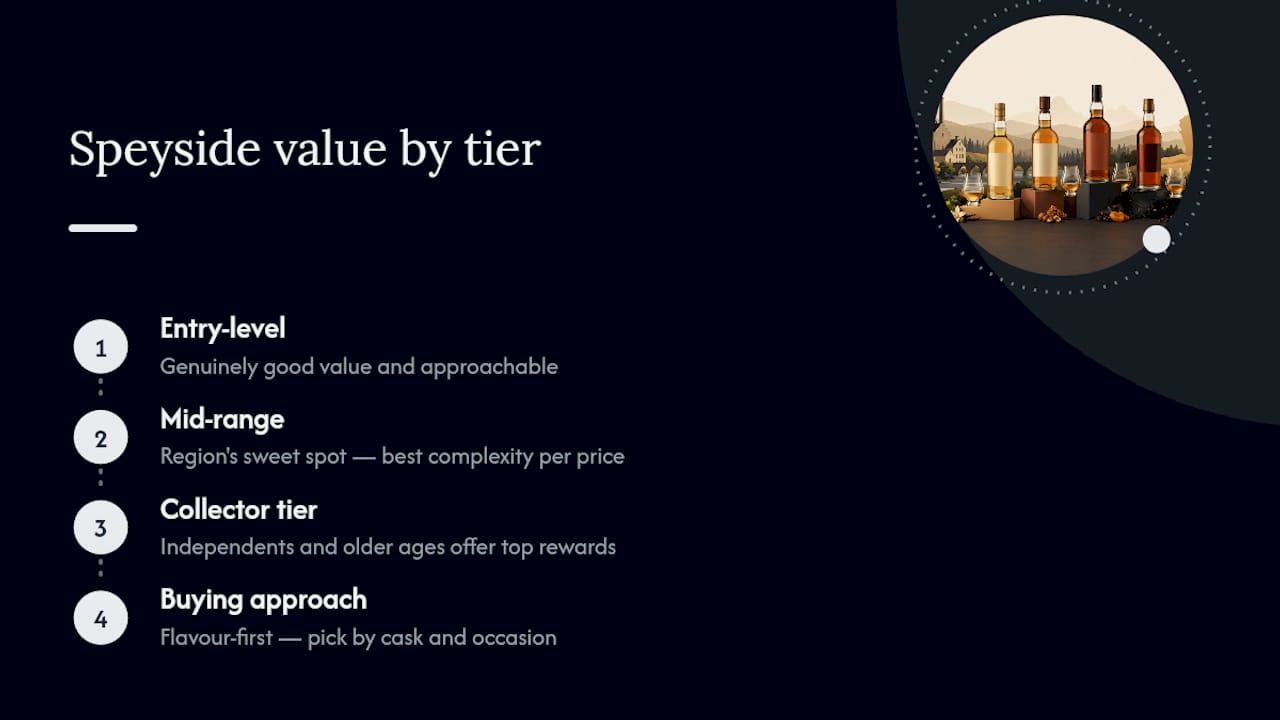
The real insight for Australian buyers is this: Speyside’s depth-to-price ratio is better than its reputation suggests. The entry-level bottles are genuinely good. The mid-range expressions are where the region shines. And the collector tier, particularly through independent releases and older age statements, offers some of the most rewarding whisky available anywhere.
Flavour-first buying, guided by cask type and a clear sense of occasion, will serve you better than chasing labels or marketing stories. The brands in this guide cover every flavour direction the region offers — start with one that matches your palate, then work outward.
Speyside whiskies available through Uisuki
Uisuki stocks a curated selection of Speyside and Scottish single malts, with regular new arrivals across entry-level, mid-range, and collector tiers. If a specific expression is hard to find through standard Australian retail channels, Uisuki’s personalised sourcing service can track it down.

The catalogue includes single malts, limited releases, and rare bottles from across Scotland and beyond — including expressions like the Hobart Whisky Bourbon Matured Rum Finished Single Malt for buyers who want to explore what Australian distillers are doing with similar cask techniques. Browse the full range at Uisuki or submit a sourcing request for a specific bottle. This section reflects Uisuki’s retail offering; product availability changes with stock.
Sources
- Speyside Whisky: A Complete Guide to the Distilleries of Speyside (2026)
- The best Speyside single malt Scotch whiskies according to the World Whiskies Awards 2026
- The Best Speyside Whisky
- World Whiskies Awards 2025 - Winners
- Speyside single malt
- Benromach | Handcrafted Speyside Single Malt Scotch Whisky