

TL;DR:
- Guided whisky tastings enhance tasting skills, regional knowledge, and confident collecting decisions.
- Proper structure, glassware, environment, and expert guidance maximize sensory and cognitive benefits.
- Advanced techniques like assessing legs, dilution, and side-by-side comparison deepen whisky appreciation.
Unlock the benefits of whisky tasting for Australian enthusiasts
Choosing the right whisky in Australia has never been more complex. Shelves are loaded with single malts from Scotland, age-statement expressions from Japan, and an ever-growing catalogue of outstanding local distilleries pushing the craft into exciting new territory. For enthusiasts and collectors alike, navigating that landscape without a structured approach is a recipe for expensive mistakes and missed flavour discoveries. Guided whisky tastings cut through the noise. They offer hands-on, expert-led experiences that sharpen your palate, deepen your regional knowledge, and give you the confidence to make smarter collecting decisions. This article unpacks exactly how to get the most from every session.
Table of Contents
- Criteria for maximising whisky tasting benefits
- Learning the science: How whisky tasting activates your senses
- Collector insights: How guided tastings improve rare whisky decisions
- Advanced tasting techniques: Unlocking every layer of whisky
- Why most enthusiasts underestimate whisky tasting benefits
- Explore premium whiskies and guided tasting experiences
- Frequently asked questions
Key Takeaways
| Point | Details |
|---|---|
| Expert guidance is vital | Australian tastings led by experts elevate both enjoyment and collector knowledge. |
| Science boosts enjoyment | Brain wave studies reveal whisky aroma relaxes and sharpens perception. |
| Collectors benefit directly | Guided flights and blind sessions help identify rare local and imported whiskies. |
| Advanced techniques matter | Proper dilution, aroma management, and tasting limits unlock every whisky’s depth. |
Criteria for maximising whisky tasting benefits
Not every tasting is created equal. A poorly ordered flight, the wrong glassware, or a room full of competing perfumes can flatten even the most extraordinary dram. Understanding what separates a genuinely insightful session from a forgettable one is the first step towards building real whisky knowledge.
Here are the key criteria that transform a basic tasting into a deeply rewarding experience:
- Establish a clear tasting order. Always move from lighter, lower-ABV expressions to heavier, more complex ones. Starting with a peated Islay malt will obliterate your ability to appreciate a delicate Highland single malt afterwards. Structure matters enormously.
- Use the right glassware. The Glencairn glass is the gold standard for good reason. Its tulip shape concentrates aromas at the rim, giving your nose far more information than a tumbler ever could. Proper glassware is not optional for serious appreciation.
- Seek expert-guided, themed sessions. Region-based or age-statement-themed tastings give context that transforms raw sensory experience into genuine knowledge. Guided tastings in Australia, such as The Whisky Ark Sydney’s sessions featuring five premium single malts across four regions with Glencairn glasses and cheese pairings, and Eau De Vie masterclasses priced from $85 to $200 covering five 15ml pours themed by region and age, show exactly how expert framing elevates appreciation through detailed discussion of production methods and terroir.
- Incorporate food pairings wisely. Cheese, in particular, resets the palate between expressions and introduces complementary fat compounds that can reveal new sweetness or softness in a whisky. Dark chocolate, smoked nuts, and charcuterie also work beautifully in a structured session.
- Control your environment. No strong perfume, no scented candles, no cooking smells nearby. Your olfactory system is the most powerful tool in the room and competing scents will actively suppress what you can detect in the glass.
For those just beginning their whisky journey, our beginner whisky tips provide a solid foundation before attending any formal session.
“A whisky tasting without structure is just drinking with good intentions.”
Pro Tip: After pouring, give the whisky at least five minutes in the glass before nosing. Aroma compounds evolve significantly as ethanol dissipates from the surface, revealing fruit, oak, spice, and floral notes that were initially masked. Rushing this step is the single most common mistake enthusiasts make. Once you have built some confidence, the expert tasting guide Australia at Uisuki can take your approach to the next level.
Learning the science: How whisky tasting activates your senses
Whisky appreciation is not simply a matter of taste and preference. There is genuine empirical science underpinning why a great tasting session feels so rewarding on multiple levels. Understanding these mechanisms helps you design better experiences and extract more from every pour.
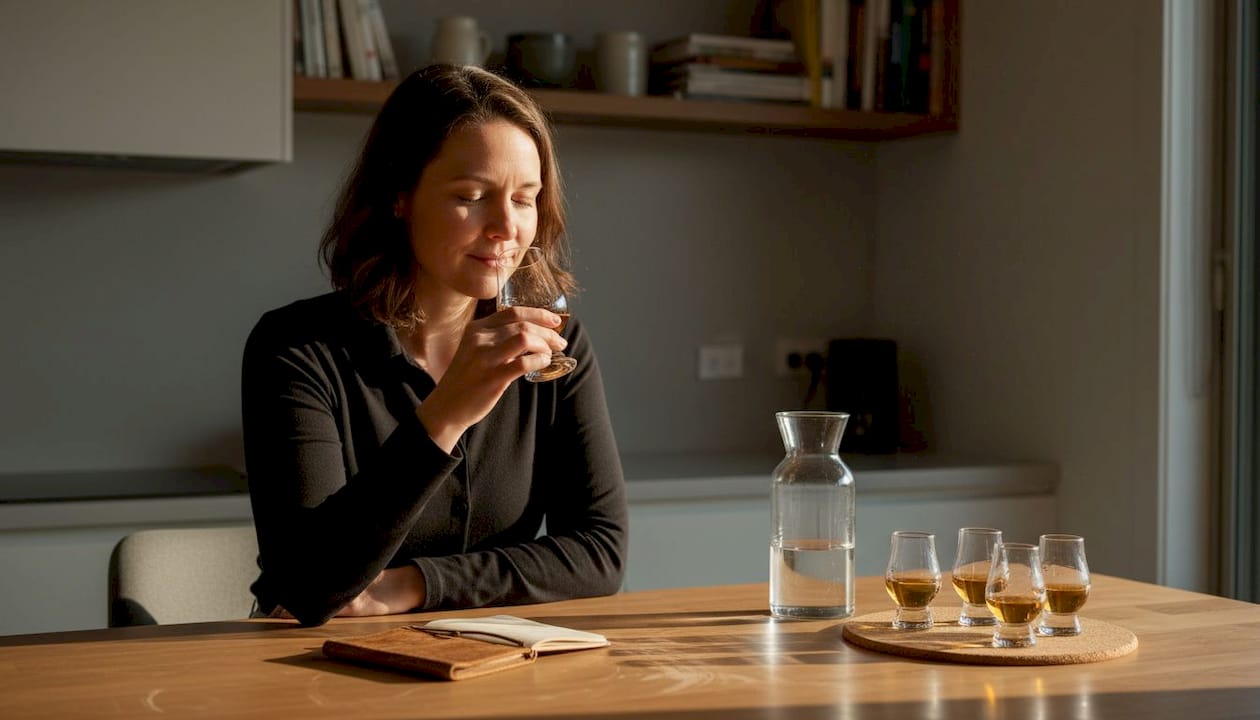
Research into whisky aroma effects confirms that mature whisky fragrance increases alpha brain wave activity, a state associated with relaxed alertness without drowsiness. This is significant. Alpha waves are linked to enhanced creativity, improved information processing, and a heightened capacity to detect and categorise sensory input. In practical terms, nosing a quality whisky genuinely primes your brain to taste more and learn more effectively.
Shared tastings amplify this effect further. When you experience a flavour alongside others and hear their descriptions, your own perception of that flavour intensifies, both positively and negatively. If your tasting companion describes a whisky as “overwhelmingly smoky,” your palate is primed to register smoke more prominently. This social dimension makes group tastings objectively more informative than solo sessions for building vocabulary and contrast recognition.
The mood benefits are equally compelling. Aroma recall interventions using familiar scents, including whisky, are used in mood management and wellbeing research. The connection between scent memory and emotional state is direct and well-documented. A whisky that transports you to a Scottish shoreline or a warm family kitchen is doing real neurological work.
Here is a summary of the key sensory effects documented in research:
| Effect | Mechanism | Practical benefit |
|---|---|---|
| Alpha wave increase | Mature whisky aroma triggers relaxed alertness | Improved sensory focus during tasting |
| Flavour amplification | Shared tasting intensifies perception | Stronger contrast and vocabulary development |
| Mood improvement | Aroma recall activates memory and emotional circuits | Increased enjoyment and wellbeing |
| Information processing | Alpha state enhances cognitive function | Better retention of regional and production knowledge |
Key sensory takeaways for your tasting approach:
- Nose the whisky before sipping to prime your alpha wave state and set your palate
- Taste alongside others to leverage social amplification of flavour perception
- Keep tasting notes to activate aroma recall benefits at future sessions
- Allow scent memory to build over multiple sessions for compounding benefit
For a deeper look at how to apply expert tasting techniques in practice, Uisuki’s natural tasting guide walks through the full sensory process step by step.
Collector insights: How guided tastings improve rare whisky decisions
For collectors, a guided tasting is not just an enjoyable evening. It is market research. The ability to evaluate a whisky critically, compare it against regional benchmarks, and contextualise it within a broader flavour profile directly informs which bottles deserve shelf space and which are best left on the retail shelf.
Different tasting formats serve different collector goals. Here is how the main options compare:
| Format | Expert input | Cost range | Comparison opportunity | Best for |
|---|---|---|---|---|
| Venue-led masterclass | High | $85 to $200 | Strong, structured flights | Regional education |
| Whisky club session | Moderate | $30 to $80 | Peer-driven, broad selection | Community and diversity |
| Retail tasting event | Moderate | Free to $50 | Brand-focused | New release evaluation |
| Side-by-side at home | Self-guided | Variable | Excellent for direct contrast | Personal preference mapping |
Guided experiences like Tower Whiskey’s Hunter Valley flights or the structured advice shared through Whisky Club Australia build premium whisky knowledge in a way that solo drinking simply cannot replicate, particularly when it comes to distinguishing rare Australian expressions from imported alternatives.
Side-by-side flights are the collector’s most powerful tool. Placing a rare Australian single malt next to a comparable Speyside expression of similar age forces objective comparison, removing the bias that comes from tasting either whisky in isolation. You notice where the local expression excels, perhaps in fresh eucalyptus and stone fruit character, and where the import offers something different in dried fruit complexity or oak integration.
Key benefits for collectors from guided tasting:
- Build a reliable internal reference library of regional flavour benchmarks
- Identify your genuine preferences before spending on premium or rare bottles
- Access distillery and master blender insight not available on retail labels
- Connect with other collectors who share leads on hard-to-find expressions
Pro Tip: Incorporate at least one blind tasting per quarter. Remove labels, pour into neutral glasses, and evaluate without knowing the producer or region. Blind sessions strip away brand bias and force your palate to do all the work, often revealing that your actual favourite differs from what you assumed. This is where hidden gems are discovered. For guidance on what to collect in 2026, our best single malts 2026 guide is an excellent starting point, alongside our dedicated collector shopping guide.
Advanced tasting techniques: Unlocking every layer of whisky
Once you have experienced a few structured sessions, basic nosing and sipping will start to feel insufficient. Advanced tasting techniques allow you to extract far more information from every pour, manage your palate across multiple samples, and identify qualities that casual drinkers overlook entirely.
Follow this step-by-step process for a more thorough evaluation:
- Assess the legs. Tilt and swirl the glass, then observe how the liquid sheets back down the side. Slow, thick legs indicate higher viscosity and often higher ABV or significant oily mouthfeel. Fast, thin legs suggest a lighter-bodied expression. According to how to taste whisky guidance, legs also provide early clues about cask influence and maturation environment.
- Control your environment. Confirm there are no competing fragrances before beginning. Even fresh coffee brewing in the next room can suppress your ability to detect floral or fruit notes in the whisky.
- Dilute high-ABV expressions deliberately. Adding three to five drops of still water to a cask-strength whisky opens up the molecular structure, allowing esters and aldehydes to volatilise more freely. The result is a measurably broader aroma profile and often a smoother finish. This single step transforms many intimidatingly powerful whiskies into revelatory experiences.
- Manage palate fatigue actively. After four to five samples, your taste receptors begin to saturate and your ability to detect subtle differences diminishes sharply. Research into palate fatigue confirms that whisky lactone, a compound naturally present in oak-matured spirit, reduces astringency perception by approximately 20 per cent, meaning your palate experiences cumulative smoothing that can mask differences between samples. Use water, plain crackers, or mild cheese to reset between drams.
- Use blind and side-by-side comparison to sharpen contrast. Evaluating two whiskies simultaneously forces your palate to identify relative differences rather than absolute characteristics. This is far more effective for building tasting vocabulary and identifying collector-worthy expressions.
Key troubleshooting points for advanced sessions:
- If a whisky smells sharp or alcoholic, wait longer before nosing. Do not rush the first five minutes.
- If all whiskies start tasting similar, stop. Palate fatigue has set in and continuing is counterproductive.
- If you cannot identify a flavour note, try adding a tiny drop of water and returning to the glass in two minutes.
Pro Tip: Limit your serious evaluation sessions to four to five whiskies maximum. This is not a conservative recommendation but a practical ceiling based on how quickly palate fatigue compounds across a flight. Quality of assessment drops sharply after this point. Our whisky quality evaluation guide covers these professional assessment methods in fuller detail.
Why most enthusiasts underestimate whisky tasting benefits
Here is an uncomfortable truth: most Australian whisky enthusiasts treat guided tastings as a social activity first and an educational tool second. That order should be reversed.
The cognitive and mood benefits of structured tasting are not incidental. They are central to building a collection you will genuinely value for years. Ignoring the science means missing the single best mechanism for reducing expensive impulse purchases, developing genuine palate confidence, and making gifting decisions that impress rather than disappoint. When you understand that aroma recall actively improves mood and that alpha brain wave states sharpen your sensory focus, you stop treating a tasting as a nice evening out and start treating it as an investment in your own judgement.
Guided tastings also reduce overconsumption risk by slowing down the pace and focusing attention on evaluation rather than volume. A collector who understands what they are tasting and why drinks less and appreciates more. That is both safer and more economically sound. The collecting benefits for serious Australian enthusiasts extend well beyond the bottle rack. Guided tasting is not optional for anyone serious about building a respected collection. It is foundational.
Explore premium whiskies and guided tasting experiences
If this article has sparked your curiosity to go deeper, the next step is straightforward. Uisuki stocks a carefully curated range of premium and rare whiskies from Scotland, Japan, the USA, and Australia’s own outstanding distilleries, with detailed tasting notes, ABV information, and expert recommendations for every expression.
Whether you are building your first serious collection, searching for a rare bottle to complete a flight, or looking for the perfect gift for a fellow enthusiast, Uisuki’s team can help you source it. Browse new arrivals, request personalised sourcing for hard-to-find expressions, and access a full library of educational articles to complement every tasting experience. Visit Uisuki.com.au and take the next step in your whisky journey today.
Frequently asked questions
What are the most important factors for a successful whisky tasting?
Expert guidance, proper glassware, and a controlled environment are the three pillars of a successful session. Structured tastings like those at The Whisky Ark Sydney demonstrate how combining Glencairn glasses, themed flights, cheese pairings, and regional expertise consistently elevates appreciation beyond what solo tasting achieves.
Does whisky tasting improve mood or enhance relaxation?
Yes, and there is solid science behind it. Mature whisky fragrance increases alpha brain wave activity, promoting a relaxed yet alert state, while aroma recall interventions using familiar scents can meaningfully improve mood and general wellbeing.
Why do collectors attend guided tastings instead of tasting alone?
Guided tastings provide expert context, structured comparison flights, and community insight that solo sessions simply cannot replicate. Experiences like the Hunter Valley flights at Tower Whiskey Distillery help collectors benchmark rare Australian expressions against imports and make more confident purchasing decisions.
How does adding water to whisky affect flavour perception?
Adding a few drops of water to a high-ABV whisky unlocks volatile aroma compounds, broadening the nose and softening the finish. Water dilution is especially valuable for cask-strength expressions where alcohol can initially suppress more delicate flavour notes.
Is palate fatigue common during whisky tastings and how can it be reduced?
Palate fatigue is very common after four to five samples. Whisky lactone reduces astringency perception by around 20 per cent across a flight, meaning later samples feel smoother and can seem less distinct. Resetting with water, mild cheese, or plain crackers between drams keeps your palate more reliable throughout the session.