

Most whisky drinkers know Glenfiddich as the world’s bestselling single malt, but few understand what truly sets this Speyside distillery apart from hundreds of competitors. Since 1887, Glenfiddich has remained family-owned whilst pioneering innovations that transformed single malt from a niche Scottish product into a global phenomenon. This guide explores Glenfiddich’s heritage, production methods, core expressions, expert opinions, and practical buying tips for Australian collectors seeking to appreciate or invest in this iconic whisky.
Table of Contents
- Key takeaways
- Heritage and traditional craftsmanship of Glenfiddich
- Production methods: balancing tradition and innovation
- Exploring Glenfiddich’s core range and special collections
- Expert verdicts and buying tips for Australian collectors
- Discover Glenfiddich and other premium whiskies at Uisuki
- Frequently asked questions
Key Takeaways
| Point | Details |
|---|---|
| Family ownership defines Glenfiddich | Glenfiddich remains family owned across multiple generations, enabling long term quality beyond quarterly profits. |
| Marketing innovations | It pioneered global single malt marketing and introduced the iconic triangular bottle. |
| 15yo value vs 12yo | Experts rate the fifteen year old as strong value compared with the twelve year old for Australian buyers. |
| Australian availability reliable | Availability in Australia is reliable through specialist retailers and authorised Glenfiddich stockists. |
| Core range flavour spectrum | The core range offers a broad spectrum of flavours to suit many palates. |
Heritage and traditional craftsmanship of Glenfiddich
William Grant founded Glenfiddich in 1886 in Dufftown, Moray, with a vision to create the finest single malt whisky in the valley. He built the distillery by hand with his nine children, and the family produced their first spirit in 1887, establishing a legacy that continues today under fifth-generation family ownership through William Grant & Sons. This unbroken family stewardship distinguishes Glenfiddich from corporate-owned competitors and enables long-term quality commitments over quarterly profit pressures.
The distillery’s scale reflects both tradition and ambition. Glenfiddich operates 43 handcrafted copper pot stills, each shaped to precise specifications that influence spirit character through copper contact and reflux. Local Robbie Dhu Spring water flows through every stage of production, contributing mineral qualities that define the house style. More than 1.2 million casks mature across 47 warehouses on-site, representing one of Scotch whisky’s largest single-distillery inventories and demonstrating the family’s commitment to aged stock reserves.
Glenfiddich pioneered modern single malt marketing when most distilleries sold exclusively to blenders. In 1963, the distillery became the first to actively promote its single malt globally, introducing the iconic triangular bottle inspired by the three Robbie Dhu peaks. The family opened Scotland’s first whisky visitor centre in 1969, welcoming enthusiasts to experience production firsthand and building the educational tourism model now standard across the industry.
Traditional methods anchor production despite commercial scale:
- Small copper pot stills with distinctive swan necks create multiple distillation refluxes for lighter spirit
- Douglas fir wooden washbacks encourage longer fermentation and complex flavour development
- On-site cooperage maintains and repairs casks to exacting standards
- Floor maltings operated until 2013, preserving historical techniques longer than most competitors
“Glenfiddich’s commitment to family ownership and traditional craftsmanship, combined with innovative marketing, transformed single malt whisky from a Scottish curiosity into a global category.”
This balance between heritage and progress defines Glenfiddich’s identity. The family invests in cutting-edge warehousing and quality control whilst maintaining production methods William Grant would recognise, creating whiskies that honour tradition without becoming museum pieces.
Production methods: balancing tradition and innovation
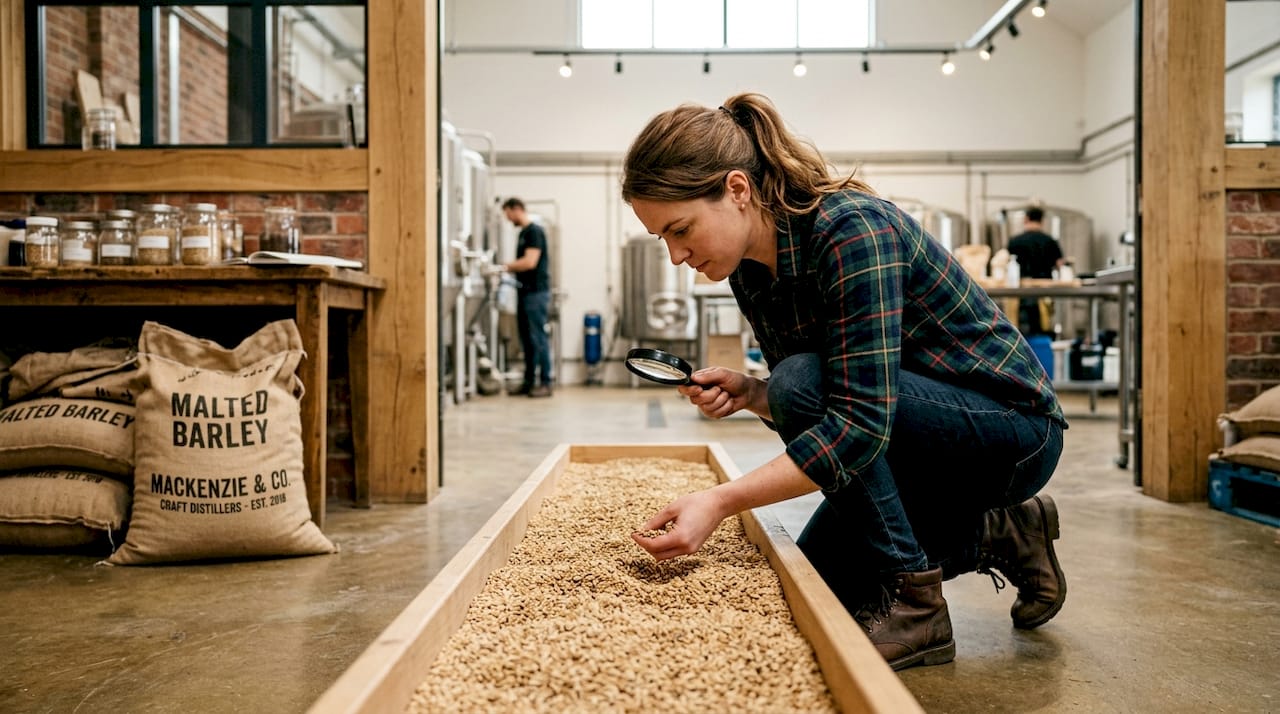
Glenfiddich’s production begins with unpeated malted barley, establishing the light, fruity Speyside character that differentiates these whiskies from smoky Islay expressions. The distillery sources barley primarily from Scottish farms, maintaining supply relationships that ensure consistent quality and support local agriculture. Malting now occurs off-site at industrial facilities, though the distillery specifies exact germination and kilning parameters to preserve flavour profiles developed over 140 years.
Fermentation extends 60 to 72 hours in Douglas fir wooden washbacks, significantly longer than the 48-hour industry standard. This extended contact allows wild yeasts residing in the wood to contribute complex esters and fruity notes impossible to achieve in stainless steel vessels. The resulting wash reaches approximately 8% alcohol, rich with flavour precursors that survive distillation and mature into the signature Glenfiddich profile.
Distillation occurs in copper pot stills with distinctive swan necks that encourage reflux, where heavier alcohols condense and redistil for lighter spirit. Glenfiddich operates 14 wash stills and 29 spirit stills, allowing precise cuts that separate desirable heart from harsh heads and tails. Direct fire heating on some stills adds subtle caramelised notes, whilst steam coils on others provide gentler heat for delicate distillation. This dual approach gives blenders diverse spirit styles to combine in final expressions.
Maturation introduces the innovations that distinguish Glenfiddich from traditionalist competitors:
- Ex-bourbon American oak casks provide vanilla, coconut, and gentle sweetness forming the base of most expressions
- European oak sherry casks add dried fruit, spice, and darker colour to premium age statements
- Rum casks contribute tropical fruit notes in experimental releases
- Wine casks from Bordeaux, Port, and other regions create limited editions exploring new flavour territories
The 15-year-old expression employs solera vatting, a technique borrowed from sherry production where casks are never fully emptied. Older whiskies marry with younger spirit in a perpetual system, ensuring batch consistency whilst building complexity impossible in single-cask releases. This innovation demonstrates Glenfiddich’s willingness to adopt techniques from other traditions when they enhance quality.
Pro Tip: Understanding cask influence helps you select expressions matching your palate. Bourbon cask whiskies offer lighter, sweeter profiles ideal for newcomers, whilst sherry cask expressions deliver richer, spicier complexity suited to experienced enthusiasts.
Scale supports quality rather than compromising it. The 47 warehouses allow optimal maturation conditions, with older stock resting in traditional dunnage warehouses where casks lie three high on earthen floors. Cooler temperatures and higher humidity slow evaporation and concentrate flavours gradually. Younger stock matures in modern racked warehouses offering efficient space utilisation without sacrificing the time and patience required for proper ageing.
Exploring Glenfiddich’s core range and special collections
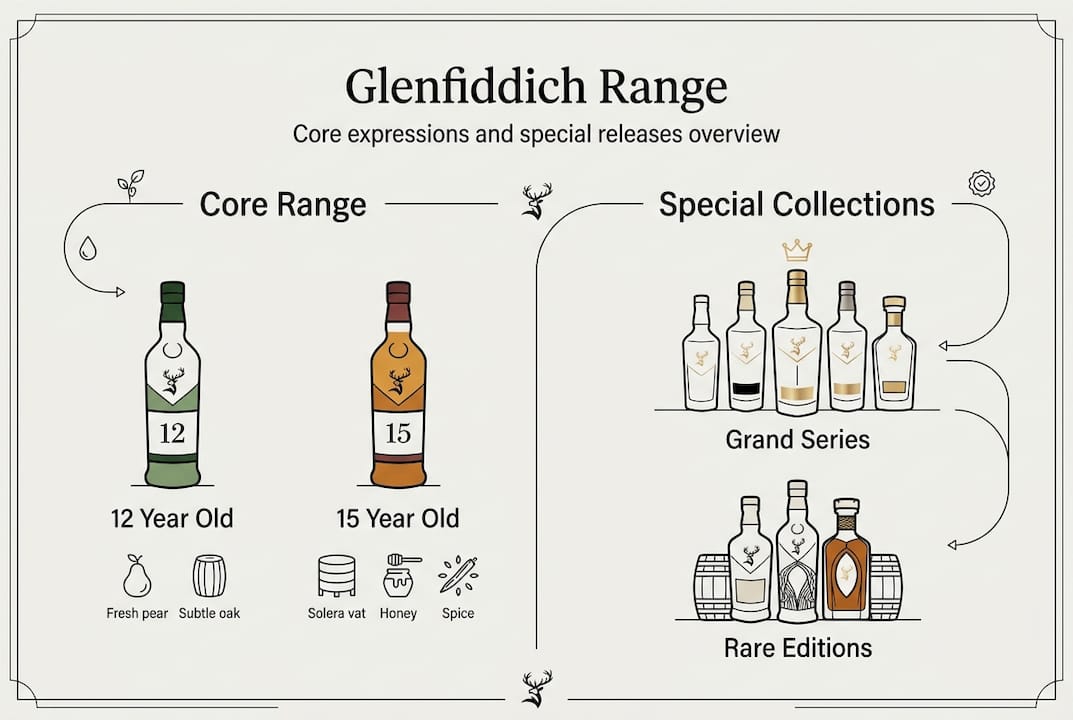
The 12-year-old expression anchors Glenfiddich’s portfolio as an accessible introduction to Speyside single malt. Matured exclusively in American and European oak casks, it delivers light pear, apple, and subtle oak flavours at 40% ABV. The approachable profile suits newcomers exploring single malts beyond blended Scotch, though enthusiasts sometimes find it lacks the complexity justifying premium pricing. Australian retailers stock 50ml miniatures perfect for sampling before committing to full bottles.
The 15-year-old Solera expression represents exceptional value according to expert consensus. Solera vatting blends whiskies from sherry, bourbon, and new oak casks in a perpetual system, creating consistent batches with honeyed sweetness, rich fruit, and balanced oak. At approximately 40% ABV, it offers significantly more complexity than the 12-year-old for modest additional cost, making it the recommended starting point for serious collectors building Glenfiddich collections.
Premium age statements cater to enthusiasts seeking deeper maturation:
- 18-year-old: Matured in bourbon and sherry casks, offering robust apple, cinnamon, and oak with elegant balance
- 21-year-old Gran Reserva: Finished in Caribbean rum casks adding tropical fruit, toffee, and spice complexity
- 23-year-old Grand Cru: Finished in French cuvée casks from rare Bordeaux wines, delivering sophisticated fruit and oak integration
These expressions range from 40% to 43% ABV, providing fuller mouthfeel and flavour intensity than entry offerings whilst remaining approachable for collectors accustomed to standard-strength whiskies.
| Expression | Age | ABV | Cask type | Flavour profile | Target audience |
|---|---|---|---|---|---|
| 12-year-old | 12 years | 40% | Bourbon, European oak | Light pear, apple, subtle oak | Newcomers, casual drinkers |
| 15-year-old Solera | 15 years | 40% | Sherry, bourbon, new oak | Honey, rich fruit, balanced oak | Enthusiasts seeking value |
| 18-year-old | 18 years | 40% | Bourbon, sherry | Robust apple, cinnamon, oak | Experienced collectors |
| 21-year-old Gran Reserva | 21 years | 40% | Rum cask finish | Tropical fruit, toffee, spice | Premium enthusiasts |
| 23-year-old Grand Cru | 23 years | 40% | Cuvée cask finish | Sophisticated fruit, oak | Luxury collectors |
Special collections push boundaries beyond core expressions. The Grand Series explores ultra-premium releases including 26, 30, 40, and 50-year-old whiskies representing pinnacle achievements in long-term maturation. These limited releases command investment-grade prices reflecting scarcity and exceptional quality. The Experimental Series tests innovative cask finishes and production techniques, offering collectors unique expressions unavailable from traditionalist competitors. The Perpetual Collection employs solera-style vatting across various age statements, building on the 15-year-old’s success with more complex interpretations.
Glenfiddich holds the distinction of being the world’s bestselling single malt for over 50 years, moving more than 1 million cases annually. This commercial success reflects consistent quality and broad appeal rather than diminishing collectability. Limited archive releases and vintage expressions maintain investment interest amongst serious collectors.
Pro Tip: Start your collection with the 15-year-old for its flavour complexity and excellent value, then explore Grand Series expressions to experience innovative cask finishes and rare age statements that showcase Glenfiddich’s experimental approach to traditional Speyside whisky.
Expert verdicts and buying tips for Australian collectors
Whisky critics consistently praise Glenfiddich for approachable, consistent quality whilst noting limitations in entry expressions. The 15-year-old receives ratings around 8/10 for balancing value and complexity, with reviewers highlighting the solera vatting’s contribution to depth and consistency. In contrast, the 12-year-old scores approximately 6/10, with some experts considering it dated and simplistic compared to modern competitors offering higher ABV and more adventurous cask programmes at similar prices.
Compared to sherry-heavy rivals like Macallan, Glenfiddich presents a lighter, more delicate profile emphasising fruit and floral notes over rich dried fruit and spice. This difference reflects production philosophy rather than quality hierarchy. Collectors preferring elegant, nuanced whiskies gravitate toward Glenfiddich, whilst those seeking bold, intense flavours often choose sherry-focused distilleries. Neither approach is superior; understanding your palate preferences guides selection.
Glenfiddich’s unpeated character positions it opposite Islay styles like Ardbeg or Laphroaig. The absence of smoke allows subtle fruit, honey, and oak flavours to shine without competing with peat’s dominant influence. Collectors building diverse portfolios benefit from including both styles, using Glenfiddich to represent classic Speyside elegance alongside smoky Islay expressions for contrast.
Australian collectors should prioritise specific characteristics when selecting Glenfiddich bottles:
- Higher ABV releases (45% and above) deliver more flavour intensity and better value, avoiding chill filtration that strips texture
- Age statements beyond 15 years offer complexity justifying premium prices, particularly for investment purposes
- Limited editions and archive releases provide rarity driving secondary market appreciation
- Cask strength expressions showcase distillery character without dilution, appealing to enthusiasts and collectors
Reliable Australian sources include specialist retailers stocking authentic Glenfiddich across the range. Kent St Cellars maintains consistent inventory of core expressions and occasional limited releases. Online platforms like Uisuki offer curated selections with expert guidance, helping collectors navigate options and secure rare bottles as they become available.
Practical buying strategies for Australian collectors:
- Assess age and ABV as primary indicators of investment potential and flavour depth, prioritising 15-year-old and above at 43% or higher
- Explore Grand Series expressions for luxury acquisitions offering unique cask finishes and exceptional maturation
- Monitor specialist retailers for limited archive releases providing investment opportunities and collection centrepieces
- Compare prices across multiple sources, factoring shipping costs and retailer reputation into total value calculations
- Start with mid-range expressions like the 15-year-old to understand house style before investing in premium age statements
Pro Tip: Balance palate preference with collector value by starting with the 15-year-old to establish your appreciation for Glenfiddich’s style, then gradually acquire premium age statements and limited releases as your collection matures and your understanding of the distillery’s range deepens.
Investment potential varies across the range. Core expressions like the 12 and 15-year-old maintain stable pricing but rarely appreciate significantly, functioning as drinkers rather than investment bottles. Premium age statements (21 years and above) and limited editions show stronger secondary market performance, particularly discontinued releases and vintage expressions. Collectors seeking financial returns should focus on these categories whilst maintaining realistic expectations about whisky as an alternative investment.
Discover Glenfiddich and other premium whiskies at Uisuki
Navigating Glenfiddich’s extensive range becomes simpler with expert guidance from specialists who understand both the distillery’s offerings and collector priorities. Uisuki curates a selection of Glenfiddich expressions spanning entry-level 12-year-old through premium age statements, helping Australian collectors access authentic bottles without international shipping complications.

Beyond Glenfiddich, Uisuki specialises in sourcing rare and limited edition Scotch single malts for Australian collectors seeking to build diverse portfolios. The platform combines reliable shipping, competitive pricing, and customer support that helps you select whiskies matching your palate preferences and collection goals. Whether you’re exploring Speyside elegance for the first time or hunting vintage expressions to complete your collection, specialist retailers provide the expertise and inventory that general liquor stores cannot match.
Pro Tip: Explore Uisuki’s website regularly for new Glenfiddich arrivals and exclusive offers, particularly around product launches when limited editions become available to early buyers before selling out to international markets.
Frequently asked questions
What is Glenfiddich single malt whisky?
Glenfiddich is a family-owned Speyside single malt Scotch whisky distillery founded in 1886, known for producing non-peated, fruity whiskies using traditional copper pot stills. The distillery pioneered global single malt marketing in 1963 and remains the world’s bestselling single malt. Unique production methods include solera vatting and diverse cask maturation programmes that balance heritage with innovation.
What makes Glenfiddich’s 15-year-old whisky special?
The 15-year-old employs solera vatting, blending whiskies from sherry, bourbon, and new oak casks in a perpetual system that ensures consistent quality and builds complexity. Experts rate it significantly higher than the 12-year-old for delivering exceptional value and balanced flavour. This expression represents the sweet spot in Glenfiddich’s range for enthusiasts seeking quality without ultra-premium pricing.
How can Australian collectors buy authentic Glenfiddich whiskies?
Purchase from reputable specialist retailers like Uisuki or Kent St Cellars that stock verified authentic bottles and provide expert guidance. These platforms maintain consistent inventory of core expressions and secure limited editions as they release. Avoid grey market sellers offering suspiciously low prices, as counterfeit premium whisky represents a growing problem in secondary markets.
How does Glenfiddich compare to other Speyside single malts?
Glenfiddich offers a lighter, more delicate profile than sherry-focused competitors like Macallan, emphasising fruit and floral notes over rich dried fruit intensity. The distillery’s scale and consistency appeal to collectors seeking reliable quality, whilst smaller producers offer more experimental approaches. Both styles have merit; your preference depends on whether you favour elegant subtlety or bold complexity in Speyside whiskies.
Which Glenfiddich expression offers the best investment potential?
Limited editions, archive releases, and age statements beyond 21 years show strongest secondary market appreciation, particularly discontinued expressions and vintage bottlings. The 15-year-old offers excellent drinking value but limited investment upside due to continuous production. Serious collectors should focus on Grand Series releases and special editions released in small quantities, balancing enjoyment with potential financial returns over time.