

TL;DR:
- Rare whisky is scarce due to limited production, age, exclusive releases, or discontinuation, and purchasing strategies depend on channels like distillery clubs, retailers, auctions, and brokers. Building relationships, verifying provenance, and acting quickly through memberships and newsletters are essential to secure sought-after bottles in a competitive market. Provenance documentation and legal ownership are crucial for maintaining value and avoiding counterfeit and legal issues.
Rare whisky is defined as any bottle scarce through limited production runs, advanced age, exclusive distillery releases, or discontinued expressions. Knowing where to buy rare whisky separates collectors who build meaningful cellars from those who miss every allocation. The primary channels are distillery membership clubs, specialist retailers, online auctions, and private brokers. Each channel carries different trade-offs around price, access difficulty, and provenance assurance. Membership and allocation systems govern the most desirable bottles, and documentation of authenticity is non-negotiable when spending serious money. This guide covers every major sourcing method, the mechanics behind allocation chains, and the specific steps Australian buyers can take right now.
Where to buy rare whisky: main sourcing channels
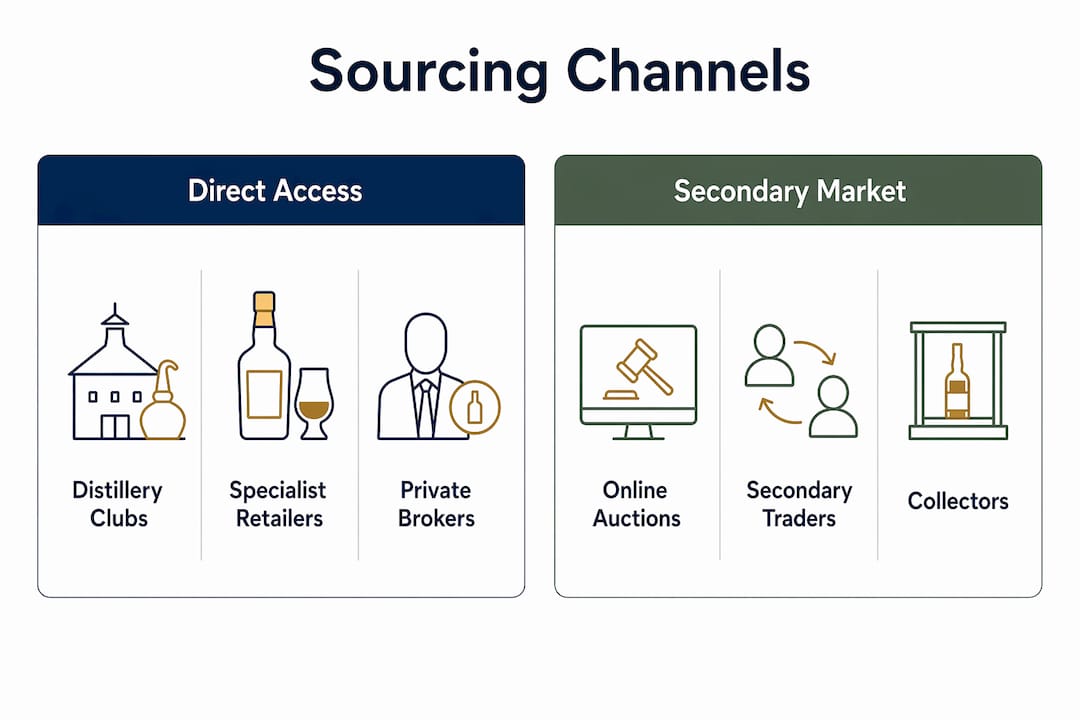
The best places to find rare whisky fall into four distinct categories, each with its own access rules and risk profile.

Distillery membership clubs offer the most direct route to limited releases. The Isle of Raasay Slàinte Club is a clear example: the 2026 Limited Release is available exclusively to members who use a unique code at checkout. No membership, no bottle. This model is increasingly common among Scottish and Japanese distilleries that want to reward loyal customers rather than feed the secondary market.
Specialist retailers with strong supplier relationships receive allocations of bottles that never appear on general sale. These shops require you to build a purchase history before they offer you anything truly rare. Think of it as a loyalty programme with bottles as the reward.
Online whisky auctions provide access to bottles that have already left the primary market. Platforms dedicated to whisky auctions list everything from 30-year-old single malts to Japanese limited editions. Prices reflect market demand rather than RRP, so you often pay a premium. The upside is genuine breadth of selection.
Private brokers and secondary market traders sit between auctions and retail. They source bottles directly from collectors and estates. Prices can be negotiated, but due diligence on provenance is entirely your responsibility.
| Channel | Access Difficulty | Price vs. RRP | Provenance Assurance |
|---|---|---|---|
| Distillery clubs | High (membership required) | At RRP | Excellent |
| Specialist retailers | Medium (history needed) | At or above RRP | Good |
| Online auctions | Low (open to all) | Above RRP | Variable |
| Private brokers | Medium | Negotiable | Buyer’s responsibility |
Pro Tip: Register with multiple distillery clubs simultaneously. Many releases sell out within hours of member notification, so spreading your memberships across Scottish, Japanese, and Australian distilleries maximises your chances of securing at least one allocation per quarter.
How do allocation systems control access to rare bottles?
The allocation chain is a supply chain governed by relationships, not just availability. Retailers who move larger volumes receive better limited edition allocations from importers and distributors. This means the shop you buy your everyday dram from is also the shop most likely to call you when something rare arrives.
The three-tier structure works like this in most markets:
- The importer receives a fixed quantity from the distillery or brand owner.
- The importer allocates bottles to distributors based on sales volume and relationship strength.
- Distributors pass allocations down to retailers using the same logic.
- Retailers then decide which customers receive the offer, again based on purchase history.
Some rare releases bypass public online drops entirely, going straight to long-term retail customers through private notification. If you have never bought from a shop before, you will not receive that call.
Membership clubs short-circuit this chain entirely. The Isle of Raasay Slàinte Club model proves that distilleries can sell directly to consumers at full margin while guaranteeing the bottle goes to a genuine enthusiast rather than a reseller.
Monitoring distillery newsletters, enthusiast forums, and retailer waitlists is the most reliable way to anticipate allocations before they go public. Allocation announcements often precede shelf availability by several weeks. That window is your opportunity to register interest and confirm your place on a waitlist.
Pro Tip: Set up a dedicated email address solely for whisky retailer and distillery newsletters. The volume of notifications is high, and missing one announcement in a cluttered inbox can cost you a bottle worth hundreds of dollars.
What legal and provenance checks do you need when buying rare whisky?
Provenance is as critical as the bottle itself when establishing value and trust in the rare whisky market. Collectors verify authenticity by cross-checking auction lot entries, storage receipts, and seller invoices. A bottle without documentation is a bottle with an uncertain history, and that uncertainty destroys resale value.
When buying at auction or through a broker, treat the paperwork as part of the product. The following checks are non-negotiable:
- Original purchase invoice. Confirms the bottle was bought through legitimate channels and establishes the first owner.
- Auction lot number and catalogue entry. Provides a verifiable record of the bottle’s condition and description at the time of sale.
- Storage history. Confirms the bottle was kept in appropriate conditions, particularly relevant for older expressions where temperature and light exposure affect quality.
- Seller identification. A named, traceable seller is far preferable to an anonymous listing.
- Photographs of the label, capsule, and fill level. Visual evidence that the bottle matches its description before you commit funds.
For cask ownership, the legal requirements are more demanding. Legal title to a whisky cask requires a Delivery Order filed with an HMRC-approved bonded warehouse. Without a recognised Delivery Order, your ability to resell or bottle the cask is legally compromised. Viticult Whisky uses bailment contracts and HMRC-approved bonded warehouses, with annual storage and insurance fees in the range of £150–£300. That structure is the benchmark for legitimate cask investment.
“Documentation is not bureaucracy. It is the difference between owning a whisky and believing you own a whisky.”
Counterfeit bottles exist in the rare whisky market. Older expressions from closed distilleries like Port Ellen or Brora attract fakes. Always buy from established auction houses or retailers with verifiable track records, and request a condition report before bidding.
Practical tips for buying rare whisky online and in australia
Australian buyers have more options than most realise. Online specialist retailers such as Uisuki and Whisky Discovery Australia offer rare and collectible bottles with delivery services and buyer support across the country. The range covers Scottish single malts, Japanese expressions, and Australian craft distillery releases that rarely appear on international platforms.
Here is what actually works for Australian collectors:
- Build purchase history with two or three specialist retailers. Allocation decisions at the retailer level consider customer loyalty and volume. Spreading your spending too thin across ten shops means you are nobody’s priority customer.
- Use retailer waitlists actively. Most good shops maintain waitlists for specific expressions. Registering your interest costs nothing and puts you ahead of walk-in buyers.
- Request bottles directly. Uisuki accepts personalised sourcing requests. If you are after a specific expression, asking directly is more effective than waiting for it to appear in a newsletter. You can learn more about this approach through their rare whisky request guide.
- Check free delivery thresholds. Many Australian online retailers offer free shipping above a spend threshold. Consolidating purchases to hit that threshold saves money on bottles you would buy anyway.
- Be cautious on secondary market platforms. Unverified sellers on general marketplace sites carry real provenance risk. Stick to dedicated whisky platforms with seller verification and dispute resolution.
For gift buyers, the practical advice is simpler. Buy from a retailer with clear product descriptions, ABV details, and a returns policy. Uisuki lists ABV percentages, batch numbers, and tasting notes on every product page, which removes the guesswork when buying for someone else.
Pro Tip: For selecting rare whisky as a gift, choose a bottle with a named batch number and documented release details. It gives the recipient something to research and discuss, which is half the pleasure of receiving a rare bottle.
Key takeaways
The most reliable way to buy rare whisky is to combine active membership in distillery clubs, a consistent purchase history with specialist retailers, and rigorous provenance checks for any secondary market purchase.
| Point | Details |
|---|---|
| Distillery clubs offer direct access | Membership codes like the Slàinte Club model bypass retail allocation entirely. |
| Retailer relationships determine allocation | Buy consistently from two or three specialist shops to improve your priority status. |
| Provenance documentation is mandatory | Always request invoices, lot numbers, and storage history before purchasing. |
| Cask ownership requires legal paperwork | A Delivery Order from an HMRC-approved bonded warehouse confirms legal title. |
| Australian buyers have strong local options | Platforms like Uisuki offer rare bottles with local delivery and sourcing support. |
The uncomfortable truth about buying rare whisky in 2026
I have watched the rare whisky market shift considerably over the past several years, and the single biggest change is this: the best bottles no longer reach the open market at all. Distilleries and retailers have become sophisticated about directing rare stock toward their most engaged customers. If you are waiting for a Karuizawa or a Springbank Local Barley to appear on a general retail site, you are already too late.
The relationship-building advice in this article is not a soft suggestion. It is the actual mechanism by which rare whisky changes hands in 2026. I have seen collectors with deep knowledge and genuine enthusiasm miss allocations simply because they had not bought enough from the right shop. That is frustrating, but it is the reality.
Provenance documentation is the other area where I see buyers make costly mistakes. People get excited about a bottle and skip the paperwork checks. Then they try to resell it and discover the lack of documentation has cut the value significantly. Treat every rare purchase like a property transaction. You would not buy a house without checking the title. The same logic applies here.
Technology has genuinely helped. Online auction platforms have made the secondary market more transparent, and retailer websites now carry far more detail than they did five years ago. But technology has also made it easier for bad actors to present poorly documented bottles convincingly. The tools for verification and the tools for deception have improved at the same rate.
My practical advice: pick two specialist retailers you trust, buy from them regularly, and ask questions. The staff at good whisky shops remember customers who engage seriously. That relationship is worth more than any single bottle.
— Brendan
Find rare and limited edition whisky at uisuki
Uisuki is an Australian online retailer specialising in premium, rare, and hard-to-find whisky from Scotland, Japan, Australia, and the USA. Every listing includes ABV, batch details, and tasting notes so you know exactly what you are buying.
The range includes bottles like the Hobart Whisky Bourbon Matured Rum Finished Single Malt, a documented limited batch release from one of Australia’s most respected craft distilleries. For Japanese collectors, the Ichiro’s Malt and Grain Limited Edition world blended whisky represents exactly the kind of allocation-controlled release that rarely surfaces outside specialist channels. Uisuki also accepts personalised sourcing requests, so if you are after something specific, reach out directly. Free delivery is available on qualifying orders across Australia.
FAQ
What is the best way to buy rare whisky in australia?
The most effective approach combines membership in distillery clubs, a consistent purchase history with specialist online retailers like Uisuki, and active use of retailer waitlists. Australian buyers also benefit from local platforms that carry rare domestic releases unavailable on international sites.
How do whisky allocation systems work?
Allocations flow from importer to distributor to retailer, with each tier favouring buyers who purchase in higher volumes and maintain long-term relationships. Retailers with stronger sales histories receive better access to limited edition bottles from importers.
What documents should i request when buying rare whisky?
Always request the original purchase invoice, auction lot number, storage history, and seller identification. Cross-checking these records against auction catalogues and storage receipts confirms authenticity and protects resale value.
Is buying whisky casks different from buying bottles?
Yes. Cask ownership requires a Delivery Order filed with an HMRC-approved bonded warehouse to establish legal title. Without this documentation, resale and bottling rights are legally uncertain.
How do i find out about rare whisky releases before they sell out?
Subscribe to distillery and retailer newsletters, join enthusiast forums, and register on retailer waitlists. Allocation announcements often precede public availability by several weeks, giving prepared buyers a genuine advantage.