

Most australian whisky collectors know how challenging it can be to truly capture every nuance in a premium bottle. The astonishing variety of tasting notes found in whiskies from Scotland, Ireland, and Japan reveals just how complex and rewarding the sensory journey can become. Learning to decode these notes unlocks deeper appreciation and helps collectors communicate flavour profiles with precision. This guide clarifies the key elements of tasting notes, offering new ways for australian enthusiasts to elevate their whisky experience.
Table of Contents
- Defining Whisky Tasting Notes And Their Role
- How Tasting Notes Elevate Appreciation
- Tasting Notes In Buying And Collecting Decisions
- The Language And Structure Of Tasting Notes
- Common Misconceptions And Pitfalls To Avoid
Key Takeaways
| Point | Details |
|---|---|
| Whisky tasting notes are essential for communication | They bridge individual perceptions and collective understanding, enhancing whisky appreciation. |
| Tasting notes guide collectors’ decisions | They provide critical insights into quality, rarity, and potential investment, enabling informed choices. |
| A structured approach to tasting enhances experience | Using standardised frameworks helps articulate complex flavours and promotes objective analysis. |
| Avoid common misconceptions in whisky tasting | Practice blind tastings and develop a standardised protocol to minimise bias and enhance judgement. |
Defining Whisky Tasting Notes and Their Role
Whisky tasting notes represent a sophisticated sensory language that transforms the complex experience of whisky appreciation into a communicable narrative. These detailed descriptions go far beyond simple flavour identification, serving as a critical bridge between individual perception and collective understanding. Whisky tasting involves systematic analysis through meticulous examination of visual characteristics, aromas, and taste profiles.
At their core, tasting notes decode the intricate sensory landscape of whisky, capturing nuanced elements like terroir, distillation techniques, aging processes, and cask influences. Professional tasters develop a specialised vocabulary that allows them to articulate subtle differences between whiskies with remarkable precision. Sensory descriptors might include terms like “smoky,” “honeyed,” “peaty,” or “maritime,” each revealing specific aspects of the whisky’s character and origin.
Here’s a reference table outlining common whisky tasting descriptors and what they indicate:
| Descriptor | Flavour Attributes | Region/Origin Hints |
|---|---|---|
| Smoky | Charred wood, earthiness | Islay, coastal distilleries |
| Honeyed | Sweet, smooth, nectar | Highlands, Speyside |
| Peaty | Moss, earthy richness | Islay, select Scottish malts |
| Fruity | Citrus, apple, dried fruit | Speyside, American oak casks |
| Maritime | Salinity, sea breeze | Coastal Scotland, island malts |
| Spiced | Clove, cinnamon, nutmeg | Rye, sherried maturation |
| Woody | Oak, vanilla, tannin | Long cask ageing, bourbon |
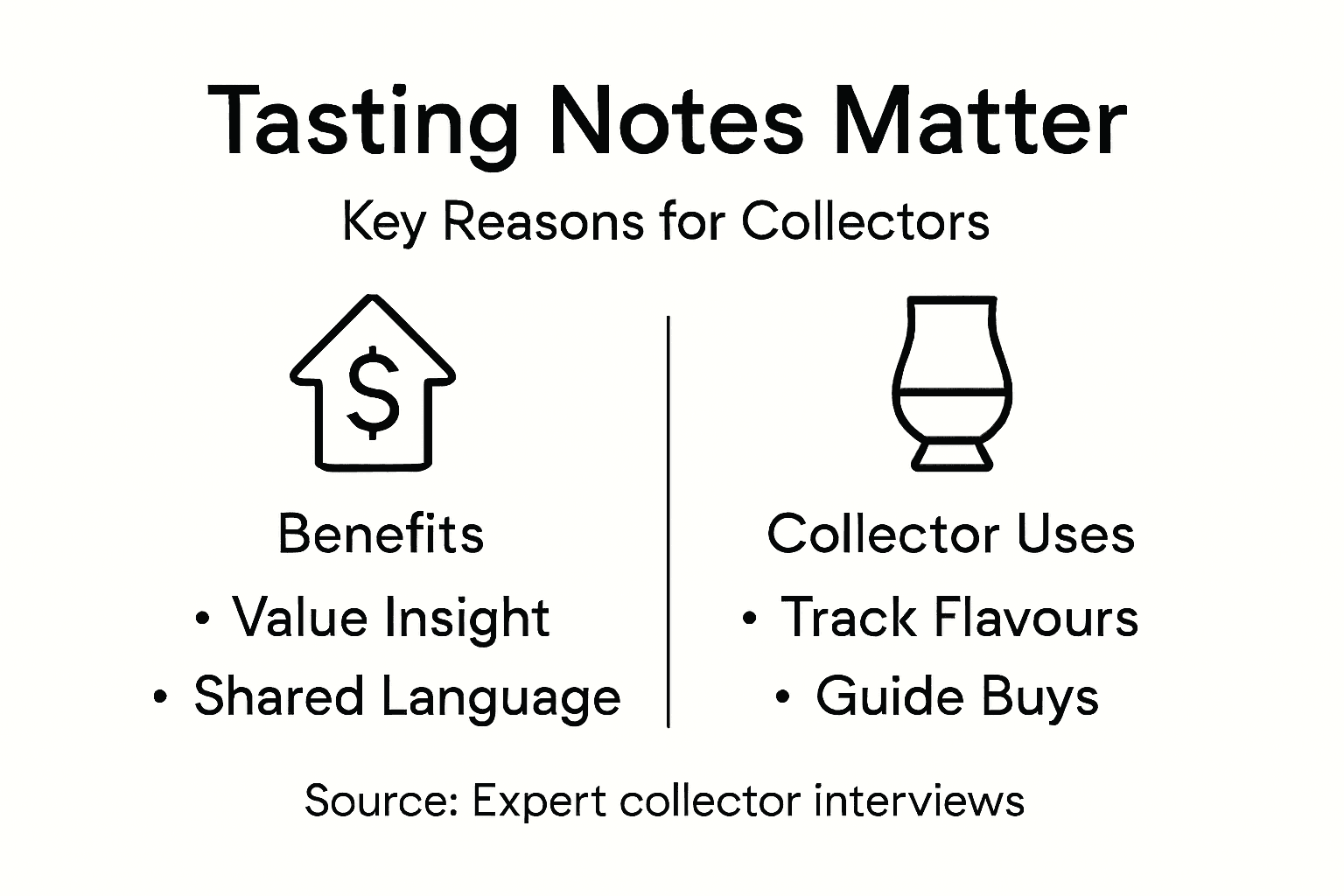
Tasting notes serve as an essential communication tool that bridges individual experience with broader whisky culture. They help collectors understand a whisky’s unique profile, assess its quality, and make informed purchasing decisions. By providing a structured framework for evaluation, these notes enable enthusiasts to compare and appreciate whiskies from different regions, distilleries, and production styles, transforming subjective tasting into a more objective and shareable experience.
Pro tip: Keep a personal tasting journal to track and develop your sensory vocabulary, helping you progressively refine your whisky appreciation skills.
How Tasting Notes Elevate Appreciation
Sensory analysis of whisky transforms the drinking experience from a simple act of consumption into an intellectual and emotional journey. Tasting notes provide a sophisticated framework that allows enthusiasts to explore the intricate layers of flavour, turning each sip into a nuanced exploration of craftsmanship and terroir. By articulating the complex sensory experiences, collectors can develop a deeper understanding and appreciation of the whisky’s unique characteristics.
The process of decoding tasting notes involves recognising a rich palette of sensory markers that extend beyond basic flavour identification. Professional tasters and collectors learn to distinguish subtle hints of spice, wood, fruit, and smoke that tell the story of a whisky’s origin and production. Tasting notes reveal intricate flavour interplays that connect the drink to its geographical and cultural heritage, transforming each glass into a narrative of tradition and expertise.
Moreover, tasting notes serve as a critical tool for whisky collectors in assessing value, rarity, and potential investment potential. By understanding the precise sensory profile of a whisky, collectors can make informed decisions about purchasing, storing, and potentially reselling rare bottles. The detailed descriptors help create a shared language among enthusiasts, enabling more sophisticated discussions and deeper appreciation of the nuanced world of whisky collecting.

Pro tip: Develop your tasting vocabulary by attending whisky tastings and comparing notes with experienced collectors, allowing you to refine your sensory perception and understanding.
Tasting Notes in Buying and Collecting Decisions
Quantitative sensory analysis transforms whisky collecting from a subjective hobby into a strategic investment approach. Tasting notes provide collectors with a sophisticated framework for evaluating potential acquisitions, offering detailed insights into a whisky’s unique characteristics, production quality, and potential future value. By understanding the nuanced flavour profiles, collectors can make more informed decisions about which bottles represent genuine investment opportunities.
The strategic importance of tasting notes extends beyond simple flavour description. Professional collectors use these detailed sensory profiles to assess rarity, provenance, and potential appreciation of whisky bottles. Comprehensive tasting notes reveal critical details about a whisky’s production variables, including cask type, aging process, and distinctive flavour markers that distinguish exceptional bottles from ordinary releases. These insights become crucial when determining a whisky’s collectibility and potential long-term value.
Moreover, tasting notes serve as a sophisticated diagnostic tool for collectors navigating the complex whisky market. They help identify unique expressions that might appreciate in value, distinguishing between mass-produced offerings and limited-edition releases. Collectors learn to decode subtle sensory information that signals a bottle’s potential as a prized collection piece, considering factors like regional characteristics, distillery reputation, and intricate flavour complexity.
Pro tip: Develop a systematic approach to documenting tasting notes, creating a personal reference that tracks flavour profiles, rarity, and potential investment potential of your whisky collection.
The Language and Structure of Tasting Notes
Whisky tasting language represents a sophisticated sensory communication system that transforms complex flavour experiences into articulate descriptions. This specialised vocabulary bridges the gap between subjective perception and objective analysis, allowing whisky enthusiasts to capture the intricate nuances of each unique expression. Professional tasters develop a refined lexicon that goes beyond simple flavour identification, creating a rich narrative that communicates the essence of a whisky’s character.
The structural framework of tasting notes typically follows a standardised three-stage approach, breaking down the sensory experience into distinct components: nose (aroma), palate (taste), and finish (aftertaste). Each stage requires different descriptive techniques, ranging from precise technical language to evocative metaphorical expressions. Tasters might describe the nose as having hints of maritime salt or dried fruits, the palate as displaying complex layers of spice and wood, and the finish as lingering with notes of caramel or subtle smokiness.
The following table compares structured and unstructured whisky tasting approaches:
| Approach | Structure Level | Pros | Cons |
|---|---|---|---|
| Standardised Notes | High | Objective comparisons; track history | May feel restrictive |
| Unstructured Tasting | Low | Personal creativity; unique experience | Hard to compare; bias risk |
Beyond technical description, the language of tasting notes incorporates a rich tapestry of cultural and sensory references. Professional tasters draw inspiration from diverse experiences, comparing whisky flavours to landscape imagery, culinary experiences, and even emotional states. This approach transforms tasting notes from mere technical documents into storytelling narratives that capture the emotional and cultural dimensions of whisky appreciation. The goal is not just to describe flavour, but to communicate the entire sensory and emotional journey of a particular whisky.
Pro tip: Develop a personal tasting vocabulary by keeping a detailed journal that captures your unique sensory impressions, allowing you to refine your descriptive language over time.
Common Misconceptions and Pitfalls to Avoid
Common tasting pitfalls can significantly undermine a collector’s ability to accurately assess and appreciate whisky. Many enthusiasts fall into predictable traps that compromise their sensory evaluation, ranging from subjective biases to technical misunderstandings. These misconceptions can lead to flawed interpretations, potentially affecting purchasing decisions and overall whisky appreciation.
One of the most significant misconception categories involves preconceived notions and emotional attachments to specific brands or styles. Collectors often unconsciously allow previous experiences or marketing narratives to colour their perception, rather than approaching each tasting with a truly objective mindset. This bias can manifest in several ways: romanticising a particular distillery, dismissing entire whisky regions, or allowing price point to artificially influence perceived quality. Experienced collectors learn to suspend judgment and approach each whisky as a unique sensory experience, free from external expectations.
Technical misunderstandings also plague many whisky enthusiasts. Common errors include improper glassware selection, incorrect serving temperature, and rushed tasting processes that prevent full sensory exploration. Collectors might mistakenly believe that expensive whiskies are inherently superior or that complex tasting notes automatically indicate higher quality. In reality, whisky appreciation requires a nuanced understanding that goes beyond surface-level impressions, demanding patience, practice, and a willingness to challenge personal preconceptions.
Pro tip: Develop a standardised tasting protocol that minimises personal bias by using blind tasting techniques and maintaining a consistent evaluation framework.
Enhance Your Whisky Collection with Expert Flavour Insight
Understanding the importance of whisky tasting notes is key for every serious collector looking to make informed choices and appreciate each bottle’s unique character. Whether you seek to decode subtle notes like peaty, honeyed, or maritime flavours or aim to build a refined personal tasting vocabulary, having access to premium whiskies with detailed descriptions is essential. At Uisuki.com.au, we offer a curated selection of rare and exceptional whiskies including popular options from Glenfiddich, unique expressions from Glenglassaugh, and diverse global selections at our World Whiskies collection.

Dive into a world of flavour and history by exploring bottles that match your evolving sensory insights. With our detailed product listings, insightful descriptions, and expert guidance you can confidently expand your collection today. Visit Uisuki.com.au to start discovering whiskies that perfectly align with your tasting journey and collector goals.
Frequently Asked Questions
What are whisky tasting notes?
Whisky tasting notes are detailed sensory descriptions that capture the flavours, aromas, and characteristics of a whisky. They enhance the appreciation and understanding of the whisky’s profile, allowing enthusiasts to articulate their experiences.
How do tasting notes benefit whisky collectors?
Tasting notes provide collectors with crucial insights into a whisky’s quality, uniqueness, and potential investment value. They help assess rarity, provenance, and the craftsmanship behind each bottle.
What should I include in my personal tasting journal?
Your personal tasting journal should document your sensory impressions, including flavours, aromas, and emotional responses. Note the specific tasting descriptors you use to refine your vocabulary and understanding over time.
How can I develop a sophisticated whisky tasting vocabulary?
You can develop your whisky tasting vocabulary by attending tastings, comparing notes with experienced collectors, and regularly documenting your impressions in a journal. This practice will help you articulate the nuances of various whiskies more effectively.