

Malt whisky is made from 100% malted barley and almost always distilled in pot stills, giving it a fuller, more expressive character. Grain whisky uses other cereals (or a mix including some malted barley) run through continuous column stills, which produces a lighter, cleaner spirit. Regional rules, particularly in Scotland and Ireland, lock these definitions in law. If you’re after something to sip slowly, lean malt. If you want a smooth mixer or a backbone for a blend, grain does the job.
TL;DR:
- A high-quality single grain whisky can offer complexity comparable to some malts at a lower price due to production efficiencies.
- Longer-aged single grain whiskies, once mainly used for blending, are increasingly bottled alone and valued for their cask-driven character.
- The flavor profile of malt and grain whiskies depends heavily on cask type and maturation, often outweighing the influence of the spirit’s base ingredients.
- Checking the mash bill and cask details provides a better indication of flavor potential than category labels alone.
- Price often reflects cask quality and rarity more than age or category, making well-aged single grain a cost-effective option for nuanced drinking.
Table of Contents
- Malt vs grain whiskey: the ingredients behind each style
- How production shapes malt and grain whisky differently
- What malt and grain whisky taste like, and how casks change that
- Single malt, single grain, or blend: what to buy for the occasion
- Legal definitions: what “malt” and “grain” actually mean on a label
- Why trust this guide: Brendan and Uisuki’s expertise
- The verdict on malt vs grain whiskey, and three tips before you buy
- How malt and grain whisky evolved into today’s categories
- Why malt and grain whisky sit at different points in the market
- What malt and grain whisky cost, and whether the price reflects the quality
- An honest take on the malt versus grain debate
- Browse malt and grain whisky, or ask Uisuki to find your bottle
- Sources
Malt vs grain whiskey: the ingredients behind each style
The real split starts at the mash tun. Malt whisky uses 100% malted barley, meaning the grain has been steeped in water and allowed to germinate before drying, a process that activates enzymes. Those enzymes convert the barley’s starches into fermentable sugars, and that conversion is the entire point of malting. Grain whisky, by contrast, draws on a wider basket of cereals, and the choice of grain shapes the eventual character of the spirit even before a drop touches a still.
- Corn (maize) tends to bring sweetness and a heavier body, which is why it dominates American grain recipes.
- Rye adds spice and a peppery bite, prized in North American ryes and some European grain whiskies.
- Wheat contributes softness and a creamy texture, often used where distillers want a gentler grain backbone.
- Unmalted barley shows up in Irish pot still whiskey for texture without the malt’s full flavour load.
Here’s the twist most drinkers miss: many grain mash bills still include a portion of malted barley, not for flavour, but for its enzymes. Malted barley supplies the amylases needed to break down starch in cheaper, unmalted grains, so a grain whisky can lean on corn or wheat for its taste while still relying on barley to get the fermentation started. Distillers sometimes substitute commercial enzymes for part of that malt, trimming costs while keeping conversion efficient.
How production shapes malt and grain whisky differently
Equipment matters as much as ingredients. Pot stills work in batches, and each run retains more of the oily, flavour-carrying compounds called congeners. Column stills run continuously, stripping out more of those congeners and pushing the spirit to a higher, cleaner strength.
- Mashing and fermentation rely on malt enzymes to unlock sugars, whether the base grain is barley, corn, wheat, or rye.
- Batch pot distillation concentrates flavour and texture, which is why single malts often taste heavier and more layered.
- Continuous column distillation produces a lighter, higher-proof spirit, ideal for blending rather than sipping neat.
- Legal proof limits vary by country. US straight whiskies, including bourbon and rye, must be distilled below 80% ABV to retain grain character, while anything above that threshold falls into the separate “light whiskey” category.
Pro Tip: If a grain whisky lists an unusually high ABV on the still (not the bottle), expect a cleaner, more neutral spirit. Distillers can adjust plates and reflux on a column still to dial the character closer to malt-like or closer to neutral, depending on what they’re aiming for.
What malt and grain whisky taste like, and how casks change that
Malt whisky typically carries more weight on the palate. Expect malty, biscuity notes as a baseline, with fruit, spice, or smoke and peat layered on top depending on the distillery and region. That range exists largely because pot still congeners and barley character give the spirit more raw material to build complexity from.
Grain whisky starts lighter. The base spirit tends toward sweetness or near-neutrality, which means the cask does more of the talking.
- Ex-bourbon casks lend vanilla and caramel, softening grain whisky’s edges without overwhelming it.
- Sherry casks push dried fruit and spice into both malt and grain spirits, though the effect reads more dramatically against grain’s quieter base.
- New oak adds tannin and spice quickly, useful for shorter maturation periods.
- Extended ageing lets grain whisky develop genuine complexity over time.
Long-aged single grain releases have become one of the more interesting shifts in the category. Rather than disappearing into blends, well-matured grain whiskies now stand on their own, showing sweet, elegant profiles shaped almost entirely by cask influence rather than pot still congeners. That’s a genuine departure from how grain whisky was treated a generation ago, when it rarely got bottled solo at all.
Single malt, single grain, or blend: what to buy for the occasion
Buying decisions get easier once you know what each style is built for. Single malts reward slow nosing and reveal more as they open in the glass, making them the natural choice for collectors chasing specific distillery character.
- Choose single malt when you want to taste a distillery’s signature style neat, or you’re building a collection around specific expressions.
- Choose single grain or blended whisky for approachable, consistent drinking, especially in cocktails where a heavier malt might clash with other ingredients.
- Choose blends when you want balance. The blender’s craft lies in using grain whisky’s lightness to smooth a malt’s intensity, producing something more consistent bottle to bottle.
Grain whisky’s role in blending isn’t a footnote. More than 90% of Scotch and Irish whisky sold is blended, and grain spirit is the reason those blends taste the same in 2026 as they did a decade ago.
Legal definitions: what “malt” and “grain” actually mean on a label
Labelling rules aren’t decorative. They tell you exactly what’s in the bottle before you spend a cent.
| Jurisdiction | Malt whisky rule | Grain whisky rule |
|---|---|---|
| Scotland | 100% malted barley, pot still, matured minimum 3 years in Scotland | Other cereals allowed, continuous column still, same 3 year minimum |
| Ireland | Traditionally pot still, often includes malted and unmalted barley | Column still production, lower malt percentage permitted |
| United States | No direct “malt whisky” equivalent under Scotch rules | Straight whiskies distilled below 80% ABV; “light whiskey” applies above that |
Scotland and Ireland both anchor “malt” to 100% malted barley and pot still production, but grain rules diverge more between countries. Ireland’s pot still category blends malted and unmalted barley in ways Scotland doesn’t recognise under its own malt definition, and US naming conventions don’t map onto either system directly. Reading the label’s fine print, rather than assuming a familiar term travels across borders, saves confusion at the bottle shop.
Why trust this guide: Brendan and Uisuki’s expertise
This guide draws on Brendan’s ongoing work explaining whisky production and flavour for Uisuki’s readers, alongside the store’s day to day experience sourcing and selling bottles across categories. Brendan writes the site’s deeper explainers on grain composition, malt character, and cask influence, giving readers a technical grounding before they shop. Uisuki’s role as a specialist retailer means the store handles sourcing requests, curates listings with detailed ABV and cask information, and ships both locally and internationally. That combination, production knowledge paired with retail experience, is what shapes the practical advice in this guide.
The verdict on malt vs grain whiskey, and three tips before you buy
Malt whisky delivers weight and complexity through malted barley and pot stills; grain whisky delivers lightness and versatility through other cereals and column stills. Neither is objectively better, they’re built for different jobs.
- Check the mash bill before buying if you want a specific flavour profile, since corn, rye, and wheat behave differently.
- Ask about the cask, especially for grain whisky, since maturation does most of the flavour work there.
- Taste neat first, then add a few drops of water to open up aromatics before judging a bottle either way.
For deeper reading, Uisuki’s guide on the effect of malt on whisky flavour breaks down cask chemistry further.
How malt and grain whisky evolved into today’s categories
Malt whisky came first, born out of necessity. Scottish and Irish farmers distilled what grew locally, and barley suited the climate. Pot stills were the only distillation technology available until the early 1800s, so every whisky made before then was, by default, something close to today’s single malt.
The column still changed everything. Robert Stein patented a continuous still in the 1820s, and Aeneas Coffey refined the design in 1830, allowing distillers to run cheaper grains like corn and wheat through a continuous process that produced spirit faster and at higher proof. Grain whisky as a distinct category effectively begins here, and it arrived at a convenient moment: it gave blenders a light, consistent base to stretch and soften pot still malt whisky, which was often too intense for the emerging mass market of the Victorian era.
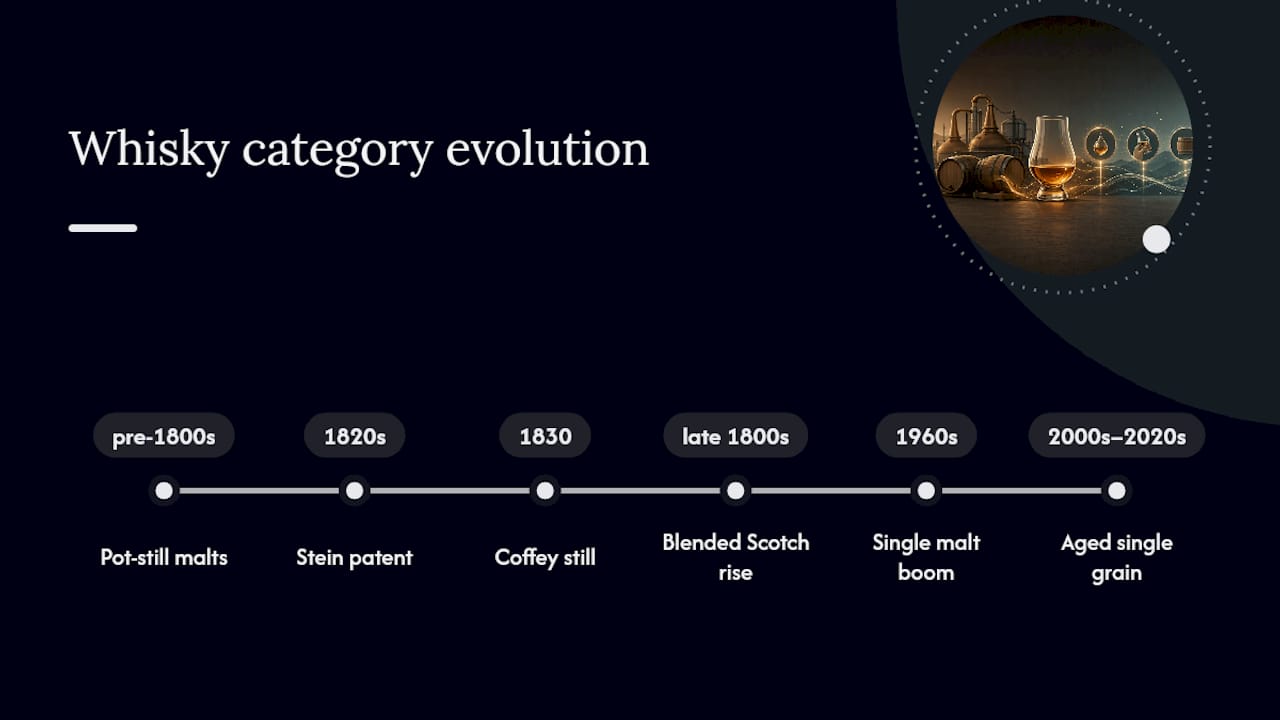
Blended Scotch built its empire on that pairing through the late 1800s and into the 20th century, with brands using grain whisky to make blends approachable enough for everyday drinking. Single malt’s modern prestige is comparatively recent. It really took hold from the 1960s onward as distilleries began bottling and marketing their own single malt expressions instead of sending every drop into blends. Grain whisky spent most of that period as an unglamorous workhorse, until long-aged single grain bottlings started appearing in specialist ranges over the last two decades, giving the category its own collector following for the first time.
Why malt and grain whisky sit at different points in the market
Malt whisky, particularly single malt, occupies the premium end of most whisky ranges. Limited pot still runs, longer maturation periods, and distillery-specific character all support higher price points and a collector market that treats certain bottlings the way wine collectors treat vintage Bordeaux.
Grain whisky has historically played a supporting role, valued more for what it contributes to a blend than for standalone sales. Column stills run efficiently at scale, producing large volumes of consistent spirit at a lower cost per bottle than pot still malt. That efficiency is exactly why grain whisky underpins the blended whisky market, which still represents the bulk of global Scotch and Irish whisky sales.
The market is shifting at the edges, though. Long-aged single grain releases are carving out a niche among enthusiasts who want something different from the usual single malt shelf, and these bottlings often price competitively against malts of similar age because grain spirit costs less to produce even after decades in cask. That gap between production cost and eventual price is part of what makes aged single grain an interesting value proposition for buyers willing to look past the more famous malt category. Distilleries with strong grain whisky programs are also increasingly transparent about cask provenance, treating single grain releases as a genuine product line instead of a curiosity.
What malt and grain whisky cost, and whether the price reflects the quality
Entry-level blended whisky, built largely on grain whisky’s lighter base, sits at the most accessible price point in most bottle shops. That affordability isn’t a mark against it. It’s the direct result of column still efficiency and grain’s lower production cost, and plenty of well-made blends drink far better than their price suggests.
Single malt occupies a wider price spread. Younger, widely available single malts compete directly with premium blends, while limited releases, older age statements, and sought-after distilleries push into serious collector territory. Consumers often assume price scales cleanly with age or malt content, but cask quality and rarity usually matter more than either factor alone.
Single grain whisky is the category most likely to surprise buyers on value. A well-aged single grain can offer sweet, elegant drinking comparable in sophistication to a mid-range malt, often at a lower price simply because grain whisky hasn’t attracted the same collector premium yet. That’s less a loophole and more a temporary market inefficiency, and it won’t necessarily last as more drinkers catch on. For now, it means a curious buyer with a moderate budget can access genuinely complex, cask-driven whisky by shopping the single grain shelf instead of chasing the same handful of famous malt names everyone else wants.
An honest take on the malt versus grain debate
The conventional wisdom treats malt as inherently superior and grain as filler for blends, and that framing has outlived its usefulness. Malt whisky earns its reputation through pot still congeners and barley’s flavour potential, but that potential still depends entirely on cask quality and maturation. A mediocre malt in a tired cask loses to a well-aged single grain every time.
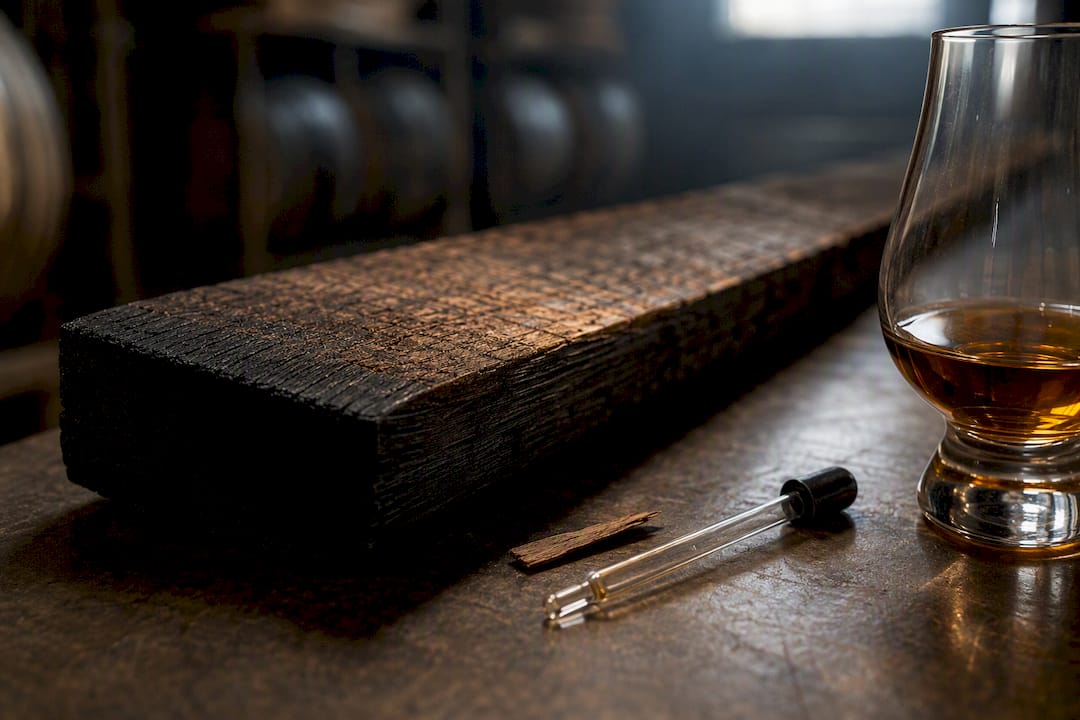
What gets underrated is how much cask choice, not spirit base, drives the final glass. Grain whisky’s lighter starting point means the cask’s fingerprints show up more clearly, which is precisely why long-aged single grains can taste so distinctive. That’s not a workaround for a “lesser” spirit, it’s a different lever being pulled.
If you’re shopping rather than just reading about this, prioritise cask information and age statement over category labels. Ask what the whisky was matured in before you ask whether it’s malt or grain. The label tells you the starting material. The cask tells you most of what actually ends up in the glass.
— Brendan
Browse malt and grain whisky, or ask Uisuki to find your bottle
Specialist whisky retailers curate single malts, single grains, and blends from Scotland, Ireland, Japan, Australia, and the US, often providing cask details and ABV to help customers shop by specific criteria.

If a specific single grain release or a hard-to-find malt isn’t listed, a specialist sourcing service can assist by locating bottles on request, offering a streamlined point of contact with expertise in mash bills, cask types, and regional labelling rules. Start by browsing the current range at Uisuki and flag any bottle you can’t find through a sourcing request.
Sources
- Grain whisky — Wikipedia
- Understanding malting barley quality — Michigan State University
- The Glenlivet — The 4 types of grains used in whisky
- Grain whisky — Sentinel Room