

This is a working list of single malt whisky brand names, grouped alphabetically and by region, built for anyone who wants to recognise a name on a shelf and know roughly what to expect from the glass. It covers Scotch and notable single malts from Japan, the USA, Ireland, India, and beyond. You can buy or source many of the bottles named here through Uisuki’s own catalogue.
TL;DR:
- Recognizing a whisky brand by region helps predict its flavor profile, such as fruity and sherry-influenced for Speyside or peaty and maritime for Islay.
- Most top Scottish distilleries are concentrated in regions like Speyside, Highlands, and Islay, with new brands from Japan, India, and the USA expanding the diversity of single malts.
- When choosing a bottle, look for label details like age, cask type, and ABV, and understand that no age statement does not necessarily mean a lesser quality.
- Regional styles vary significantly: Scotch regions have distinct characteristics, while non-Scottish countries like Japan and Taiwan offer different flavor innovations based on their climate.
- Prioritize flavor preference over brand fame when shopping and consider region filters to find value options in Highlands and Speyside, which are often overlooked.
Table of Contents
- Brand names of single malt whisky from A to Z
- How regions shape flavour, and why that matters when scanning names
- Turning a brand name into a buying decision
- Where a brand list becomes a shopping list
- What most brand lists get wrong
- Buy or source your next bottle
- Sources
Brand names of single malt whisky from A to Z
There are more than 150 Scotch whisky distilleries operating in Scotland alone, and that’s before you count Japan, the USA, Ireland, India, Taiwan, and Australia. No single article can name every producer bottling under its own label, but the roster below covers the names you’ll actually run into shopping, at a bar, or scrolling a retailer’s catalogue.
A
- Aberfeldy (Highlands)
- Aberlour (Speyside)
- Ailsa Bay (Lowlands)
- Amrut (India)
- Ardbeg (Islay)
- Ardmore (Highlands)
- Arran (Islands)
- Auchentoshan (Lowlands)
B
- Balblair (Highlands)
- Balvenie (Speyside)
- Benriach (Speyside)
- Benromach (Speyside)
- Bladnoch (Lowlands)
- BenNevis (Highlands)
- Bowmore (Islay)
- Bruichladdich (Islay)
- Bunnahabhain (Islay)
C
- Cardhu (Speyside)
- Clynelish (Highlands)
- Craigellachie (Speyside)
- Cragganmore (Speyside)
- Glen Scotia (Campbeltown)
D
- Dalmore (Highlands)
- Dalwhinnie (Highlands)
- Deanston (Highlands)
- Dewar’s (blended, but with single malt releases)
E
- Edradour (Highlands)
- Edinburgh (Lowlands, newer distillery output)
F
- Fettercairn (Highlands)
G
- GlenAllachie (Speyside)
- Glenfarclas (Speyside)
- Glenfiddich (Speyside)
- Glengoyne (Highlands)
- Glenkinchie (Lowlands)
- Glenlivet (Speyside)
- Glenmorangie (Highlands)
- Glen Grant (Speyside)
- Glen Moray (Speyside)
- Glenrothes (Speyside)
H
- Highland Park (Islands, Orkney)
- Hazelburn (Campbeltown, Springbank’s triple-distilled line)
I
- Inchgower (Speyside)
- Isle of Jura (Islands)
J
- Japanese single malts more broadly cluster under Yamazaki, Hakushu, and Yoichi (see below)
K
- Kavalan (Taiwan)
- Kilchoman (Islay)
- Knockando (Speyside)
- Knockdhu (Highlands, sold as anCnoc)
L
- Lagavulin (Islay)
- Laphroaig (Islay)
- Ledaig (Islands, Tobermory’s peated expression)
- Linkwood (Speyside)
- Longmorn (Speyside)
M
- Macallan (Speyside)
- Mortlach (Speyside)
N
- Nikka (Japan, home to Yoichi and Miyagikyo)
O
- Oban (Highlands)
- Old Pulteney (Highlands)
P
- Penderyn (Wales)
R
- Royal Brackla (Highlands)
- Royal Lochnagar (Highlands)
S
- Speyburn (Speyside)
- Springbank (Campbeltown)
- Strathisla (Speyside)
- Starward (Australia)
T
- Talisker (Islands, Skye)
- Tamdhu (Speyside)
- Teaninich (Highlands)
- Tobermory (Islands)
- Tomatin (Highlands)
- Tomintoul (Speyside)
- Tullibardine (Highlands)
W
- Wolfburn (Highlands)
Y
- Yamazaki (Japan)
- Yoichi (Japan)
This roster leans heavily Scottish because Scotland still produces the widest spread of single malt brand names anywhere, but it’s not the only game going. Ireland, the USA, and Australia are all adding names to this list every year, and some of the buyer checklist below applies just as much to a bottle from Tasmania as one from Speyside.
How regions shape flavour, and why that matters when scanning names
Region is the fastest way to translate an unfamiliar brand name into a rough idea of what’s in the bottle, even though it’s a heuristic with exceptions rather than a hard rule.
- Speyside (Macallan, Glenfiddich, Glenlivet): the biggest cluster of distilleries in Scotland, generally fruity, honeyed, and sherry-influenced.
- Highlands (Dalmore, Glenmorangie, Oban): broad and varied, from light and floral to rich and heather-honeyed.
- Islay (Ardbeg, Laphroaig, Bowmore): peat smoke, iodine, and maritime brine, the most polarising style on the list.
- Islands (Talisker, Highland Park, Tobermory): coastal and peppery, often with a lighter peat hand than Islay.
- Lowlands (Auchentoshan, Glenkinchie): lighter, grassier, and gentler on the palate, a good starting point for newcomers.
- Campbeltown (Springbank, Glen Scotia): a once-dominant region now down to a handful of distilleries, with a distinctive briny, oily character.
- Beyond Scotland: Japan (Yamazaki, Nikka) leans balanced and precise; Taiwan (Kavalan) runs tropical and fast-maturing in its warm climate; India (Amrut) shares that heat-driven intensity; the USA and Australia are newer entrants producing everything from bourbon-cask-influenced malts to cool-climate, sherry-forward styles.
Not all of this sits under Scotch Whisky Regulations either. Other producing countries define single malt differently, so a Japanese or Taiwanese label won’t always follow the same three-year maturation rule that governs Scotch. Worth knowing before you assume every “single malt” on a shelf plays by identical rules. For a deeper look at how these regional styles diverge, Uisuki’s guide to whisky regions and its flavour-first breakdown of Scotch styles both go further than a brand list can.
Turning a brand name into a buying decision
Recognising a name is step one. Turning that into a smart purchase takes a quick pass through a few details on the label.
- Decide the flavour direction first — peaty, sherried, or light and fruity — before you start comparing prices.
- Set a budget tier — entry-level 10 to 12 year statements, mid-tier 15 to 18, or collector-grade releases above that.
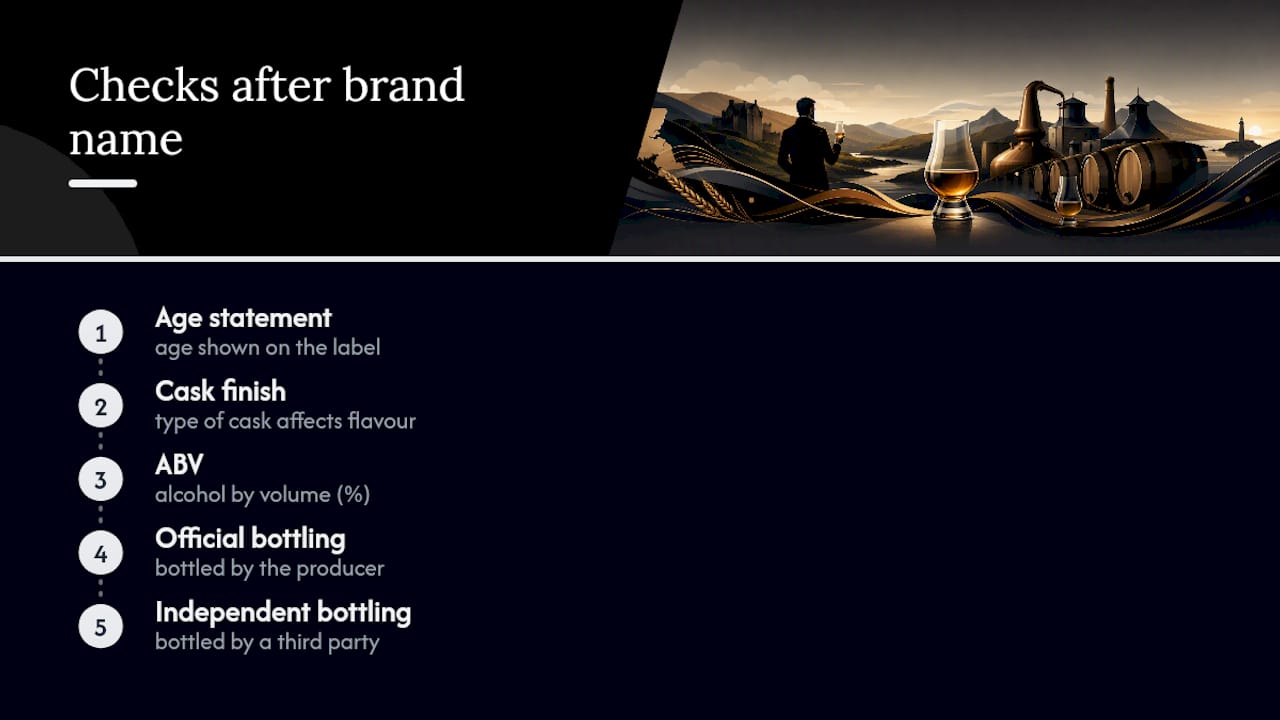
- Check the label for age statement, cask type or finish, and ABV (Scotch single malt must be bottled at a minimum of 40%).
- Compare official versus independent bottlings and check current availability before committing.
Pro Tip: An age statement only tells you the youngest whisky in the blend, not the average. A No Age Statement (NAS) release isn’t automatically younger or lesser. It just means the distiller had more flexibility to blend older and younger casks together for complexity, and some NAS bottles outperform age-stated ones at the same price.
For a longer walkthrough of this decision process, Uisuki’s step-by-step guide to choosing single malt whisky breaks each of these checks down further.
Where a brand list becomes a shopping list
Uisuki runs as a specialist online retailer, with detailed listings, ABV and cask information on every bottle, educational content, and a standing offer to source rare or hard-to-find releases on request. The A–Z catalogue and top picks page turns names on this list into buyable product pages, with regional guides alongside for anyone still deciding where to start.
What most brand lists get wrong
Most lists of single malt brand names stop at the name. They’ll tell you Ardbeg is Islay and Macallan is Speyside, then leave you to work out everything else on your own. That’s backwards. A brand name is only useful once you know what to check next: age statement, cask finish, ABV, and whether you’re looking at an official bottling or an independent one.
The bigger blind spot is treating “single malt” as a Scotch-only category. Award lists increasingly feature single malts from Japan, India, Taiwan, and the USA alongside Scottish stalwarts, and buyers who only scan Scotch names are missing genuinely excellent bottles. Kavalan and Amrut aren’t novelty entries. They’re competing on merit.
My advice: use region as a starting filter, not a final verdict. Some of the best value sits in Highlands and Speyside releases that never make “best of” lists simply because they’re not peated or dramatic. Prioritise matching flavour to your own palate over chasing a famous name, and treat the label details, not the brand reputation, as the real decision point.
— Brendan
Buy or source your next bottle
Every name on this list, and hundreds more, sit in Uisuki’s own catalogue, not a hypothetical shelf. If you’ve spotted a brand above you want to try, or you’re chasing something rarer that didn’t make the roster, the fastest path is straight to the source rather than hunting across multiple retailers. Uisuki carries new arrivals and hard-to-find bottles across Scotland, Japan, Australia, and the USA, backed by detailed product listings covering ABV, cask type, and price tier, plus a standing sourcing request option for anything not currently in stock.
Local and international shipping are both supported, with multiple payment options at checkout. If a bottle from this A–Z roster catches your eye, search the Uisuki catalogue directly, or submit a sourcing request for something specific and let the team track it down.
Sources
- Discover Single Malt Scotch whisky — Scotch Whisky Association
- Single malt Scotch: definition, production and what to expect — Scotch Authority