

Whisky costs what it costs because of six compounding factors: time locked in a cask, the wood that cask is made from, genuine scarcity from closed distilleries and finite old stock, the raw cost of running a distillery, deliberate premiumisation by brands, and taxes that vary by market. Some of these are structural and permanent. Others are marketing dressed up as scarcity, and telling the difference is what separates a smart buy from an overpriced one.
TL;DR:
- The age of whisky is driven by decades-long production lag and natural evaporation, making older bottles scarce and expensive regardless of current demand.
- Cask type, origin, and cooperage significantly influence costs, with Mizunara oak and sherry-seasoned barrels costing much more than standard ex-bourbon casks.
- Closed distilleries and past low-production periods create genuine scarcity that supports long-term price growth, unlike marketing-driven claims of scarcity.
- Production costs from ingredients, energy, small stills, and craft methods set a real price floor, but brand premiums and marketing strategies often elevate final prices more than costs.
- Awards and critic scores can boost prices quickly through market hype, especially for limited releases, but provenance and production constraints better indicate true value.
Table of Contents
- What makes whisky expensive: age and maturation
- Cask type, cooperage and the cost of wood
- Why closed distilleries and production limits drive prices up
- What production costs add to the price of whisky
- Brand positioning and premiumisation: what you’re really paying for
- Taxes, duty and why the same bottle costs different amounts by country
- Limited editions, allocation and the secondary market
- Does expensive whisky actually taste better?
- How specialist retailers document provenance
- How provenance and region shape what you pay
- How warehouse location and maturation environment affect cost
- Blended whisky vs single malt: why the cost structures differ
- Do awards and critic scores actually move whisky prices?
- A collector’s honest take on paying up
- Finding premium and rare bottles worth the price
- Sources
What makes whisky expensive: age and maturation
Age is the most obvious lever, and also the most misunderstood. A distillery can increase output this year, but it cannot manufacture a 25 year old whisky faster than 25 years. That lag is the entire reason older expressions command a premium: today’s demand for aged stock has to be met from spirit laid down decades ago, and that pool only ever shrinks. The production lag between distillation and sale runs anywhere from ten to twenty five years, which means the whisky hitting shelves now was a decision made by someone who is possibly retired.
Every year in cask, the distillery loses volume to evaporation, known in the trade as the angel’s share. In Scotland’s climate that’s typically around 2% of the cask’s volume per year, which compounds brutally over a couple of decades. A cask filled with enough spirit for hundreds of bottles at ten years old might yield noticeably fewer by twenty five, simply because so much has evaporated into the warehouse rafters. On top of that:
- Warehousing, insurance and security on maturing stock all cost money for years before a single bottle is sold.
- Working capital gets tied up in barrels that generate zero revenue until they’re bottled.
- Casks can drop below the legal minimum bottling strength (40% ABV in most markets) if left too long, forcing early bottling or write-offs.
- Longer maturation means fewer bottles per cask and higher insurance premiums on the warehouse itself.
Pro Tip: If a bottle carries no age statement, don’t assume it’s cheap stock. Distilleries increasingly use NAS releases to blend around genuinely scarce aged casks, so the liquid inside can be older, and pricier, than the label lets on. Understanding how age statements are calculated helps you read between the lines.
Cask type, cooperage and the cost of wood
Not all wood costs the same, and the difference shows up directly in the bottle price. Ex-bourbon barrels are relatively cheap and plentiful because the US bourbon industry produces a constant supply of once-used casks. Sherry-seasoned casks cost considerably more, because a cooper has to build the cask, ship it to a Spanish bodega, fill it with wine for months or years purely to season the wood, then ship it again to a distillery. Mizunara oak sits above both: the Japanese oak is prone to leaking, harder to source in large volumes, and demands cooperage skills that few coopers outside Japan have mastered.
- Ex-bourbon casks: low cost, high availability, the industry’s default workhorse.
- Sherry-seasoned casks: higher cost due to wine sourcing, seasoning time and specialist cooperage.
- Mizunara casks: highest cost, driven by scarcity of suitable oak, slower seasoning cycles and a real risk of failure during maturation.
That cost hierarchy flows straight through to allocation. A distillery filling ten mizunara casks a year simply cannot produce the bottle count of one filling five hundred ex-bourbon barrels, and the retail price has to account for both the wood cost and the tiny run size.
Why closed distilleries and production limits drive prices up
Scarcity comes in two flavours: the kind that’s permanent, and the kind that’s manufactured. The permanent kind starts with closed or “ghost” distilleries. When a distillery shuts its doors, whatever whisky it laid down before closing is the entire remaining supply, forever. No amount of demand can conjure more of it, which is precisely why bottles from long-closed Scottish distilleries routinely fetch prices that dwarf anything currently in production.
There’s a second, subtler version of this same problem. Many distilleries went through lean periods, low production, mothballing, ownership changes, decades ago. Whisky distilled during those quiet years is now the only source of anything bottled at 20 or 30 years old from that site, and there simply wasn’t much of it made in the first place. Age-stated expressions draw on a limited historical production run that cannot be topped up retroactively, no matter how popular the brand becomes today.
- Closed distillery stock is fixed forever, it only ever decreases as bottles are opened.
- Historical low-output years create scarcity gaps decades later that no marketing decision can fix.
- Genuine structural scarcity supports long-term price appreciation, unlike scarcity a brand can simply switch off.
A useful gut check when a bottle’s price seems steep: could this expression be produced in larger volumes if demand spiked next year? If the answer is yes, you’re likely paying for allocation strategy, not real scarcity.
What production costs add to the price of whisky
Before a drop ever touches a cask, the distillery has already spent heavily on ingredients, energy and labour. None of this is glamorous, but it’s real money baked into every litre.
- Long fermentations and small stills. Distilleries chasing a particular character often run longer fermentation cycles or use smaller stills, both of which cut throughput per day compared with high-volume continuous production.
- Capital costs. Building a distillery, then waiting years before the first sellable spirit exists, means owners are servicing loans on equipment that generates no income for a long stretch.
- Barley, energy and labour. Malted barley prices, the energy needed to run stills and kilns, and skilled distillery labour all sit on the cost sheet before maturation even begins.
- Craft and small-batch methods. Hand-selected casks, manual bottling and small production runs genuinely cost more per bottle, and the value shows up in consistency and character rather than volume.
None of this alone explains a $300 price tag, but stacked together it sets a real cost floor beneath everything that follows.
Brand positioning and premiumisation: what you’re really paying for
Here’s the uncomfortable truth for collectors: premiumisation, not production cost, is doing most of the heavy lifting on flagship bottle prices. Premiumisation contributes a considerably larger share of recent price increases than barley, energy and labour costs combined. Brands have worked out that heavier glass, embossed boxes, wax seals and a story about heritage move a bottle from the everyday shelf to the “special occasion” shelf, and buyers pay for that positioning.
- Premium packaging (heavy bottles, wooden presentation boxes, wax dipping) adds real manufacturing cost but far less than the price jump it enables.
- Discontinuing entry-level expressions and replacing them with pricier NAS or “reserve” tiers is a common premiumisation tactic.
- The so-called Asia premium, where distilleries price releases higher for fast-growing Asian markets, has pushed up global price floors as brands avoid undercutting their own positioning elsewhere.
Watch for a brand quietly retiring its cheapest bottle while launching three new “premium” tiers above it. That’s positioning, not a change in what’s in the glass.
Taxes, duty and why the same bottle costs different amounts by country
Duty and consumption tax are added on top of everything already discussed, and they vary enormously by country. In markets with high spirits duty, tax alone can account for a substantial slice of the shelf price before any margin is applied.
- Excise duty and VAT (or the local equivalent) are calculated differently in nearly every country, which is why identical bottles never match in price across borders.
- Distributor and retailer margins, plus freight and insurance for high-value shipments, add further layers before the bottle reaches a shelf.
- Exporters often price deliberately higher for markets with strong demand, which is part of why the same release costs noticeably more in one country than another.
When comparing prices between countries, always check whether you’re comparing duty-inclusive retail prices or pre-tax figures, they’re rarely the same conversation.
Limited editions, allocation and the secondary market
Small-batch and single-cask releases create their own price gravity. When a distillery bottles one cask, there might be 200 or 300 bottles in existence, full stop. That kind of allocation naturally pushes collectors toward paying more, because there’s no second production run coming.
- Single-cask and small-batch releases are scarce by design, and often sell out through allocation lists before public release.
- Auction results and secondary-market resales set price benchmarks that retailers and even distilleries watch closely when pricing the next release.
- A release selling for triple its RRP at auction within months signals collector hype, not necessarily long-term structural scarcity, unless the distillery itself has closed or the cask type can’t be replicated.
Pro Tip: Before paying an allocation premium, check the rarity story collectors actually value behind the release. If a distillery can simply announce “batch two” next year, the scarcity is temporary marketing, not the closed distilleries or single-vintage casks that hold long-term value.
Does expensive whisky actually taste better?
Not necessarily. Price reflects scarcity, cask cost and brand positioning, none of which guarantees a better dram than a $70 bottle from a well-run distillery. Check independent tasting notes, cask type and ABV before assuming price equals quality. Pay for age or rare cask when the liquid genuinely justifies it, and separate what you’re buying to drink from what you’re buying to collect or hold. They’re different purchases with different rules.
How specialist retailers document provenance
Reputable retailers should be able to tell you the fill date, cask type, ABV and provenance chain behind a rare bottle, not just a price tag. Before buying, ask about allocation size, supporting paperwork, and how shipping and insurance are handled for high-value bottles. A specialist that manages sourcing directly, rather than relying on secondary resellers, gives you a clearer paper trail.
How provenance and region shape what you pay
Where a whisky is made changes its price ceiling before a single cask decision even gets made. Scotch benefits from over a century of global brand recognition and Protected Geographical Indication status, which supports pricing even on relatively young releases. Japanese whisky commands a premium partly on provenance alone, distilleries like those behind sought-after Japanese releases have spent decades building scarcity narratives that Western collectors now compete over, often pushing prices well beyond what the liquid’s age would suggest elsewhere.
Australian whisky occupies a different position entirely. Smaller distilleries, higher input costs (particularly for imported casks) and a warmer climate that accelerates maturation all feed into pricing that often surprises newcomers who expect antipodean whisky to undercut Scotch. Faster maturation in a hot climate isn’t automatically a shortcut to lower prices. It changes the flavour profile and evaporation rate, but the distillery still carries the same capital and labour costs as anywhere else, often at a smaller production scale that pushes per-bottle costs up rather than down.
American whiskey sits at the more accessible end for entry-level bourbon, largely because of huge production scale and a mature barrel supply chain feeding the broader spirits industry. But American craft and limited releases have started climbing just as fast as Scotch allocations, once a distillery builds a cult following, region stops being a discount and starts being its own premium story.
The practical takeaway: region tells you about the cost base and the story a bottle can lean on, not the actual liquid quality inside. A well-made bottle from an emerging region can outperform an overpriced one trading purely on its country of origin.
How warehouse location and maturation environment affect cost
Climate does more to a cask’s economics than most drinkers realise. Scotland’s cool, damp climate slows evaporation and extraction, which is part of why long maturation periods there are viable at all, the angel’s share stays manageable across twenty or thirty years. Move that same cask to a hot, dry climate and evaporation losses climb sharply, sometimes losing more volume in five years than a Scottish warehouse loses in fifteen.
That has direct pricing consequences. Distilleries maturing in hot climates either accept steeper stock losses (and price bottles higher to cover it) or mature for shorter periods and market the result as a stylistic choice rather than a compromise. Neither approach is wrong, but both cost more per litre of finished whisky than a temperate warehouse achieves.
Warehouse type matters too. Traditional dunnage warehouses, stone-floored, low-rise, naturally humid, are more expensive to build and maintain than modern racked warehouses that stack pallets of casks efficiently to the ceiling. Distilleries that stick with dunnage storage for character reasons are deliberately paying more per cask stored, and that cost eventually reaches the price tag. Location near coastlines or in maritime climates, prized for the briny, saline character it can impart, often means higher insurance and transport costs too, since many of the best-regarded warehouse sites sit in remote or hard-to-access regions.
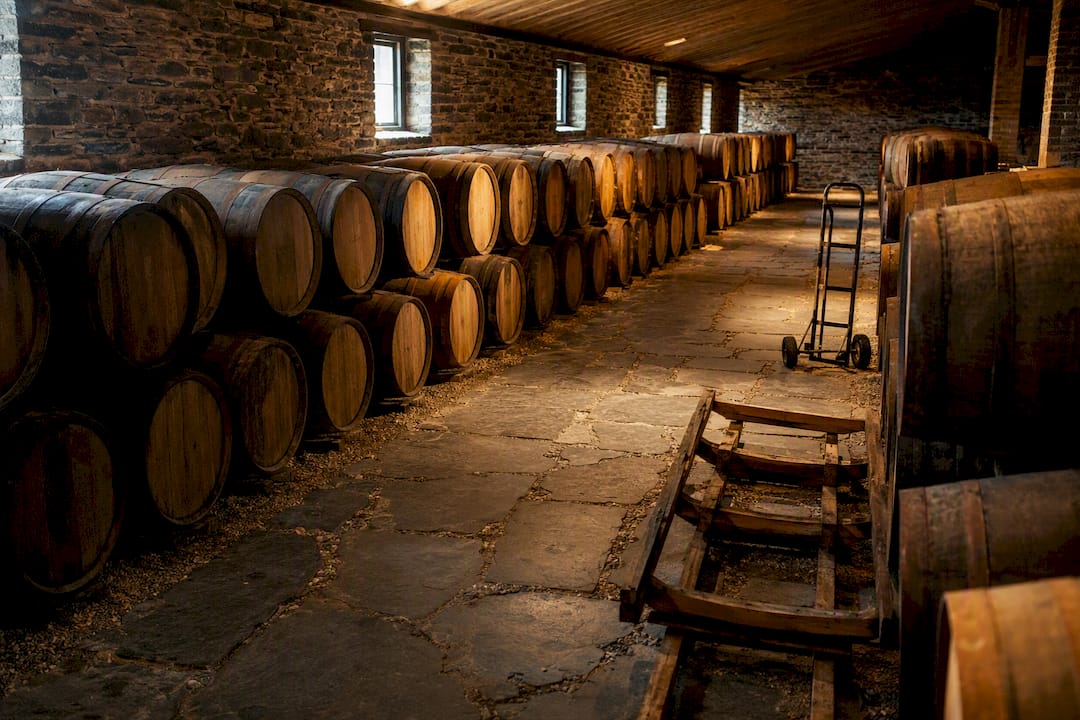
None of this is marketing. It’s a genuine cost structure tied to physics and geography, and it’s part of why two casks filled on the same day at different sites can taste completely different, and cost completely different amounts, decades later.
Blended whisky vs single malt: why the cost structures differ
Single malt comes from one distillery using only malted barley, and that constraint alone makes it more expensive to produce consistently than blended whisky. A single malt has to carry its flavour profile entirely on the output of one site, one set of stills, one warehouse’s worth of maturation conditions. There’s no flexibility to smooth out a weak batch by blending in stock from elsewhere.
Blended whisky, by contrast, draws on multiple distilleries and grain whisky, which gives master blenders far more room to manage cost, consistency and scarcity simultaneously. If one component distillery has a lean year, a blender can lean on stock from another. That flexibility is precisely why blends can be produced at scale and sold at accessible price points, while still allowing premium blends to exist at the top of the range using rarer component whiskies.
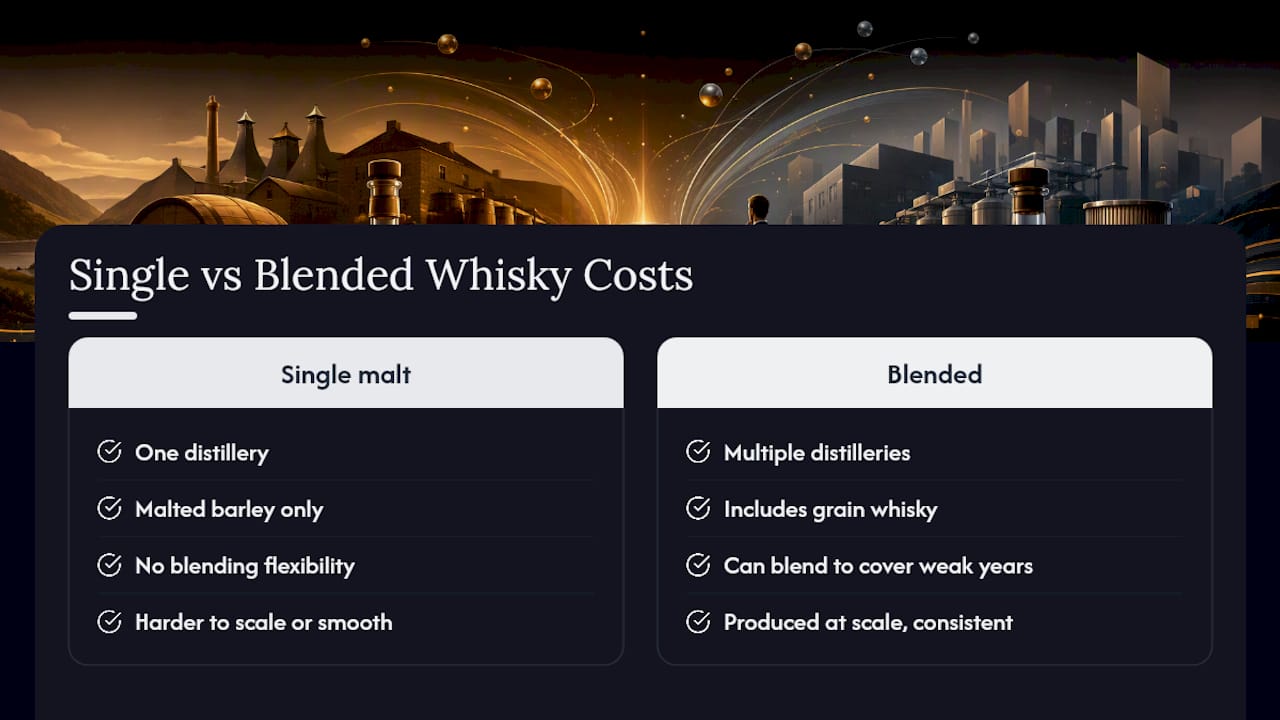
This is also where NAS blending strategy connects back to age statements. A master blender managing scarce aged stock across several distilleries can produce a NAS blend that includes genuinely old whisky without being forced to label the youngest component’s age, which under most labelling rules would set the stated age of the whole blend. NAS expressions exist partly to let blenders manage finite aged stock without either running out of old liquid or being locked into disclosing it.
The upshot for buyers: single malt’s higher average price reflects real production constraints, not just prestige. But a well-blended, older-leaning blend can quietly outperform a young single malt on both character and value, if you know to look past the “single malt” label as a proxy for quality.
Do awards and critic scores actually move whisky prices?
Yes, and often faster than the quality of the whisky itself changes. A gold medal at a major spirits competition or a high score from a respected critic can shift secondary market demand within weeks, well before most drinkers have even tried the bottle. Distilleries know this, and award-winning expressions frequently see allocation lists tighten and retail prices creep upward at the next release.
The effect compounds with scarcity. An award on a widely available blend might nudge sales without moving price much, because supply can catch up. An award on a limited single-cask release, where supply is fixed at a few hundred bottles, can send secondary market prices climbing sharply, because there’s no way to produce more to meet the new demand. That’s the same structural scarcity principle at work again, just triggered by critical acclaim rather than a distillery closing.
Critic influence isn’t always reliable as a value signal, though. Scores are subjective, panels change, and a distillery can chase a particular judging panel’s palate preferences rather than building genuinely well-balanced whisky. Treat an award as one data point among several, alongside independent tasting notes, cask type and your own palate, rather than a guarantee that a bottle is worth its price premium.
A collector’s honest take on paying up
My rule of thumb: buy to drink unless the supply story is structural, closed distillery, single cask, genuinely capped production. Marketing-driven scarcity fades once the hype cycle moves on, but a finite cask from a distillery that no longer exists only gets scarcer. Match the purchase to your actual intent, whether that’s a dram tonight, a gift, or something you’re happy to hold for years.
— Brendan
Finding premium and rare bottles worth the price
If you’ve read this far, you already know that price alone tells you nothing, provenance does. Specialist retailers curate bottles with the paperwork to back them up: fill dates, cask details and ABV listed plainly on every product page, so you’re not guessing at what you’re actually paying for.

Browse examples like the Hobart Whisky bourbon matured, rum finished single malt, a small-batch Tasmanian release with clear batch documentation, or the Ichiro’s Malt and Grain limited edition, a genuine allocation-driven bottle from a distillery with a well-documented scarcity story. Can’t find what you’re chasing? Personalised sourcing requests for hard-to-find and closed-distillery bottles may be available through some retailers, so get in touch and start the search for your next bottle today.
Sources
- Is Scotch whisky getting too expensive? | TasteSCOT
- Why whisky prices are rising in 2026: the supply story
- Whisky price explained: The cost of a bottle of whisky
- What are sherry casks? — Whiskipedia