

This page is a single malt Scotch list covering every currently distilling brand, sorted by region, plus a curated shortlist of bottles worth chasing down. Scan the A–Z catalogue if you know your region of choice, or jump straight to the notable bottles section if you just want somewhere to start. Every entry has been checked against the Scotch Whisky Association’s current operating distillery register, so you know which names are still filling casks and which have gone quiet.
TL;DR:
- Most active distilleries offer a good balance of quality and availability, making them reliable choices for both drinking and collecting.
- Cask type influences flavor more significantly than age statements, with sherry casks adding dried fruit and darker sugars, and bourbon casks imparting vanilla notes.
- Many top-scoring malt whiskies rely on innovative cask management and finishing rather than age, so newer NAS bottles can outperform older, more expensive ones.
- Availability varies globally, especially for limited releases and rare bottles, so sourcing options should be considered before purchase.
- Selecting a malt should focus on your preferred region and style, with cask type and price often playing a larger role than age or label prestige.
Table of Contents
- Single malt Scotch brands from A to Z, by region
- Notable single malt bottles worth trying
- How to choose a single malt that suits you
- Why trust this single malt list
- A note on availability for Australian and international buyers
- Browse or request a bottle from this list
- Sources
Single malt Scotch brands from A to Z, by region
Scotland’s single malt landscape splits into six recognised regions, and where a distillery sits shapes the whisky in the bottle almost as much as the mash bill does. Scotchwhisky defines a single malt simply: 100% malted barley, distilled at one distillery, in copper pot stills. Everything else, the peat, the sherry, the salt air, comes down to geography.
Speyside
Speyside has a notably dense concentration of working distilleries, and the house style leans fruity, honeyed, and approachable.
- Aberlour — sherry-forward, rich dried fruit, active.
- Balvenie — hand-turned floor maltings and a honeyed, vanilla-led profile; active and one of the few distilleries still running its own cooperage.
- Cardhu — light, floral, the backbone of many blends; active.
- Cragganmore — complex, slightly smoky for a Speysider; active.
- Glenfarclas — family-owned, deep sherry character; active.
- Glenfiddich — the world’s biggest-selling single malt by volume, pear and apple notes, unmistakably Speyside; active.
- Glenlivet — the brand that arguably invented the category’s modern popularity, smooth and citrusy; active.
- Glen Grant — light and grassy, popular in Italy; active.
- Glen Moray — approachable, often cask-finished, good value; active.
- The Macallan — sherry-oak maturation as house signature, sold at a premium; active.
- Mortlach — meaty, sulphury, an acquired taste worth acquiring; active.
- Strathisla — one of the prettiest distilleries in Scotland, malty and fruity; active.
Highlands
The largest region by geography, the Highlands don’t have one house style. You’ll find everything from coastal salinity to Speyside-adjacent sweetness here.
- Aberfeldy — heather honey, gentle spice; active.
- Ben Nevis — robust, oily, underrated; active.
- Dalmore — orange marmalade and dark chocolate, often heavily sherried; active.
- Dalwhinnie — Scotland’s highest distillery, light and heathery; active.
- Glenmorangie — tall, slender stills give a delicate, floral spirit; consistently one of the best-selling malts globally, active.
- Glen Ord — malty, spicy, underrated outside its Diageo-driven blends; active.
- Oban — coastal Highland, a bridge between smoky and sweet; active.
- Old Pulteney — briny and maritime despite sitting inland from the sea by name only; active.
- Royal Lochnagar — small production, rich and nutty; active.
Islay
Islay is peat country, though not every distillery on the island leans hard into smoke.
- Ardbeg — famously peaty, medicinal, cult following; active.
- Bowmore — balanced smoke against honey and citrus, home to some of the oldest working stills in Scotland; active.
- Bruichladdich — the experimental one, ranges from unpeated to ferociously smoky under its Octomore label; active.
- Bunnahabhain — the gentlest Islay, often barely peated; active.
- Caol Ila — clean, oily smoke, mostly destined for blends historically; active.
- Kilchoman — farm distillery, floor-to-bottle single site production; active.
- Lagavulin — dense, smoky, iodine and dried fruit in equal measure; active.
- Laphroaig — the most polarising Islay malt, tar and seaweed up front; active.
- Port Ellen — closed in 1983, revived recently in tiny, expensive batches; a collector’s name rather than a shelf staple.
Islands (excluding Islay)
Grouped separately by most retailers and collectors, the wider Islands cover Skye, Orkney, Jura, Mull, and Arran.
- Arran — young distillery, fresh and citrusy; active.
- Highland Park — Orkney heather honey with a gentle smoke; active.
- Isle of Jura — mostly unpeated, though a peated expression exists; active.
- Scapa — soft, coastal, quietly excellent; active.
- Talisker — peppery, maritime, one of Skye’s genuine icons; active.
- Tobermory (and its peated sibling Ledaig) — Mull’s only distillery; active.
Campbeltown
Once home to over 30 distilleries, Campbeltown now has three, and the survivors carry an oily, briny signature.
- Glen Scotia — coastal, slightly funky, increasingly award-winning in recent years.
- Glengyle (Kilkerran) — revived in 2004, still finding its full identity.
- Springbank — triple-distilled in part, waxy and complex; widely considered the region’s benchmark.
Lowlands
Traditionally triple-distilled and lighter in body, the Lowlands are enjoying a genuine revival after decades of closures.
- Auchentoshan — grassy, light, an easy entry point.
- Bladnoch — revived after multiple closures, floral and delicate.
- Glenkinchie — soft, malty, sometimes called “the Edinburgh malt.”
- Daftmill — farm distillery, tiny releases, huge collector demand.
Not every historic name survives in active production. Brora, silent for decades before reopening in 2021, is a good example of why checking a distillery’s current operating status matters before you go hunting for a bottle. A few brands also complicate the picture further: The Singleton, for instance, is a marketing name spanning three separate distilleries (Dufftown, Glendullan, and Glen Ord), so provenance and tasting notes shift depending on which one you’re actually drinking.
Notable single malt bottles worth trying
This shortlist mixes accessible entry points with cellar-worthy pours, spanning every region above. Think of it as a shopping list rather than a ranking.
- Glenfiddich 12 is a flagship single malt from the Speyside region — the archetypal Speyside starter, pear and light oak, widely stocked and cheap enough to not overthink.
- The Glenlivet Founder’s Reserve — smooth, citrus-led, a safe gift for someone new to single malt.
- The Macallan Double Cask release — sherry sweetness without the triple-figure price tag of the older releases.
- Balvenie 12 DoubleWood — honeyed and approachable, the whisky most likely to convert a bourbon drinker.
- Aberlour A’bunadh — cask strength, no age statement, sherry bomb; for someone who wants intensity over subtlety.
- Glenmorangie 10 Year Old Original — delicate and floral, a good contrast bottle if you already own something peaty.
- Laphroaig 10 Year Old — the benchmark peat bomb; buy this before you buy anything smokier.
- Ardbeg 10 Year Old — smokier and slightly sweeter than Laphroaig, a cult favourite for a reason.
- Lagavulin expression aged over a decade — dense, oily, arguably the most complete Islay malt at its price point.
- Bowmore 12 Year Old — the middle ground between Ardbeg’s intensity and Bunnahabhain’s gentleness.
- Bunnahabhain 12 Year Old — proof Islay isn’t only about smoke.
- Talisker expression typically carries coastal and peppery notes — peppery and maritime, a genuine signature dram rather than an imitation of anything else.
- Highland Park known for heather honey and gentle smoke profiles — Orkney heather and light smoke, consistently good value.
- Old Pulteney 12 Year Old — briny, underrated, worth seeking out for coastal character on a budget.
- Oban 14 Year Old — a genuine bridge dram between Highland sweetness and Islay smoke.
- Dalmore 12 Year Old — orange marmalade richness for the sherry-cask fans.
- Springbank 10 Year Old — waxy, complex, and the Campbeltown benchmark most enthusiasts recommend first.
- Glen Scotia Victoriana — cask-strength, recently picked up award recognition and worth trying while it’s easy to find.
- Auchentoshan American Oak — a genuinely light, easy Lowland option for warm-weather drinking.
- Bladnoch 10 Year Old — a good example of the Lowland revival, floral without being thin.
- Isle of Jura 10 Year Old — soft, slightly sweet, an underappreciated Island option.
- Kilchoman Machir Bay — farm-to-bottle Islay, younger but full of character.
- Arran 10 Year Old — fresh, citrus-forward, a good pick for someone exploring beyond the big names.
- Bruichladdich The Classic Laddie — unpeated Islay, proof the region isn’t a one-trick pony.
Award lists change every year, and the 2026 World Whiskies Awards results show the top-scoring malts increasingly relying on layered cask management, sherry finishing, solera vatting, rather than age alone. A parallel industry round-up of the same awards backs this up, with several non-age-statement bottles outscoring their older, pricier siblings. That’s worth remembering before you assume the number on the label tells the whole story.
How to choose a single malt that suits you
Picking from a list this long comes down to four variables: region and style, cask type, age statement versus no-age-statement (NAS), and price against availability.
Region tells you roughly what to expect, but cask type often matters more. A bourbon-cask malt leans vanilla and light oak. A sherry-cask malt leans dried fruit, nuts, and darker sugars. A finished whisky, matured in one cask then moved to another for its final months, sits somewhere in between, and this is where a lot of modern innovation happens.
Age statements aren’t a reliable proxy for quality anymore. A 10 Year Old Laphroaig will out-punch plenty of NAS bottles on complexity, but plenty of well-managed NAS releases now beat older malts that spent too long in tired wood. Understanding what an age statement actually signifies helps you avoid paying a premium for a number rather than for flavour.
ABV matters too. Most standard releases have alcohol strengths in a moderate range, while cask-strength bottlings are significantly higher, meaning you’ll want water or ice on hand regardless of what the purists say.
Before buying, run through this checklist:
- What’s the occasion: a gift, a first bottle, or a cellar addition?
- Do you already lean toward smoke, sherry, or lighter fruit?
- What’s your budget, and does the price reflect age, rarity, or just marketing?
- Are you buying to drink soon or to hold for a few years?
Pro Tip: *Read the cask notes on the back label or product page before the tasting notes.
Why trust this single malt list
This catalogue draws on the Scotch Whisky Association’s public register of currently operating distilleries and the regional definitions maintained at scotchwhisky.net, cross-checked against industry directories where a brand’s status was unclear. Every entry marked “active” reflects that distillery’s current production status as of the most recent public listing, not historical operation.
A single malt list is only as useful as its accuracy on one point: is this distillery still making whisky, or are you chasing a finite, ageing stock? Getting that wrong costs collectors real money.
The list was compiled by Brendan, a Uisuki contributor, with inclusion criteria favouring brands with active production and reasonable market availability over obscure, long-closed names that exist only in auction catalogues.
— Brendan
A note on availability for Australian and international buyers
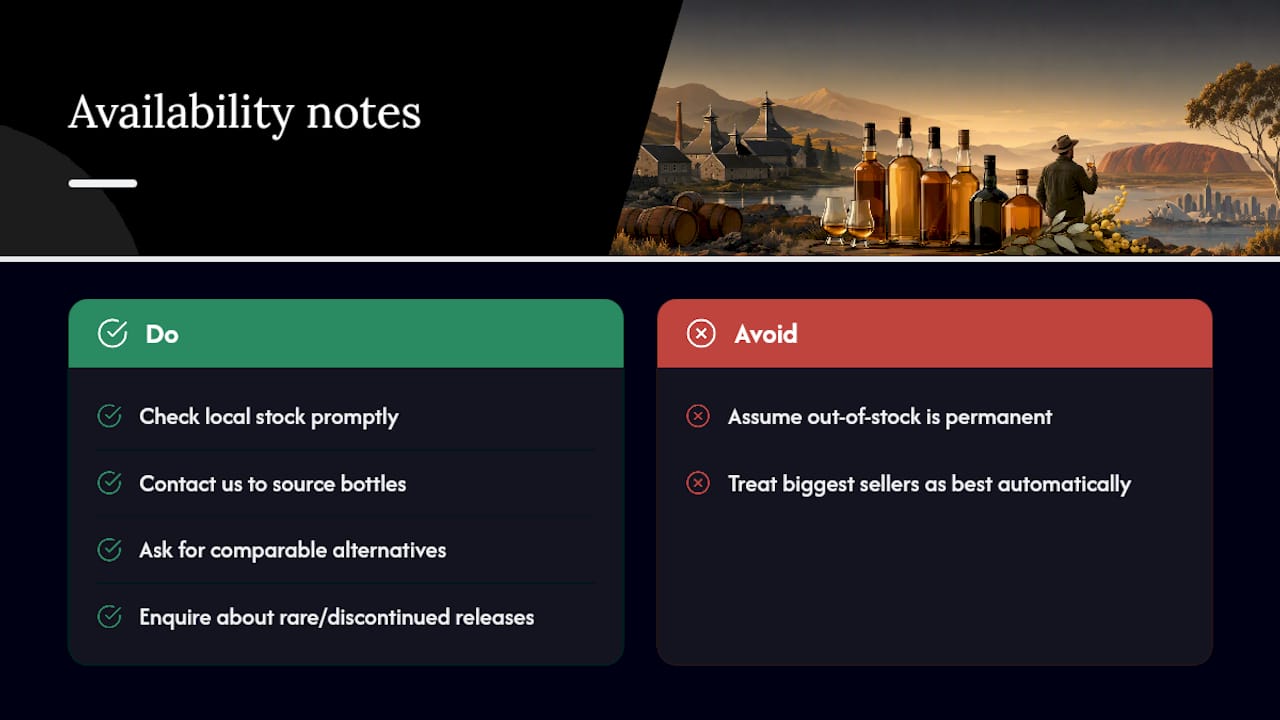
Stock of any given expression moves fast, particularly limited releases and cask-strength bottlings, and what’s on shelf in one region often isn’t in another. Distribution depth genuinely shapes what counts as “popular”: the biggest sellers aren’t always the best drams, just the easiest to find. If something on this list is out of stock locally, we can usually source it or point you toward a comparable alternative. For rare, limited, or discontinued expressions, get in touch directly rather than assuming it’s gone for good.
Browse or request a bottle from this list
Working through a list this long is one thing. Actually getting your hands on the bottle you want is another, and that’s where Uisuki does the heavy lifting: we stock a curated range across every region above and take custom sourcing requests for anything we don’t already have on the shelf.
Whether you’re chasing a first Speyside bottle or trying to track down something closer to Port Ellen territory, you can browse the current single malt range or check out collector-focused picks for 2026 if you’re buying to hold rather than drink soon. Shipping runs locally within Australia and internationally, with free shipping thresholds on qualifying orders. If a specific expression isn’t listed, send through a sourcing request and we’ll chase it down or suggest a genuine equivalent based on cask type and region rather than just swapping in whatever’s easiest to move.
Sources
- List of current operating Scotch Whisky distilleries (April 2026) — Scotch Whisky Association
- Scotchwhisky
- The world’s best single malt Scotch according to the 2026 World Whiskies Awards — Forbes
- The best single malts in the world according to the World Whiskies Awards 2026 — The Whiskey Wash
- Edrington posts sales led by Macallan — Shanken News Daily