

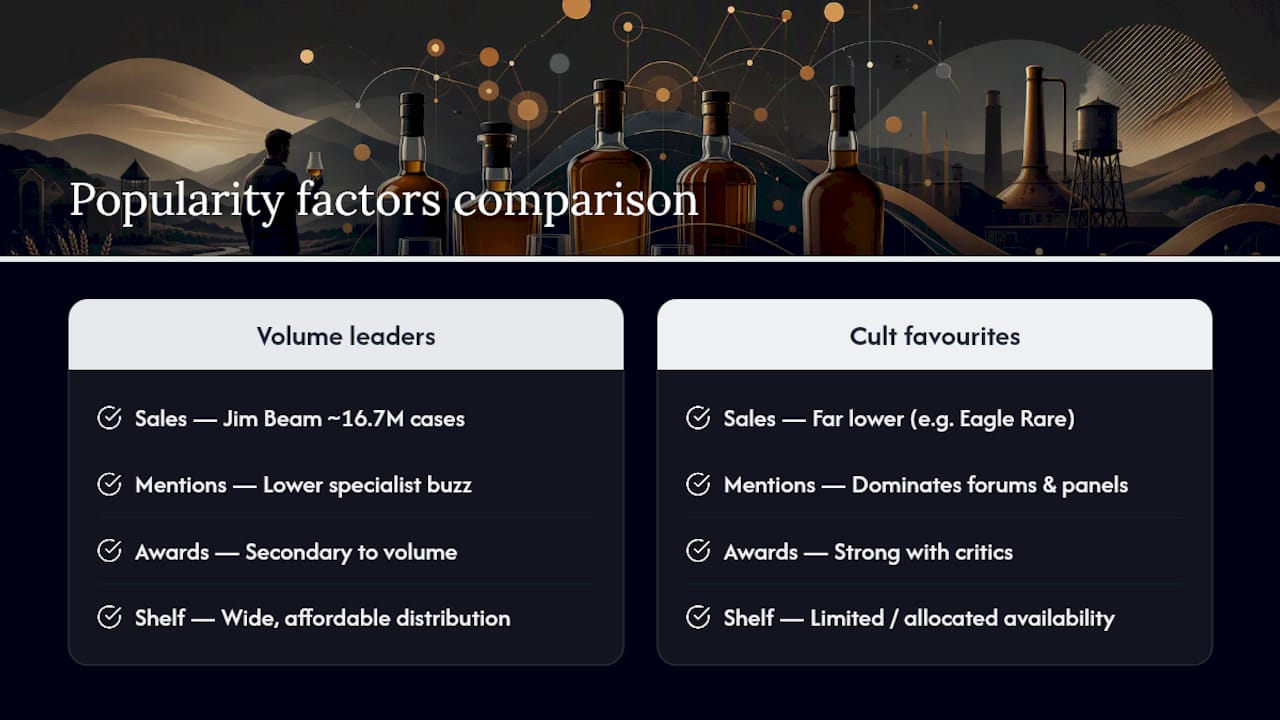
Jack Daniel’s, Jim Beam, Buffalo Trace and Maker’s Mark dominate the most popular American whiskeys list for one simple reason: scale. Jim Beam moved roughly 16.7 million nine-litre cases in 2025, with Jack Daniel’s close behind at 14.1 million cases. But popularity isn’t only about volume. Buffalo Trace and Eagle Rare win on scarcity and critic buzz, while Woodford Reserve and Knob Creek sit in the middle, doing serious numbers while still earning tasting-panel respect.
Here’s the full top 10, with the one-line reason each bottle made the cut:
- Jim Beam — the world’s best-selling bourbon by case volume
- Jack Daniel’s — Tennessee whiskey’s global flagship, second by volume
- Evan Williams — a value bourbon that outsells most premium labels
- Buffalo Trace — cult scarcity meets everyday drinkability
- Maker’s Mark — the wheated bourbon that built a soft-palate audience
- Wild Turkey — high-proof loyalty plus a strong cocktail following
- Woodford Reserve — the craft-leaning flagship of a major distillery
- Bulleit — the rye-forward bourbon bartenders reach for first
- Eagle Rare — allocated single barrel with outsized critic love
- Knob Creek — small batch credibility at a still-reachable price
Key Takeaways
The most popular American whiskeys split into two camps: mass-market volume leaders like Jim Beam and Jack Daniel’s, and critic-favoured, allocated bottles like Buffalo Trace and Eagle Rare.
| Point | Details |
|---|---|
| Volume leaders dominate sales | Jim Beam and Jack Daniel’s top global case volume, driving everyday availability and price. |
| Popularity isn’t one metric | Rankings blend sales data, critic panels, award recognition and shelf availability. |
| Match bottle to use case | Pick by best-for tag: cocktails, sipping, everyday drinking or collecting. |
| Allocation drives real-world price | Buffalo Trace and Eagle Rare often cost more than sticker price due to scarcity. |
| Com sources hard-to-find bottles | Com stocks curated American whiskey and offers custom sourcing for allocated releases. |
Table of Contents
- The ranked top 10 most popular American whiskeys
- How did we define “most popular”?
- How to choose the right bottle for your needs
- Market snapshot: sales leaders and export trends
- Sources
The ranked top 10 most popular American whiskeys
1. Jim Beam leads on sheer volume. It’s a classic four-grain bourbon with notes of vanilla, corn sweetness and a light oak finish. Best for: everyday drinking.
2. Jack Daniel’s isn’t technically a bourbon. The Lincoln County Process (charcoal mellowing before barrelling) gives it that smoother, slightly sooty sweetness Tennessee whiskey is known for. Best for: cocktails and mixing.
3. Evan Williams punches well above its price. Expect caramel, toasted bread and a short, clean finish. Best for: everyday drinking on a tight budget.
4. Buffalo Trace built its reputation on being hard to find at retail price. Nose of vanilla and brown sugar, palate of mint and toffee, a long, warm finish. Best for: sipping and entry-level collecting. Budget-friendly on paper, but allocation means you often pay more or wait longer than the sticker suggests.
5. Maker’s Mark swaps rye for red winter wheat in its mash bill, which softens the whole profile into caramel, vanilla and baking spice with none of the peppery bite. Best for: sipping neat, especially for newer bourbon drinkers.
6. Wild Turkey runs hotter than most at 50.5% ABV for the flagship 101 proof expression, delivering caramel and dried fruit with real backbone. Best for: cocktails that need to hold their own against ice and mixers. Budget-to-mid price, and it’s everywhere.
7. Woodford Reserve is the more polished, orchard-fruit-and-spice release from a distillery that also produces limited small-batch series for enthusiasts. Best for: sipping when you want something a step above flagship bourbons.
8. Bulleit leans hard into rye, with a spicier, drier profile than most bourbons on this list plus a genuine straight rye expression alongside it. Best for: rye-curious drinkers and classic cocktails like the Manhattan.
9. Eagle Rare is a 10-year-old single barrel that punches above its price point, which is exactly why it disappears off shelves. Notes of leather, toffee and dry oak. Best for: collectors and patient sippers. Nominally budget-to-mid priced, but allocation pushes real-world prices higher.
10. Knob Creek — Best for: sipping neat when you want more barrel character without paying collector prices. Mid-range price, generally available.
How did we define “most popular”?
Popularity here means a weighted mix of global case sales, enthusiast and critic mentions, award recognition and shelf availability. Pure sales leaders like Jim Beam and Jack Daniel’s earn their spots on volume alone. Others, like Eagle Rare, sell far less but dominate enthusiast forums and critic tasting panels.
Data sources include brand sales reports, export figures and specialist tasting panels judging nose, palate, finish, complexity and balance. As one industry breakdown puts it, volume and quality measure different things: scale rewards affordability and distribution, while critic picks reward barrel character and rarity.
Jim Beam’s ~16.7 million nine-litre cases in 2025 is the single largest sales figure behind this ranking. This list for 2026 blends that kind of volume data with tasting merit, so you get sales leaders and cult favourites side by side.
How to choose the right bottle for your needs
Match the bottle to the job. Cocktails call for higher-proof, spice-forward whiskeys like Wild Turkey or Bulleit. Neat sipping rewards softer, wheated profiles like Maker’s Mark or well-aged pours like Knob Creek. Collecting means chasing allocated releases like Buffalo Trace or Eagle Rare, where price and availability rarely line up neatly.
A few practical shopping habits help:
- Check age statements on the label. A stated age (like Eagle Rare’s 10 years) is a legal guarantee of minimum barrel time; “no age statement” bottles can still be excellent but give you less to go on.
- Compare price bands across a few retailers before buying allocated bottles. Secondary-market markups on Buffalo Trace and Eagle Rare are common and worth knowing before you commit.
- Learn the mash bill basics. Rye-heavy bourbons (Bulleit) taste spicier; wheated bourbons (Maker’s Mark) taste softer. Our rye versus bourbon breakdown covers this in more depth.
Pro Tip: Train your palate with pantry references before you trust your own tasting notes. Side-by-side comparisons against vanilla extract, caramel sauce or fresh oak shavings help you correctly identify oak-driven flavours rather than lumping everything under a vague “woody” label.
Market snapshot: sales leaders and export trends
Sales volume tells a different story to critic acclaim, and 2025 to 2026 data makes that gap obvious. American whiskey remained the United States’ most exported spirit despite a 1% dip in global volume, with growth pushing into newer markets including Brazil and Australia.
Jim Beam’s volume lead came alongside a 4.6% decline year-on-year, a reminder that even the biggest brands see swings. Production pauses, facility upgrades and portfolio shuffling at major distilleries can tighten supply from one year to the next, which is exactly why allocated names like Buffalo Trace and Eagle Rare feel harder to find some years than others.
Curator’s note from the author
Tasting through both mass-market flagships and allocated single barrels changes how you read a “top 10” list. Sales scale and critic merit rarely point at the same bottle, which is why this ranking keeps both in view for drinkers and buyers alike. Need help sourcing something specific? Get in touch.
Where to buy curated American whiskey selections
There’s a real gap between what’s stocked at your local bottle shop and what serious collectors actually chase, and that’s where a curated retailer earns its keep. Com stocks hard-to-find and limited releases across whisky regions, including American names, alongside detailed listings covering ABV, price and provenance so you know exactly what you’re buying before checkout.

If a bottle from this list, or something rarer still, isn’t sitting on our shelves, our custom sourcing service can chase it down for you. Browse pieces like the Ichiro’s Malt and Grain limited edition to see the calibre of allocation we go after, then send through a sourcing request for the bottle you actually want on your shelf.
Sources
- The 10 American whiskeys the world actually drinks
- Best American Whiskeys of 2025 | Breaking Bourbon