

Nine categories cover almost every American whisky you’ll find on a shelf: bourbon, rye, wheat, corn, malt, American single malt, Tennessee whiskey, blended American whiskey, and bottled-in-bond. What separates most of them isn’t marketing, it’s the mash bill, the dominant grain fermented and distilled, which federal law pins to a specific percentage threshold for each style.
Every one of these categories is defined in the Code of Federal Regulations and enforced by the Alcohol and Tobacco Tax and Trade Bureau, the TTB. That’s not a minor detail. It means a bottle labelled “bourbon” or “rye” isn’t just following convention, it’s legally bound to specific grain ratios, barrel types, and proof limits before it ever reaches your glass.
Here’s the short version of what separates the main styles:
- Bourbon: at least 51% corn, aged in new charred oak barrels
- Rye whiskey: at least 51% rye, spicier and drier than bourbon
- Wheat whiskey: at least 51% wheat, softer and rounder
- Corn whiskey: at least 80% corn, often unaged or lightly aged
- Malt whiskey: at least 51% malted barley
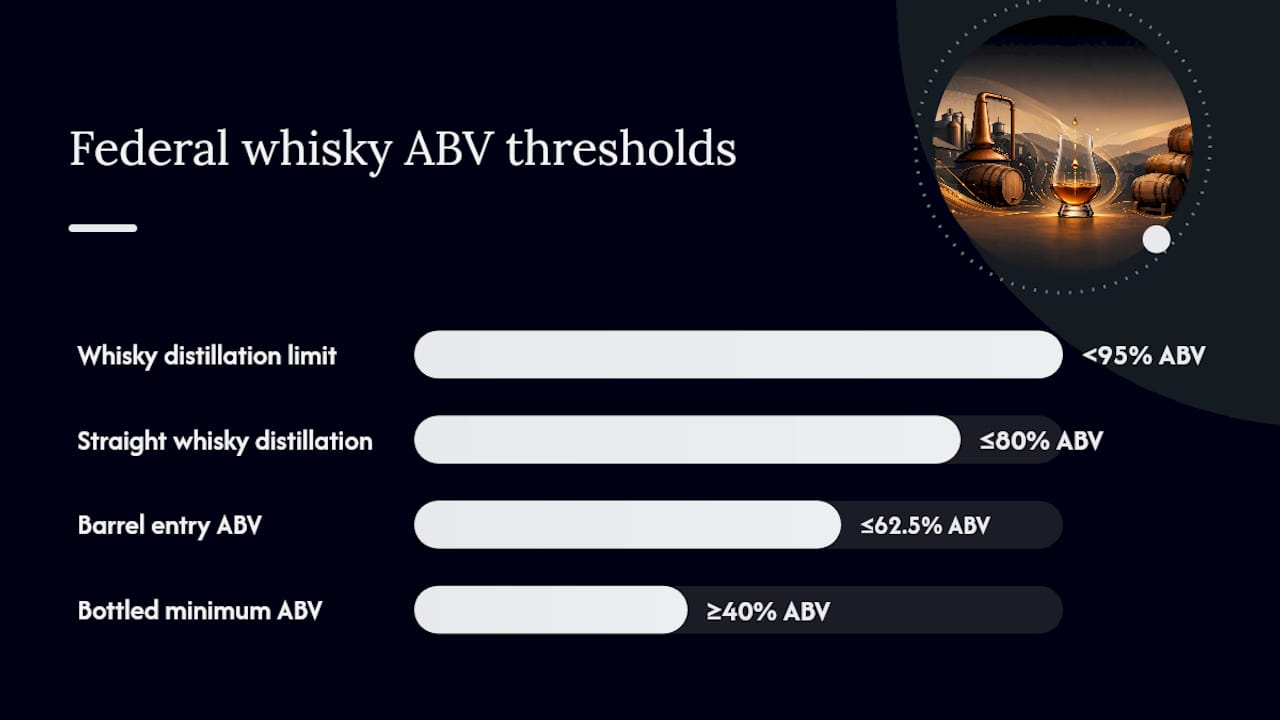
Key thresholds to remember: every straight whiskey must be distilled to no more than 80% ABV (160 proof), enter the barrel at no more than 62.5% ABV (125 proof), and bottle at a minimum of 40% ABV (80 proof). Miss any of those numbers and the label can’t legally use certain terms.
Key Takeaways
American whisky categories are defined by mash-bill grain percentages and federal production rules, not by taste, region, or brand reputation alone.
| Point | Details |
|---|---|
| Grain threshold defines the type | Bourbon, rye, wheat, and malt each need at least 51% of their named grain; corn whiskey needs at least 80%. |
| “Straight” means age and purity | At least two years in new charred oak with no additives, not a flavour or quality claim. |
| Bottled-in-bond is the strictest label | Single distillery, single season, four years minimum ageing, bottled at exactly 50% ABV. |
| American single malt allows used casks | 100% malted barley and single-distillery production, but no new charred oak requirement, unlike straight whiskey. |
| Com sources across styles and regions | Com curates American whisky alongside Scotch, Japanese, and Australian bottles, including single malt and blended releases. |
Table of Contents
- What counts as American whisky types under federal law
- The core grain types: bourbon, rye, wheat, corn and malt
- Tennessee, blended, straight and bottled-in-bond: what these labels change
- American single malt: the newest federally recognised category
- How to actually read an American whisky label
- Matching flavour expectations to grain and style
- Why the legal framework matters more than most drinkers realise
- Where Com fits into your next bottle
- FAQ: American whisky types
- Sources
What counts as American whisky types under federal law
The word “whisky” itself has a legal definition before you even get to bourbon or rye. Under TTB rules, whisky is a spirit distilled from a fermented mash of grain at less than 95% ABV, possessing the taste, aroma, and characteristics generally attributed to whisky, and bottled at not less than 40% ABV. That baseline applies to every subtype discussed in this article.
Distillation proof is where most of the legal distinctions start. Straight whiskeys, the category that includes straight bourbon and straight rye, must come off the still at no more than 80% ABV. They then enter the barrel at no more than 62.5% ABV. Distilling higher than that strips out more of the grain’s character, which is one reason craft producers often deliberately distil lower than the legal ceiling to keep more flavour intact.
Country-of-origin labelling matters too. A whisky calling itself a “type” that’s a “distinctive product of the United States”, such as bourbon, must actually be produced in the US. You can’t distil bourbon-style whisky overseas and slap “bourbon” on the label; the CFR §5.143 is explicit about this.
| Label field | What it typically shows |
|---|---|
| Class/type | Bourbon, rye, wheat, corn, malt, or blended |
| Primary grain threshold | Usually 51% minimum for the named grain |
| Distillation limit | ≤80% ABV (160 proof) for straight whiskeys |
| Barrel/storage requirement | New charred oak for bourbon and rye; exceptions apply for malt and single malt |
| Minimum ageing | 2 years for “straight” designation; none required for standard whisky |
The TTB’s Beverage Alcohol Manual lays out these class and type standards in full, and it’s worth bookmarking if you ever want to settle an argument about what actually makes a bourbon a bourbon. One thing to keep in mind: plenty of regional terms you’ll see on shelves, like “Texas whiskey” or “Empire Rye”, carry real production philosophy behind them but aren’t federally codified categories. Treat them as producer storytelling layered on top of the legal framework, not a replacement for it.
The core grain types: bourbon, rye, wheat, corn and malt
Each of these five styles is defined primarily by its dominant grain, and that grain does most of the work in shaping what lands in your glass.
Bourbon needs a mash bill of at least 51% corn, and it must age in new charred oak containers, no exceptions, no reused barrels. There’s no legal minimum ageing period for plain bourbon, though “straight bourbon” needs at least two years. Expect sweetness up front, vanilla and caramel from the char, with corn giving it a rounder, fuller body. Terms like “wheated bourbon” (wheat as the secondary grain instead of rye) or “high-rye bourbon” are common on labels, but they’re marketing descriptors, not separate legal categories, according to Wikipedia’s overview.
Rye brings spice, black pepper, sometimes a slightly bitter or herbal edge that bourbon rarely shows. It’s the grain most cocktail bartenders reach for in a Manhattan because it holds its own against vermouth and bitters.

It’s the gentlest of the grain-forward styles, softer texture, less spice, sometimes described as bready or subtly sweet. You won’t find nearly as many wheat whiskies on shelves as bourbon or rye, which makes it a niche pour worth trying if you find one.
Unlike bourbon, it doesn’t have to touch new charred oak at all, and it’s often bottled unaged or only briefly aged in used or uncharred containers. The result tastes closer to moonshine than bourbon, sweet, grainy, sometimes a little raw.
Expect a cereal, slightly nutty character, closer in feel to a Scotch mash bill but produced under American rules and typically finished differently.
Tennessee, blended, straight and bottled-in-bond: what these labels change
Beyond grain type, four designations reshape what’s actually happening in production, ageing, or blending, and each one tells you something different about what’s in the bottle.
This step is what legally distinguishes Tennessee whiskey from bourbon, even though the two share almost identical mash bill and barrel rules.
Straight whiskey isn’t about grain at all, it’s about time and purity. Any of the grain types above can carry the “straight” label if it’s aged at least two years in new charred oak with no added colouring, flavouring, or blending spirits beyond water for proofing. If a straight whiskey is aged under four years, the label must state the actual age. This single rule trips up a lot of buyers who assume “straight” means something about flavour intensity rather than a minimum ageing floor.
Blended American whiskey works differently again. That’s a legitimate, legally defined category, but it produces a lighter, often smoother and less intense spirit than a straight whiskey on its own.
Bottled-in-bond is the strictest consumer-facing designation on this list, and collectors pay attention to it for good reason. To earn the label, a whiskey must:
- Be the product of a single distilling season at a single distillery
- Be aged at least four years in a federally bonded warehouse
- Be bottled at exactly 50% ABV (100 proof)
- Carry the distiller’s name and location on the label
That combination guarantees provenance and age in a way most other labels don’t, which is exactly why bottled-in-bond bourbon and rye have become popular with collectors chasing transparency over marketing claims.
American single malt: the newest federally recognised category
American single malt only became a formal standard of identity recently, and it’s worth understanding exactly what the TTB locked in. The rules require the whisky to be made from 100% malted barley, distilled entirely at a single US distillery, distilled to no more than 80% ABV, and bottled at a minimum of 40% ABV, according to the TTB’s own announcement.
What makes this category genuinely different from straight bourbon or straight rye is what’s missing from the rulebook: there’s no requirement to use new charred oak. Producers can mature American single malt in used bourbon barrels, sherry casks, or other previously used cooperage, the same flexibility Scotch distillers have relied on for centuries. That single exception opens up a much wider flavour range than the new-oak-only rules impose on bourbon and rye, letting distillers chase fruitier, spicier, or more delicate profiles depending on the cask they choose.
Pro Tip: If a label says “single malt” but doesn’t specify American production, check the distillery location before assuming it’s a domestic product. American single malt must come from one US distillery start to finish, and labels that mention cask finishing (sherry, port, rum) are often a strong hint you’re looking at this newer category rather than a straight whiskey.
How to actually read an American whisky label
Reading a bottle properly takes about ten seconds once you know what to check. Work through it in this order:
- Check the class/type statement. Bourbon, rye, wheat, corn, malt, or blended, this tells you the dominant grain or the blending method.
- Look for “straight”. If it’s there, you know the spirit was aged at least two years with no additives beyond water.
- Check for an age statement. Required if the whiskey is under four years old; often included voluntarily even when it isn’t required.
- Look for “bottled-in-bond”. This confirms single distillery, single season, four years minimum, and 50% ABV.
- Check the ABV/proof. Higher proof (over 50% ABV) generally means less dilution and more concentrated flavour, though this varies by producer.
- Note the distillery location. Confirms whether country-of-origin rules for “American type” whiskies are being followed correctly.
“Rye Whiskey” without “straight” could legally include additives or colouring, though many producers still make it clean, they just haven’t hit the two-year ageing mark or chose not to use the term. “Blended Rye Whiskey” signals the presence of neutral grain spirit blended with straight rye, generally a lighter, more approachable pour.
Regional terms deserve a mention here too. “Texas whiskey” or “Empire Rye” often signal a genuine regional production philosophy and local grain sourcing, as seen with New York’s Empire Rye producers, but they sit outside federal codification. Treat them as a producer’s pitch about identity and terroir, not a guarantee of any particular legal standard.
Matching flavour expectations to grain and style
Grain type predicts flavour more reliably than almost anything else on the label, though it’s a strong tendency rather than an iron rule.
- Bourbon: vanilla, caramel, light oak sweetness. Works well neat or in an Old Fashioned.
- Rye: black pepper, spice, sometimes a herbal or citrus edge. The natural choice for a Manhattan.
- Wheat: soft, mellow, faint bread-like sweetness. Best sipped neat to appreciate the subtlety.
- Corn: raw, grainy sweetness, often less refined than aged bourbon. Try it in cocktails that call for a punchy base spirit.
- Malt/American single malt: nutty, cereal notes, with cask influence (sherry, used bourbon barrels) adding fruit or dried-fruit complexity. Good with dark chocolate.
- Tennessee whiskey: similar to bourbon but with a cleaner, slightly smoother finish thanks to charcoal filtering.
- Bottled-in-bond: expect bolder, more concentrated flavour simply because it’s bottled at 50% ABV rather than the more common 40 to 45%.
Barrel choices and mash-bill tweaks shift these baselines constantly. A high-rye bourbon leans spicier than a wheated bourbon even though both are legally “bourbon”. Consumer guides on categories like this consistently point out that tasting notes are probabilistic, not guaranteed, the label tells you the legal framework, not the exact flavour you’ll get from every bottle within it.
Why the legal framework matters more than most drinkers realise
Most people treat whisky categories as flavour descriptions when they’re actually production contracts. That distinction changes how you should shop.
I’d argue the biggest misconception buyers carry is assuming “straight” signals quality or intensity rather than a minimum ageing floor with no additives. It’s a purity and age guarantee, nothing about how good the whisky tastes. A two-year straight rye can be rougher than a well-aged blended American whiskey, the legal category just tells you what’s not in the bottle, not how well it was made.
The American single malt standard is the more interesting development, because it’s the first major category in decades that deliberately breaks from the new-charred-oak orthodoxy that defines bourbon and rye. That flexibility means quality will vary more within this category than within bourbon, where the rules force a narrower flavour corridor. Buyers chasing American single malt should expect more experimentation, and more inconsistency, than they’re used to from straight bourbon. That’s not a flaw. It’s exactly what makes the category worth watching over the next few years as more distilleries commit to it.
Where Com fits into your next bottle
Once you know the difference between a straight rye and a blended one, or why bottled-in-bond carries more weight than a standard proof statement, the harder part is actually finding bottles that match what you’re after. Com curates whisky from the US alongside Scotland, Japan, and Australia, so you’re not stuck choosing between a handful of supermarket bourbons when what you actually want is a well-aged single malt or a hard-to-find bottled-in-bond release.

If the American single malt category caught your attention, the Hobart Whisky Bourbon Matured Rum Finished Single Malt shows exactly the kind of cask experimentation that category allows, matured in bourbon casks and finished in rum. For readers curious how American blended styles compare to international ones, the Ichiro’s Malt and Grain blended whisky is worth a look for context. Com ships across Australia and internationally, with expert sourcing available for anyone chasing a specific bottled-in-bond release or rare American single malt. Browse the current range and get in touch if you’re after something not yet listed.
FAQ: American whisky types
What’s the difference between bourbon and rye whiskey? Both age in new charred oak, but rye delivers a spicier, drier profile while bourbon leans sweeter and rounder.
Is Tennessee whiskey the same as bourbon?
Does “straight” whiskey mean it’s better quality? No. “Straight” is a legal designation requiring at least two years of ageing in new charred oak with no additives. It guarantees purity and minimum age, not flavour intensity or overall quality.
What makes American single malt different from Scotch single malt?
What does bottled-in-bond guarantee? It’s the strictest transparency label available on American whisky.
Can corn whiskey be aged the same way as bourbon? No.
Sources
- Bureau of Alcohol, Tobacco and Firearms — BAM chapter 4 (types and standards)
- Alcohol and Tobacco Tax and Trade Bureau, Treasury § 5.143
- Every type of American whiskey explained, and how they differ — The Whiskey Wash
This article is general information about American whisky classifications. Always confirm current legal specifics with the TTB or CFR directly if you’re relying on them for anything beyond casual reading, and drink responsibly.