

If you only have one choice, pick a well-chosen bottle from the recipient’s favourite region. Otherwise, these seven gift categories work reliably for Scotch lovers at any budget: bottle gifts, glassware and decanters, tasting sets and miniatures, personalised gifts, barware accessories, subscriptions and experiences, and thoughtful presentation. Each suits a different kind of drinker.
- Bottle gifts — best for someone whose regional taste you already know
- Glassware and decanters — best for the drinker who savours a serve slowly and notices detail
- Tasting sets and miniatures — best for beginners or anyone you want to introduce to new regions
- Personalised gifts — best for milestones: retirements, weddings, big birthdays
- Accessories and barware — best for the traveller or the home host who already owns bottles
- Subscriptions and experiences — best for the person who says they “have everything”
- Presentation and packaging — the multiplier that makes any of the above feel considered
Pro Tip: Personalised items typically need a few business days for production once ordered, on top of standard delivery. Order early for milestone dates, and always confirm the recipient meets the legal drinking age before you buy.
Key Takeaways
The best gifts for Scotch lovers match drinking style and experience level to the gift category before price ever enters the decision.
| Point | Details |
|---|---|
| Match region to palate | Islay suits smoke lovers, Speyside suits fruit and vanilla fans, Highlands suit undecided recipients. |
| Glass shape changes taste | Tasting glasses concentrate aroma for neat drinkers; tumblers suit on-the-rocks pours. |
| Personalise with laser etching | Laser engraving survives dishwashers and years of use; printed labels fade within a year or two. |
| Confirm timelines and age rules | Personalised orders often need 1 to 3 business days plus shipping, and recipient age must be verified. |
| Buy from a curated specialist | Com offers curated regional bottles, international shipping and custom sourcing for hard-to-find requests. |
Table of Contents
- A quick checklist for choosing gifts for scotch lovers
- Bottle gifts: matching region to the recipient’s palate
- Why glassware and decanters change how a drinker experiences their scotch
- Tasting sets and miniatures: the low-risk way to introduce variety
- Personalised gifts: what to check before you order
- Accessories and barware for the scotch drinker who has bottles already
- Subscriptions and tasting experiences as ongoing gifts
- Books and education: gifts that build a collector’s palate
- Food pairings that turn a bottle into a tasting event
- Matching the gift to how much they already know
- What most gift guides get wrong about buying for scotch drinkers
- Where to buy scotch gifts once you’ve picked a category
- Sources
A quick checklist for choosing gifts for scotch lovers
Work through three questions before you open a single product page. It saves you from buying something that looks good in a photo but misses the recipient entirely.
- What’s their experience level? A newcomer benefits more from a tasting flight than a $200 single malt they can’t yet contextualise. A collector already has the obvious bottles.
- How do they actually drink it? Neat drinkers want glassware and rare bottles. On-the-rocks drinkers want a solid tumbler and good ice tools. Cocktail-leaning drinkers want a highball glass and mixers.
- What’s the occasion and budget? A casual catch-up gift sits differently to a 50th birthday or a retirement present, and the budget should reflect that gap.
A bottle is the right call when you know the recipient’s regional preference cold. An experience or accessory is the smarter choice when you’re gifting someone whose palate you’re still learning, or when you want the gift to last longer than one bottle does.
Watch for three red flags: novelty bottles with flashy packaging and thin whisky inside, retailers that bury shipping costs until checkout, and personalisation services quoting vague turnaround times. If a site can’t tell you exactly when your engraved item ships, that’s a sign to look elsewhere.
Bottle gifts: matching region to the recipient’s palate
Region is the single most useful piece of information you can act on when you don’t know the exact bottle someone wants. Scotch flavour profiles cluster by geography, and getting this right does more for the gift than any amount of fancy wrapping.
- Islay whiskies lean heavily into peat and smoke, sometimes with a maritime, iodine edge. Good for drinkers who already say they like “bold” or “smoky” scotch.
- Speyside malts trend fruity, honeyed and vanilla-forward, often matured heavily in sherry or bourbon casks. This is the safest region for someone newer to single malts.
- Highlands whiskies sit in the middle: balanced, sometimes lightly spiced, rarely polarising. A solid default when you genuinely don’t know their preference.
- Campbeltown bottles offer a briny, slightly oily character that suits explorers who’ve worked through the obvious regions already.
Price bands matter more than people expect. Entry gifting territory (roughly $60 to $120) covers solid, well-regarded single malts that don’t scream “budget option.” Move into the $150 to $300 range and you’re looking at older age statements, cask-strength expressions or limited regional releases, the kind Taster’s Club recommends when a gift needs to feel like an occasion rather than a courtesy.
Above $300, you’re in collector territory: rare distillery releases, discontinued expressions or limited runs. This is also where packaging upgrades earn their keep. A boxed bottle with a ribbon and a handwritten tasting note card turns a $70 gift into something that reads as considered rather than last-minute. Pairing the bottle with a short note on why you picked that particular region shows more thought than the price tag does on its own.
Why glassware and decanters change how a drinker experiences their scotch
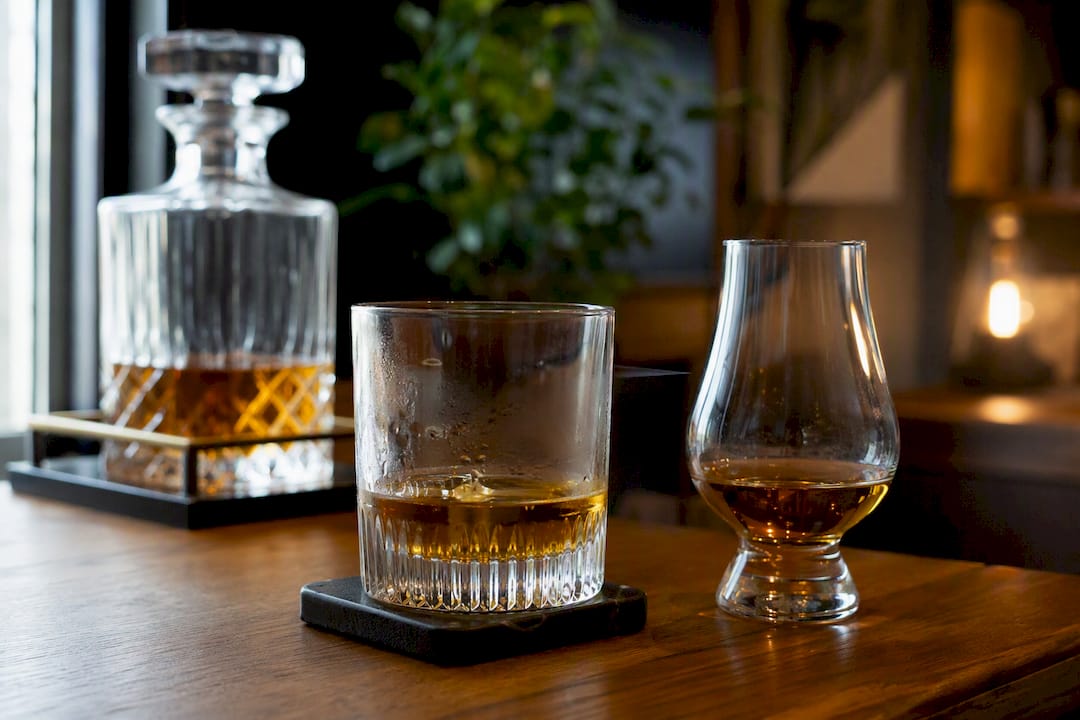
Glass shape isn’t a marketing gimmick. It genuinely changes how aroma reaches the nose, which is most of what you taste. Glassmakers like Norlan explain that different vessel shapes suit different serves: tasting glasses concentrate aroma for neat drinking, heavier tumblers handle ice and dilution for on-the-rocks pours, and highball glasses work best for mixed serves.
- A dedicated tasting glass suits someone who drinks neat and actually nose their whisky before sipping.
- A heavy-bottomed tumbler suits the drinker who prefers their scotch over ice or in a simple mixed serve.
- A decanter suits someone who displays their collection, and it does double duty as a striking piece on a bar cart even when it’s empty.
If you’re personalising a glass or decanter, laser etching holds up far better over time than printed labels or sticker-based engraving. It survives dishwashers and years of handling, where ink-based methods tend to fade or peel within a year or two. Uisuki’s own guide to essential whisky glass types breaks down which shape suits which drinking style in more detail.
Pro Tip: If you’re unsure whether someone drinks neat or on the rocks, gift a tumbler. It works for both, where a dedicated tasting glass only really suits neat pours.
Tasting sets and miniatures: the low-risk way to introduce variety
A full bottle commits the recipient to one flavour profile. A tasting set doesn’t. That’s the whole appeal, and it’s why flight-style gifts consistently rank well for people newer to Scotch or for gift-givers unsure what a recipient prefers.
- Regional flight sets bundle miniatures from Islay, Speyside, Highlands and sometimes Campbeltown so the recipient can compare side by side.
- Book-style tasting kits pair samples with a printed guide or video tasting notes. Products like the Book of Scotch Whisky set combine five single malt miniatures with educational content, which makes the gift feel like an experience rather than just five small bottles.
- Peated versus unpeated sets work well for someone who’s told you they like or dislike smoke, letting them explore variations within that lane.
Check portion sizes before buying: most miniatures run 30ml to 50ml, enough for two or three proper tastes each rather than full drinks. If you’re shipping internationally, confirm the destination’s import rules on alcohol before checkout. Some countries cap the volume or number of bottles allowed per shipment, and a tasting set with five small bottles can sometimes trip volume limits that a single full bottle wouldn’t.
Personalised gifts: what to check before you order
Personalisation turns a good gift into a keepsake, but the details matter more here than in any other category. Get the engraving method or the timeline wrong and you’ve either got a fading label in two years or a gift that arrives after the birthday.
- Laser engraving on glass or decanters is permanent and dishwasher-safe, and it’s the option worth paying extra for.
- Bespoke label printing on the bottle itself works for a one-off visual impact but won’t survive handling the way etched glass does.
- Presentation boxes with the recipient’s name or a short message elevate even a mid-range bottle into something that photographs and feels like an event gift.
Retailers such as Lark Distillery advertise personalised bottle shipping within 1 to 3 business days once production is complete, and personalised decanter sets from specialty gift retailers follow similar timelines. Always confirm the exact cutoff date against your delivery deadline, not just the general lead time quoted on the product page. Retirements, milestone birthdays and weddings are the occasions where personalisation earns its cost. Keep the engraved message short: a name, a date, or a single line means more than a paragraph crammed onto a small brass plate.
Accessories and barware for the scotch drinker who has bottles already
Once someone owns a few good bottles and a decent glass, accessories become the gifts that actually get reached for. These suit the drinker who’s past the “just getting started” phase but doesn’t need another bottle right now.
- A water pipette for drinkers who like to open up a cask-strength pour with controlled drops of water rather than guessing.
- Whisky stones for anyone who wants chilling without dilution, useful for the on-the-rocks crowd who still wants full flavour.
- A leather glass case for the traveller who brings their own glass to tastings or on trips.
- A flight tray or decanter stand for the home host who does tastings for friends and wants something that looks the part on a sideboard.
Check materials before buying. Stainless steel stones outlast soapstone versions, and full-grain leather cases hold up far better than bonded leather over repeated use. A short warranty or a returns policy on the product page is a decent proxy for how confident the maker is in their own build quality.
Subscriptions and tasting experiences as ongoing gifts
A subscription solves the “they have everything” problem better than almost any single item, because it delivers new discoveries over months rather than one moment of unwrapping.
Monthly whisky clubs and curated tasting boxes work well for recipients who enjoy trying new expressions but don’t want to research and buy bottles themselves. One-off tasting events suit someone who prefers a single memorable experience over an ongoing commitment. Match the subscription length to how invested the recipient already is: three months suits a light interest, twelve months suits a genuine enthusiast. Before buying, check regional availability (not every club ships everywhere), confirm age verification is part of the signup process, and read the cancellation policy so you’re not locking someone into charges they didn’t expect.
Books and education: gifts that build a collector’s palate
Scotch knowledge compounds the same way a collection does, which makes books and structured learning materials some of the most underrated gifts you can buy. A good regional guide teaches someone to read a bottle’s back label and predict its flavour before they’ve even opened it, which changes how they shop for themselves afterwards.
Look for three types of educational gifts. Regional guides walk through Speyside, Islay, Highlands and Campbeltown in depth, explaining why geography and cask type produce such different results. Tasting note references help a drinker put language to what they’re experiencing, which matters more than it sounds. Most people can tell a smoky whisky from a fruity one but struggle to describe it beyond “good” or “not for me.” History-focused books cover distillery origins, prohibition-era smuggling and the industry’s near collapse in the 1980s, giving context that makes every future bottle more interesting.
The strongest gifts in this category pair the book with a physical tasting element rather than leaving it as a standalone read. Book-style kits that bundle miniatures with a guide, like the Book of Scotch Whisky set, let the recipient taste the regional differences the text describes as they read. That combination sticks far better than a book alone, and it works for a beginner and a seasoned drinker filling gaps in their regional knowledge.
Food pairings that turn a bottle into a tasting event
Scotch doesn’t need food to be enjoyed, but the right pairing gift turns a solitary pour into a proper tasting session, which is exactly what makes it a memorable present rather than a functional one.
Cheese pairs particularly well with Highland and Speyside malts. A sharp cheddar or a nutty gruyère cuts through the sweetness of a sherry-cask whisky without fighting it. Dark chocolate, especially anything above 70% cocoa, complements the vanilla and caramel notes common in bourbon-matured Scotch, while a smokier Islay dram can stand up to chocolate with a touch of chilli or sea salt. Cigars are the traditional pairing for peated, full-bodied malts. The smoke in the whisky and the smoke in the cigar don’t compete so much as reinforce each other, which is why many gift retailers bundle the two.
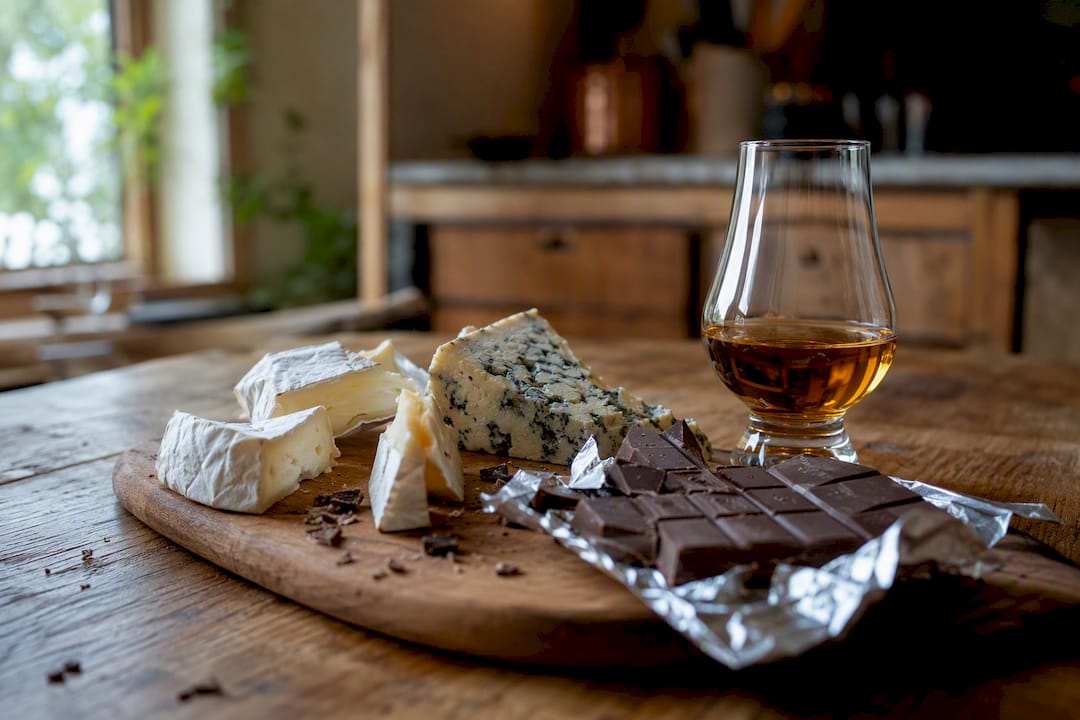
Building a small pairing set around a bottle costs little extra but adds real thought. A wedge of good cheddar, a bar of dark chocolate and a bottle from a matching region communicates that you considered how the gift would actually be enjoyed, not just what would look good under wrapping paper. This works particularly well as an add-on to a mid-range bottle gift, turning a $100 present into an evening rather than just a purchase.
Matching the gift to how much they already know
The right gift for a scotch novice and the right gift for a longtime collector are rarely the same thing, and mismatching the two is one of the most common gifting mistakes.
For beginners, favour breadth over rarity. A regional tasting flight, an entry-level Highland or Speyside bottle, and a basic tasting glass teach more about personal preference than a single expensive bottle ever could. Beginners also benefit most from educational pairings: a tasting kit with a guide does more for someone six months into their scotch interest than a rare bottle they don’t yet have the palate to fully appreciate.
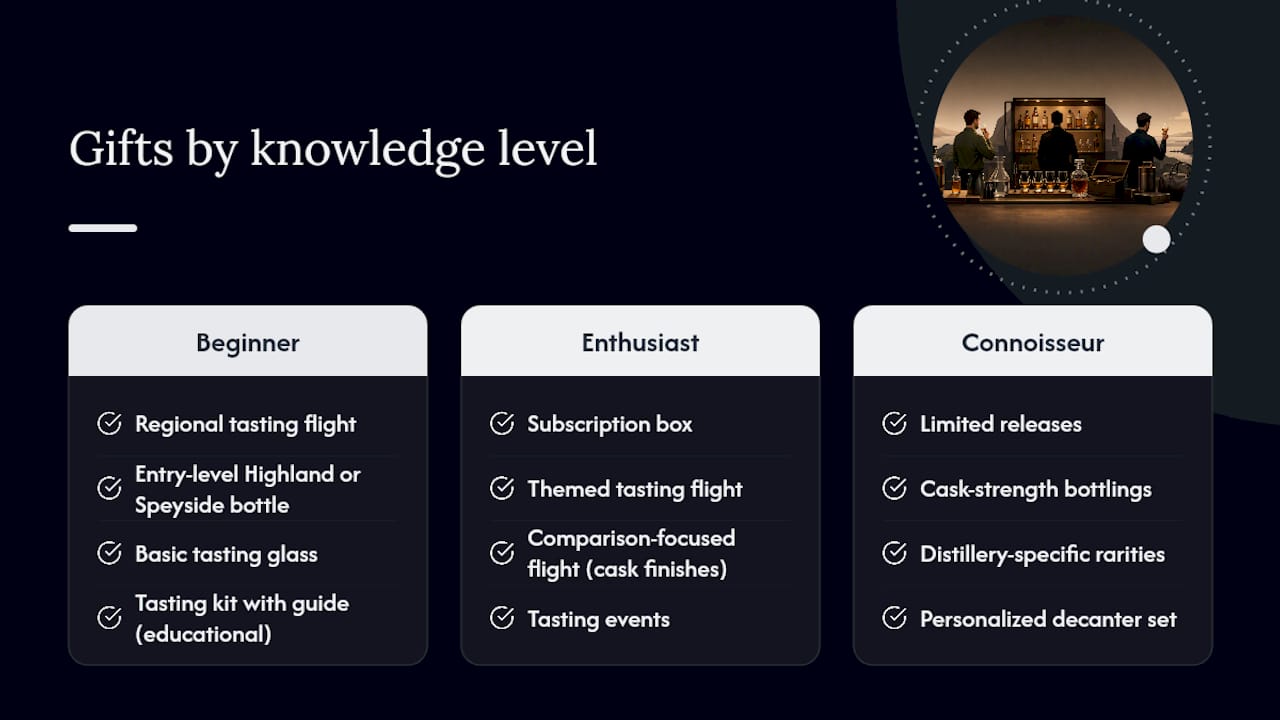
For connoisseurs, specificity matters more than variety. They likely already know their preferred region and probably own the standard expressions from it. Look for limited releases, cask-strength bottlings, or a distillery they haven’t tried yet within a region they love. Personalised decanter sets and higher-end glassware also land better here, since a collector has usually already sorted their basic gear and appreciates an upgrade rather than a starter kit. Somewhere in the middle sits the enthusiast who knows their preferences but hasn’t gone deep on rare releases. A subscription box or a themed flight built around a specific comparison (three different cask finishes, say) tends to satisfy that middle tier better than either extreme.
What most gift guides get wrong about buying for scotch drinkers
Most gift advice treats Scotch like any other bottle of alcohol: pick something in the right price range, wrap it nicely, done. That undersells how much the type of gift matters more than the price point. A $70 tasting flight for a beginner beats a $150 bottle they can’t yet contextualise, and a $40 laser-etched tumbler beats a $100 bottle for someone who already owns six.
The overrated move is defaulting to the biggest or rarest bottle you can afford. Rarity impresses collectors who already know what they’re missing from their shelf. It does nothing for someone still working out which region they like. The underrated move is pairing categories: a mid-range bottle with a matching tasting glass, or a tasting flight with a short educational book. Combinations read as considered in a way that a single impressive object often doesn’t.
If there’s one thing worth prioritising above all else, it’s matching the gift to drinking style before matching it to budget. A neat drinker, an on-the-rocks drinker and a cocktail drinker want genuinely different objects, and no amount of price justifies getting that part wrong.
— Brendan
Where to buy scotch gifts once you’ve picked a category
Once you know which category fits your recipient, the harder part is finding a retailer that actually has the specific region, age statement or presentation option you want in stock. Com curates whisky from Scotland, Japan, Australia and the USA, with rare and hard-to-find bottles alongside the more familiar names, so you’re not stuck choosing from whatever a general bottle shop happens to carry.
If you need something specific that isn’t listed, Com supports custom sourcing requests, which is useful when a recipient has a particular distillery or expression in mind. The store ships locally and internationally, so timing a delivery around a birthday or anniversary is a matter of checking lead times against your date rather than hoping for the best. For help narrowing down glassware or building a gift pack around a bottle, the whisky gift buying guide walks through pairing options in more depth. Browse the current whisky range to start matching a bottle to your recipient’s region and budget today.